Entropy: Difference between revisions
Carl McBride (talk | contribs) m (→Statistical mechanics: Added an internal link) |
m (Slight tidy.) |
||
| Line 1: | Line 1: | ||
:'' "Energy has to do with possibilities. Entropy has to do with the probabilities of those possibilities happening. It takes energy and performs a further epistemological step." '' | |||
::::: '''[[Constantino Tsallis]]''' <ref>http://www.mlahanas.de/Greeks/new/Tsallis.htm</ref> | |||
'''Entropy''' was first described by [[Rudolf Julius Emanuel Clausius]] in 1865 ( | '''Entropy''' was first described by [[Rudolf Julius Emanuel Clausius]] in 1865 <ref>[http://dx.doi.org/10.1002/andp.18652010702 R. Clausius "Ueber verschiedene für die Anwendung bequeme Formen der Hauptgleichungen der mechanischen Wärmetheorie", Annalen der Physik und Chemie '''125''' pp. 353-400 (1865)]</ref>. The [[statistical mechanics | statistical mechanical]] desciption is due to [[Ludwig Eduard Boltzmann]] (Ref. ?). | ||
==Classical thermodynamics== | ==Classical thermodynamics== | ||
In [[classical thermodynamics]] one has the | In [[classical thermodynamics]] one has the entropy, <math>S</math>, | ||
:<math>{\mathrm d} S = \frac{\delta Q_{\mathrm {reversible}}} {T} </math> | :<math>{\mathrm d} S = \frac{\delta Q_{\mathrm {reversible}}} {T} </math> | ||
where <math>Q</math> is the [[heat]] and <math>T</math> is the [[temperature]]. | where <math>Q</math> is the [[heat]] and <math>T</math> is the [[temperature]]. | ||
==Statistical mechanics== | ==Statistical mechanics== | ||
In [[statistical mechanics]] | In [[statistical mechanics]] entropy is defined by | ||
:<math>\left. S \right. = -k_B \sum_m p_m \ln p_m</math> | :<math>\left. S \right. = -k_B \sum_m p_m \ln p_m</math> | ||
| Line 35: | Line 35: | ||
==See also:== | ==See also:== | ||
*[[Entropy of a glass]] | *[[Entropy of a glass]] | ||
*[[H-theorem]] | |||
*[[Non-extensive thermodynamics]] | |||
*[[Shannon entropy]] | *[[Shannon entropy]] | ||
==References== | |||
<references/> | |||
'''Related reading''' | |||
== | |||
*[http://dx.doi.org/10.1119/1.1990592 Karl K. Darrow "The Concept of Entropy", American Journal of Physics '''12''' pp. 183-196 (1944)] | *[http://dx.doi.org/10.1119/1.1990592 Karl K. Darrow "The Concept of Entropy", American Journal of Physics '''12''' pp. 183-196 (1944)] | ||
*[http://dx.doi.org/10.1119/1.1971557 E. T. Jaynes "Gibbs vs Boltzmann Entropies", American Journal of Physics '''33''' pp. 391-398 (1965)] | *[http://dx.doi.org/10.1119/1.1971557 E. T. Jaynes "Gibbs vs Boltzmann Entropies", American Journal of Physics '''33''' pp. 391-398 (1965)] | ||
| Line 45: | Line 46: | ||
*[http://www.ucl.ac.uk/~ucesjph/reality/entropy/text.html S. F. Gull "Some Misconceptions about Entropy" in Brian Buck and Vincent A. MacAulay (Eds.) "Maximum Entropy in Action", Oxford Science Publications (1991)] | *[http://www.ucl.ac.uk/~ucesjph/reality/entropy/text.html S. F. Gull "Some Misconceptions about Entropy" in Brian Buck and Vincent A. MacAulay (Eds.) "Maximum Entropy in Action", Oxford Science Publications (1991)] | ||
*[http://dx.doi.org/10.2174/1874396X00802010007 Efstathios E. Michaelides "Entropy, Order and Disorder", The Open Thermodynamics Journal '''2''' pp. (2008)] | *[http://dx.doi.org/10.2174/1874396X00802010007 Efstathios E. Michaelides "Entropy, Order and Disorder", The Open Thermodynamics Journal '''2''' pp. (2008)] | ||
*Ya. G. Sinai, "On the Concept of Entropy of a Dynamical System," Doklady Akademii Nauk SSSR '''124''' pp. 768-771 (1959) | |||
*[http://dx.doi.org/10.1063/1.1670348 William G. Hoover "Entropy for Small Classical Crystals", Journal of Chemical Physics '''49''' pp. 1981-1982 (1968)] | |||
[[category: statistical mechanics]] | |||
[[category: Classical thermodynamics]] | |||
[[category:statistical mechanics]] | |||
[[Classical thermodynamics]] | |||
Revision as of 16:38, 11 November 2009
- "Energy has to do with possibilities. Entropy has to do with the probabilities of those possibilities happening. It takes energy and performs a further epistemological step."
Entropy was first described by Rudolf Julius Emanuel Clausius in 1865 [2]. The statistical mechanical desciption is due to Ludwig Eduard Boltzmann (Ref. ?).
Classical thermodynamics
In classical thermodynamics one has the entropy, ,

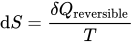
where Failed to parse (SVG (MathML can be enabled via browser plugin): Invalid response ("Math extension cannot connect to Restbase.") from server "https://wikimedia.org/api/rest_v1/":): {\displaystyle Q} is the heat and Failed to parse (SVG (MathML can be enabled via browser plugin): Invalid response ("Math extension cannot connect to Restbase.") from server "https://wikimedia.org/api/rest_v1/":): {\displaystyle T} is the temperature.
Statistical mechanics
In statistical mechanics entropy is defined by
- Failed to parse (SVG (MathML can be enabled via browser plugin): Invalid response ("Math extension cannot connect to Restbase.") from server "https://wikimedia.org/api/rest_v1/":): {\displaystyle \left. S \right. = -k_B \sum_m p_m \ln p_m}
where Failed to parse (SVG (MathML can be enabled via browser plugin): Invalid response ("Math extension cannot connect to Restbase.") from server "https://wikimedia.org/api/rest_v1/":): {\displaystyle k_B} is the Boltzmann constant, m is the index for the microstates, and is the probability that microstate m is occupied. In the microcanonical ensemble this gives:

- Failed to parse (SVG (MathML can be enabled via browser plugin): Invalid response ("Math extension cannot connect to Restbase.") from server "https://wikimedia.org/api/rest_v1/":): {\displaystyle \left.S\right. = k_B \ln \Omega}
where Failed to parse (SVG (MathML can be enabled via browser plugin): Invalid response ("Math extension cannot connect to Restbase.") from server "https://wikimedia.org/api/rest_v1/":): {\displaystyle \Omega} (sometimes written as Failed to parse (SVG (MathML can be enabled via browser plugin): Invalid response ("Math extension cannot connect to Restbase.") from server "https://wikimedia.org/api/rest_v1/":): {\displaystyle W} ) is the number of microscopic configurations that result in the observed macroscopic description of the thermodynamic system. This equation provides a link between classical thermodynamics and statistical mechanics
Arrow of time
Articles:
- T. Gold "The Arrow of Time", American Journal of Physics 30 pp. 403-410 (1962)
- Joel L. Lebowitz "Boltzmann's Entropy and Time's Arrow", Physics Today 46 pp. 32-38 (1993)
- Milan M. Ćirković "The Thermodynamical Arrow of Time: Reinterpreting the Boltzmann–Schuetz Argument", Foundations of Physics 33 pp. 467-490 (2003)
Books:
- Steven F. Savitt (Ed.) "Time's Arrows Today: Recent Physical and Philosophical Work on the Direction of Time", Cambridge University Press (1997) ISBN 0521599458
- Michael C. Mackey "Time's Arrow: The Origins of Thermodynamic Behavior" (1992) ISBN 0486432432
- Huw Price "Time's Arrow and Archimedes' Point New Directions for the Physics of Time" Oxford University Press (1997) ISBN 978-0-19-511798-1
See also:
References
Related reading
- Karl K. Darrow "The Concept of Entropy", American Journal of Physics 12 pp. 183-196 (1944)
- E. T. Jaynes "Gibbs vs Boltzmann Entropies", American Journal of Physics 33 pp. 391-398 (1965)
- Daniel F. Styer "Insight into entropy", American Journal of Physics 86 pp. 1090-1096 (2000)
- S. F. Gull "Some Misconceptions about Entropy" in Brian Buck and Vincent A. MacAulay (Eds.) "Maximum Entropy in Action", Oxford Science Publications (1991)
- Efstathios E. Michaelides "Entropy, Order and Disorder", The Open Thermodynamics Journal 2 pp. (2008)
- Ya. G. Sinai, "On the Concept of Entropy of a Dynamical System," Doklady Akademii Nauk SSSR 124 pp. 768-771 (1959)
- William G. Hoover "Entropy for Small Classical Crystals", Journal of Chemical Physics 49 pp. 1981-1982 (1968)