Hard spherocylinders

|
This article is a 'stub' page, it has no, or next to no, content. It is here at the moment to help form part of the structure of SklogWiki. If you add sufficient material to this article then please remove the {{Stub-general}} template from this page. |

The hard spherocylinder model consists on an impenetrable cylinder, capped at both ends by hemispheres whose diameters are the same as the diameter of the cylinder. The hard spherocylinder model has been studied extensively because of its propensity to form both nematic and smectic liquid crystalline phases. One of the first simulations of hard spherocylinders was in the classic work of Jacques Vieillard-Baron (Ref. 1).
Volume
The molecular volume of the spherocylinder is given by
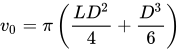
where is the length of the cylindrical part of the spherocylinder and is the diameter.


Minimum distance
The minimum distance between two spherocylinders can be calculated using an algorithm published by Vega and Lago (Ref. 1). The source code can be found here. Such an algorithm is essential in, for example, a Monte Carlo simulation, in order to check for overlaps between two sites.
Virial coefficients
- Main article: Hard spherocylinders: virial coefficients
Phase diagram
- Main aritcle: Phase diagram of the hard spherocylinder model