Joule-Thomson effect

From SklogWiki
Revision as of 12:17, 12 July 2007 by Carl McBride (talk | contribs)
Jump to navigation Jump to search

The Joule-Thomson effect is also known as the Joule-Kelvin effect.

Joule-Thomson coefficient

The Joule-Thomson coefficient is given by
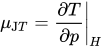
Failed to parse (SVG (MathML can be enabled via browser plugin): Invalid response ("Math extension cannot connect to Restbase.") from server "https://wikimedia.org/api/rest_v1/":): {\displaystyle \mu_{\mathrm JT} = \left. \frac{\partial T}{\partial p} \right\vert_H}

where T is the temperature, p is the pressure and H is the enthalpy.

In terms of heat capacities one has
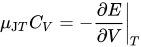
Failed to parse (SVG (MathML can be enabled via browser plugin): Invalid response ("Math extension cannot connect to Restbase.") from server "https://wikimedia.org/api/rest_v1/":): {\displaystyle \mu_{\mathrm JT} C_V = -\left. \frac{\partial E}{\partial V} \right\vert_T }

and

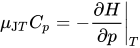
Failed to parse (SVG (MathML can be enabled via browser plugin): Invalid response ("Math extension cannot connect to Restbase.") from server "https://wikimedia.org/api/rest_v1/":): {\displaystyle \mu_{\mathrm JT} C_p = -\left. \frac{\partial H}{\partial p} \right\vert_T }


In terms of the second virial coefficient at zero pressure one has
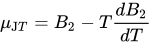
Failed to parse (SVG (MathML can be enabled via browser plugin): Invalid response ("Math extension cannot connect to Restbase.") from server "https://wikimedia.org/api/rest_v1/":): {\displaystyle \mu_{\mathrm JT} = B_2 -T \frac{dB_2}{dT}}

References

  1. Thomas R. Rybolt "A virial treatment of the Joule and Joule-Thomson coefficients", Journal of Chemical Education 58 pp. 620-624 (1981)