Joule-Thomson effect
Jump to navigation
Jump to search
The Joule-Thomson effect is also known as the Joule-Kelvin effect. This effect is present in non ideal gasses, where a change in temperature occurs upon expansion.
Joule-Thomson coefficient[edit]
The Joule-Thomson coefficient is given by
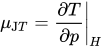
where T is the temperature, p is the pressure and H is the enthalpy.
In terms of heat capacities one has
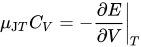
and
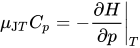
In terms of the second virial coefficient at zero pressure one has

Inversion temperature[edit]
References[edit]
- ↑ Jacques-Olivier Goussard and Bernard Roulet "Free expansion for real gases", American Journal of Physics 61 pp. 845-848 (1993)
- ↑ E. Albarran-Zavala, B. A. Espinoza-Elizarraraz, F. Angulo-Brown "Joule Inversion Temperatures for Some Simple Real Gases", The Open Thermodynamics Journal 3 pp. 17-22 (2009)
Related reading