Supercooling and nucleation

|
This article is a 'stub' page, it has no, or next to no, content. It is here at the moment to help form part of the structure of SklogWiki. If you add sufficient material to this article then please remove the {{Stub-general}} template from this page. |
Supercooling, undercooling and nucleation.
Volmer and Weber kinetic model
Volmer and Weber kinetic model [1] results in the following nucleation rate:
- Failed to parse (unknown function "\label"): {\displaystyle I^{VW} = N^{eq}(n^*) k^+(n^*) = k^+(n^*) N_A \exp \left( -\frac{W(n^*)}{k_BT} \right) \label{eq_IVW} }
Szilard nucleation model
Homogeneous nucleation temperature
The homogeneous nucleation temperature () is the temperature below which it is almost impossible to avoid spontaneous and rapid freezing.

Zeldovich factor
The Zeldovich factor [2] () modifies the Volmer and Weber expression \eqref{eq_IVW}, making it applicable to spherical clusters:

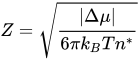
Zeldovich-Frenkel equation
Zeldovich-Frenkel master equation is given by

See also
References
- Related reading
- J. Frenkel "Statistical Theory of Condensation Phenomena", Journal of Chemical Physics 7 pp. 200-201 (1939)
- Lawrence S. Bartell and David T. Wu "Do supercooled liquids freeze by spinodal decomposition?", Journal of Chemical Physics 127 174507 (2007)
- Pieter Rein ten Wolde, Maria J. Ruiz-Montero and Daan Frenkel "Numerical calculation of the rate of crystal nucleation in a Lennard-Jones system at moderate undercooling", Journal of Chemical Physics 104 pp. 9932-9947 (1996)
- Chantal Valeriani "Numerical studies of nucleation pathways of ordered and disordered phases", PhD Thesis (2007)
- Richard C. Flagan "A thermodynamically consistent kinetic framework for binary nucleation", Journal of Chemical Physics 127 214503 (2007)
- Laura Filion, Michiel Hermes, Ran Ni and Marjolein Dijkstra "Crystal nucleation of hard spheres using molecular dynamics, umbrella sampling, and forward flux sampling: A comparison of simulation techniques", Journal of Chemical Physics 133 244115 (2010)
- Ran Ni, Simone Belli, René van Roij, and Marjolein Dijkstra "Glassy Dynamics, Spinodal Fluctuations, and the Kinetic Limit of Nucleation in Suspensions of Colloidal Hard Rods", Physical Review Letters 105 088302 (2010)
- Andrea Cavagna "Supercooled liquids for pedestrians", Physics Reports 476 pp. 51-124 (2009)
- Books
- David T. Wu "Nucleation Theory", Solid State Physics 50 pp. 37-187 (1996)
- Dimo Kashchiev "Nucleation", Butterworth-Heinemann (2000) ISBN 978-0-7506-4682-6
- Ken F. Kelton and Alan Lindsay Greer "Nucleation in Condensed Matter: Applications in Materials and Biology", Pergamon Materials Series Volume 15 (2010) ISBN 978-0-08-042147-6