Energy equation
The energy equation is given, in classical thermodynamics, by
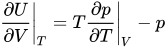
and in statistical mechanics it is obtained via the thermodynamic relation
- Failed to parse (SVG (MathML can be enabled via browser plugin): Invalid response ("Math extension cannot connect to Restbase.") from server "https://wikimedia.org/api/rest_v1/":): {\displaystyle U = \frac{\partial (A/T)}{\partial (1/T)}}
and making use of the Helmholtz energy function and the canonical partition function one arrives at
- Failed to parse (SVG (MathML can be enabled via browser plugin): Invalid response ("Math extension cannot connect to Restbase.") from server "https://wikimedia.org/api/rest_v1/":): {\displaystyle \frac{U^{\rm ex}}{N}= \frac{\rho}{2} \int_0^{\infty} \Phi(r)~{\rm g}(r)~4 \pi r^2~{\rm d}r}
where Failed to parse (SVG (MathML can be enabled via browser plugin): Invalid response ("Math extension cannot connect to Restbase.") from server "https://wikimedia.org/api/rest_v1/":): {\displaystyle \Phi(r)} is a two-body central potential, Failed to parse (SVG (MathML can be enabled via browser plugin): Invalid response ("Math extension cannot connect to Restbase.") from server "https://wikimedia.org/api/rest_v1/":): {\displaystyle U^{\rm ex}} is the excess internal energy per particle, and Failed to parse (SVG (MathML can be enabled via browser plugin): Invalid response ("Math extension cannot connect to Restbase.") from server "https://wikimedia.org/api/rest_v1/":): {\displaystyle {\rm g}(r)} is the radial distribution function.