Logarithmic oscillator thermostat
The Logarithmic oscillator [1] in one dimension is given by (Eq. 2):
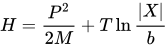
where is the position of the logarithmic oscillator, is its linear momentum, and represents its mass. is the desired temperature of the thermostat, and sets a length-scale.


As a thermostat
From the Virial theorem
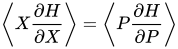
one obtains
- .

This implies that all expectation values of the trajectories correspond to the very same temperature of the thermostat, irrespective of the internal energy. In other words,

this implies that the heat capacity becomes
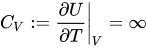
Having an infinite heat capacity is an ideal feature for a thermostat.
Practical applicability
References
- ↑ Michele Campisi, Fei Zhan, Peter Talkner, and Peter Hänggi "Logarithmic Oscillators: Ideal Hamiltonian Thermostats", Physical Review Letters 108 250601 (2012)
- ↑ Marc Meléndez Schofield "On the logarithmic oscillator as a thermostat", arXiv:1205.3478v1 (cond-mat.stat-mech) 15 May (2012)
- ↑ Marc Meléndez, Wm. G. Hoover, and Pep Español "Comment on “Logarithmic Oscillators: Ideal Hamiltonian Thermostats”", Physical Review Letters 110 028901 (2013)
- ↑ Michele Campisi, Fei Zhan, Peter Talkner, and Peter Hänggi "Campisi et al. Reply", Physical Review Letters 110 028902 (2013)
- ↑ Daniel Sponseller and Estela Blaisten-Barojas "Failure of logarithmic oscillators to serve as a thermostat for small atomic clusters", Physical Review E 89 021301(R) (2014)
- Related reading