Chemical potential: Difference between revisions
Jump to navigation
Jump to search
Carl McBride (talk | contribs) No edit summary |
Carl McBride (talk | contribs) |
||
| Line 2: | Line 2: | ||
Definition: | Definition: | ||
:<math>\mu=\left. \frac{\partial G}{\partial N}\right\vert_{T,p}</math> | :<math>\mu=\left. \frac{\partial G}{\partial N}\right\vert_{T,p} = \left. \frac{\partial A}{\partial N}\right\vert_{T,V}</math> | ||
where <math>G</math> is the [[Gibbs energy function]], leading to | where <math>G</math> is the [[Gibbs energy function]], leading to | ||
Revision as of 18:38, 4 July 2007
Classical thermodynamics
Definition:
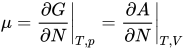
where is the Gibbs energy function, leading to

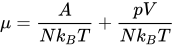
where is the Helmholtz energy function, is the Boltzmann constant, is the pressure, is the temperature and is the volume.


Statistical mechanics
The chemical potential is the derivative of the Helmholtz energy function with respect to the number of particles

where is the partition function for a fluid of identical particles


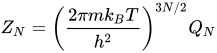
and is the configurational integral


Kirkwood charging formula
See Ref. 2
- Failed to parse (Conversion error. Server ("https://wikimedia.org/api/rest_") reported: "Cannot get mml. Server problem."): {\displaystyle \beta \mu _{\rm {ex}}=\rho \int _{0}^{1}d\lambda \int {\frac {\partial \beta \Phi _{12}(r,\lambda )}{\partial \lambda }}{\rm {g}}(r,\lambda )dr}
where is the intermolecular pair potential and Failed to parse (SVG (MathML can be enabled via browser plugin): Invalid response ("Math extension cannot connect to Restbase.") from server "https://wikimedia.org/api/rest_v1/":): {\displaystyle {\rm g}(r)} is the pair correlation function.
