Pressure: Difference between revisions
Carl McBride (talk | contribs) m (→References: Added a recent publication) |
Carl McBride (talk | contribs) (Subsumed Virial pressure into the pressure page) |
||
| Line 28: | Line 28: | ||
where where <math>\ \sigma_{x}</math>, <math>\ \sigma_{y}</math>, and <math>\ \sigma_{z}</math> are normal stresses, and <math>\ \tau_{xy}</math>, <math>\ \tau_{xz}</math>, <math>\ \tau_{yx}</math>, <math>\ \tau_{yz}</math>, <math>\ \tau_{zx}</math>, and <math>\ \tau_{zy}</math> are shear stresess. | where where <math>\ \sigma_{x}</math>, <math>\ \sigma_{y}</math>, and <math>\ \sigma_{z}</math> are normal stresses, and <math>\ \tau_{xy}</math>, <math>\ \tau_{xz}</math>, <math>\ \tau_{yx}</math>, <math>\ \tau_{yz}</math>, <math>\ \tau_{zx}</math>, and <math>\ \tau_{zy}</math> are shear stresess. | ||
==Virial pressure== | |||
The '''virial pressure''' is commonly used to obtain the [[pressure]] from a general simulation. It is particularly well suited to [[molecular dynamics]], since [[Newtons laws#Newton's second law of motion |forces]] are evaluated and readily available. For pair interactions, one has: | |||
:<math> p = \frac{ k_B T N}{V} - \frac{ 1 }{ d V } \overline{ \sum_{i<j} {\mathbf f}_{ij} {\mathbf r}_{ij} }, </math> | |||
where <math>p</math> is the pressure, <math>T</math> is the [[temperature]], <math>V</math> is the volume and <math>k_B</math> is the [[Boltzmann constant]]. | |||
In this equation one can recognize an [[Equation of State: Ideal Gas |ideal gas]] contribution, and a second term due to the [[Virial theorem |virial]]. The overline is an average, which would be a time average in molecular dynamics, or an ensemble average in [[Monte Carlo]]; <math>d</math> is the dimension of the system (3 in the "real" world). <math> {\mathbf f}_{ij} </math> is the force '''on''' particle <math>i</math> exerted '''by''' particle <math>j</math>, and <math>{\mathbf r}_{ij}</math> is the vector going '''from''' <math>i</math> '''to''' <math>j</math>: <math>{\mathbf r}_{ij} = {\mathbf r}_j - {\mathbf r}_i</math>. | |||
This relationship is readily obtained by writing the [[partition function]] in "reduced coordinates", i.e. <math>x^*=x/L</math>, etc, then considering a "blow-up" of the system by changing the value of <math>L</math>. This would apply to a simple cubic system, but the same ideas can also be applied to obtain expressions for the [[stress | stress tensor]] and the [[surface tension]], and are also used in [[constant-pressure Monte Carlo]]. | |||
If the interaction is central, the force is given by | |||
:<math> {\mathbf f}_{ij} = - \frac{{\mathbf r}_{ij}}{ r_{ij}} f(r_{ij}) , </math> | |||
where <math>f(r)</math> the force corresponding to the [[Intermolecular pair potential |intermolecular potential]] <math>\Phi(r)</math>: | |||
:<math>-\partial \Phi(r)/\partial r.</math> | |||
For example, for the [[Lennard-Jones model | Lennard-Jones potential]], <math>f(r)=24\epsilon(2(\sigma/r)^{12}- (\sigma/r)^6 )/r</math>. Hence, the expression reduces to | |||
:<math> p = \frac{ k_B T N}{V} + \frac{ 1 }{ d V } \overline{ \sum_{i<j} f(r_{ij}) r_{ij} }. </math> | |||
Notice that most [[Realistic models |realistic potentials]] are attractive at long ranges; hence the first correction to the ideal pressure will be a negative contribution: the [[second virial coefficient]]. On the other hand, contributions from purely repulsive potentials, such as [[hard sphere model | hard spheres]], are always positive. | |||
==See also== | ==See also== | ||
*[[Pressure equation]] | *[[Pressure equation]] | ||
Revision as of 16:08, 14 March 2012
Pressure (Failed to parse (SVG (MathML can be enabled via browser plugin): Invalid response ("Math extension cannot connect to Restbase.") from server "https://wikimedia.org/api/rest_v1/":): {\displaystyle p} ) is the force per unit area applied on a surface, in a direction perpendicular to that surface, i.e. the scalar part of the stress tensor under equilibrium/hydrosatic conditions.
Thermodynamics
In thermodynamics the pressure is given by
- Failed to parse (SVG (MathML can be enabled via browser plugin): Invalid response ("Math extension cannot connect to Restbase.") from server "https://wikimedia.org/api/rest_v1/":): {\displaystyle p = - \left.\frac{\partial A}{\partial V} \right\vert_{T,N} = k_BT \left.\frac{\partial \ln Q}{\partial V} \right\vert_{T,N}}
where Failed to parse (SVG (MathML can be enabled via browser plugin): Invalid response ("Math extension cannot connect to Restbase.") from server "https://wikimedia.org/api/rest_v1/":): {\displaystyle A} is the Helmholtz energy function, Failed to parse (SVG (MathML can be enabled via browser plugin): Invalid response ("Math extension cannot connect to Restbase.") from server "https://wikimedia.org/api/rest_v1/":): {\displaystyle V} is the volume, Failed to parse (SVG (MathML can be enabled via browser plugin): Invalid response ("Math extension cannot connect to Restbase.") from server "https://wikimedia.org/api/rest_v1/":): {\displaystyle k_B} is the Boltzmann constant, Failed to parse (SVG (MathML can be enabled via browser plugin): Invalid response ("Math extension cannot connect to Restbase.") from server "https://wikimedia.org/api/rest_v1/":): {\displaystyle T} is the temperature and Failed to parse (SVG (MathML can be enabled via browser plugin): Invalid response ("Math extension cannot connect to Restbase.") from server "https://wikimedia.org/api/rest_v1/":): {\displaystyle Q (N,V,T)} is the canonical ensemble partition function.
Units
The SI units for pressure are Pascals (Pa), 1 Pa being 1 N/m2, or 1 J/m3. Other frequently encountered units are bars and millibars (mbar); 1 mbar = 100 Pa = 1 hPa, 1 hectopascal. 1 bar is 105 Pa by definition. This is very close to the standard atmosphere (atm), approximately equal to typical air pressure at earth mean sea level: atm, standard atmosphere = 101325 Pa = 101.325 kPa = 1013.25 hPa = 1.01325 bar
Stress
The stress is given by

where Failed to parse (SVG (MathML can be enabled via browser plugin): Invalid response ("Math extension cannot connect to Restbase.") from server "https://wikimedia.org/api/rest_v1/":): {\displaystyle {\mathbf F}} is the force, Failed to parse (SVG (MathML can be enabled via browser plugin): Invalid response ("Math extension cannot connect to Restbase.") from server "https://wikimedia.org/api/rest_v1/":): {\displaystyle {\mathbf A}} is the area, and Failed to parse (SVG (MathML can be enabled via browser plugin): Invalid response ("Math extension cannot connect to Restbase.") from server "https://wikimedia.org/api/rest_v1/":): {\displaystyle \sigma_{ij}} is the stress tensor, given by
- Failed to parse (SVG (MathML can be enabled via browser plugin): Invalid response ("Math extension cannot connect to Restbase.") from server "https://wikimedia.org/api/rest_v1/":): {\displaystyle \sigma_{ij} \equiv \left[{\begin{matrix} \sigma _x & \tau _{xy} & \tau _{xz} \\ \tau _{yx} & \sigma _y & \tau _{yz} \\ \tau _{zx} & \tau _{zy} & \sigma _z \\ \end{matrix}}\right]}
where where Failed to parse (SVG (MathML can be enabled via browser plugin): Invalid response ("Math extension cannot connect to Restbase.") from server "https://wikimedia.org/api/rest_v1/":): {\displaystyle \ \sigma_{x}} , Failed to parse (SVG (MathML can be enabled via browser plugin): Invalid response ("Math extension cannot connect to Restbase.") from server "https://wikimedia.org/api/rest_v1/":): {\displaystyle \ \sigma_{y}} , and Failed to parse (SVG (MathML can be enabled via browser plugin): Invalid response ("Math extension cannot connect to Restbase.") from server "https://wikimedia.org/api/rest_v1/":): {\displaystyle \ \sigma_{z}} are normal stresses, and Failed to parse (SVG (MathML can be enabled via browser plugin): Invalid response ("Math extension cannot connect to Restbase.") from server "https://wikimedia.org/api/rest_v1/":): {\displaystyle \ \tau_{xy}} , Failed to parse (SVG (MathML can be enabled via browser plugin): Invalid response ("Math extension cannot connect to Restbase.") from server "https://wikimedia.org/api/rest_v1/":): {\displaystyle \ \tau_{xz}} , Failed to parse (SVG (MathML can be enabled via browser plugin): Invalid response ("Math extension cannot connect to Restbase.") from server "https://wikimedia.org/api/rest_v1/":): {\displaystyle \ \tau_{yx}} , Failed to parse (SVG (MathML can be enabled via browser plugin): Invalid response ("Math extension cannot connect to Restbase.") from server "https://wikimedia.org/api/rest_v1/":): {\displaystyle \ \tau_{yz}} , Failed to parse (SVG (MathML can be enabled via browser plugin): Invalid response ("Math extension cannot connect to Restbase.") from server "https://wikimedia.org/api/rest_v1/":): {\displaystyle \ \tau_{zx}} , and Failed to parse (SVG (MathML can be enabled via browser plugin): Invalid response ("Math extension cannot connect to Restbase.") from server "https://wikimedia.org/api/rest_v1/":): {\displaystyle \ \tau_{zy}} are shear stresess.
Virial pressure
The virial pressure is commonly used to obtain the pressure from a general simulation. It is particularly well suited to molecular dynamics, since forces are evaluated and readily available. For pair interactions, one has:
- Failed to parse (SVG (MathML can be enabled via browser plugin): Invalid response ("Math extension cannot connect to Restbase.") from server "https://wikimedia.org/api/rest_v1/":): {\displaystyle p = \frac{ k_B T N}{V} - \frac{ 1 }{ d V } \overline{ \sum_{i<j} {\mathbf f}_{ij} {\mathbf r}_{ij} }, }
where Failed to parse (SVG (MathML can be enabled via browser plugin): Invalid response ("Math extension cannot connect to Restbase.") from server "https://wikimedia.org/api/rest_v1/":): {\displaystyle p} is the pressure, Failed to parse (SVG (MathML can be enabled via browser plugin): Invalid response ("Math extension cannot connect to Restbase.") from server "https://wikimedia.org/api/rest_v1/":): {\displaystyle T} is the temperature, Failed to parse (SVG (MathML can be enabled via browser plugin): Invalid response ("Math extension cannot connect to Restbase.") from server "https://wikimedia.org/api/rest_v1/":): {\displaystyle V} is the volume and Failed to parse (SVG (MathML can be enabled via browser plugin): Invalid response ("Math extension cannot connect to Restbase.") from server "https://wikimedia.org/api/rest_v1/":): {\displaystyle k_B} is the Boltzmann constant. In this equation one can recognize an ideal gas contribution, and a second term due to the virial. The overline is an average, which would be a time average in molecular dynamics, or an ensemble average in Monte Carlo; Failed to parse (SVG (MathML can be enabled via browser plugin): Invalid response ("Math extension cannot connect to Restbase.") from server "https://wikimedia.org/api/rest_v1/":): {\displaystyle d} is the dimension of the system (3 in the "real" world). Failed to parse (SVG (MathML can be enabled via browser plugin): Invalid response ("Math extension cannot connect to Restbase.") from server "https://wikimedia.org/api/rest_v1/":): {\displaystyle {\mathbf f}_{ij} } is the force on particle Failed to parse (SVG (MathML can be enabled via browser plugin): Invalid response ("Math extension cannot connect to Restbase.") from server "https://wikimedia.org/api/rest_v1/":): {\displaystyle i} exerted by particle Failed to parse (SVG (MathML can be enabled via browser plugin): Invalid response ("Math extension cannot connect to Restbase.") from server "https://wikimedia.org/api/rest_v1/":): {\displaystyle j} , and is the vector going from Failed to parse (SVG (MathML can be enabled via browser plugin): Invalid response ("Math extension cannot connect to Restbase.") from server "https://wikimedia.org/api/rest_v1/":): {\displaystyle i} to Failed to parse (SVG (MathML can be enabled via browser plugin): Invalid response ("Math extension cannot connect to Restbase.") from server "https://wikimedia.org/api/rest_v1/":): {\displaystyle j} : Failed to parse (SVG (MathML can be enabled via browser plugin): Invalid response ("Math extension cannot connect to Restbase.") from server "https://wikimedia.org/api/rest_v1/":): {\displaystyle {\mathbf r}_{ij} = {\mathbf r}_j - {\mathbf r}_i} .

This relationship is readily obtained by writing the partition function in "reduced coordinates", i.e. Failed to parse (SVG (MathML can be enabled via browser plugin): Invalid response ("Math extension cannot connect to Restbase.") from server "https://wikimedia.org/api/rest_v1/":): {\displaystyle x^*=x/L} , etc, then considering a "blow-up" of the system by changing the value of Failed to parse (SVG (MathML can be enabled via browser plugin): Invalid response ("Math extension cannot connect to Restbase.") from server "https://wikimedia.org/api/rest_v1/":): {\displaystyle L} . This would apply to a simple cubic system, but the same ideas can also be applied to obtain expressions for the stress tensor and the surface tension, and are also used in constant-pressure Monte Carlo.
If the interaction is central, the force is given by
- Failed to parse (SVG (MathML can be enabled via browser plugin): Invalid response ("Math extension cannot connect to Restbase.") from server "https://wikimedia.org/api/rest_v1/":): {\displaystyle {\mathbf f}_{ij} = - \frac{{\mathbf r}_{ij}}{ r_{ij}} f(r_{ij}) , }
where Failed to parse (SVG (MathML can be enabled via browser plugin): Invalid response ("Math extension cannot connect to Restbase.") from server "https://wikimedia.org/api/rest_v1/":): {\displaystyle f(r)} the force corresponding to the intermolecular potential Failed to parse (SVG (MathML can be enabled via browser plugin): Invalid response ("Math extension cannot connect to Restbase.") from server "https://wikimedia.org/api/rest_v1/":): {\displaystyle \Phi(r)} :
- Failed to parse (SVG (MathML can be enabled via browser plugin): Invalid response ("Math extension cannot connect to Restbase.") from server "https://wikimedia.org/api/rest_v1/":): {\displaystyle -\partial \Phi(r)/\partial r.}
For example, for the Lennard-Jones potential, Failed to parse (SVG (MathML can be enabled via browser plugin): Invalid response ("Math extension cannot connect to Restbase.") from server "https://wikimedia.org/api/rest_v1/":): {\displaystyle f(r)=24\epsilon(2(\sigma/r)^{12}- (\sigma/r)^6 )/r} . Hence, the expression reduces to
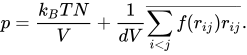
Notice that most realistic potentials are attractive at long ranges; hence the first correction to the ideal pressure will be a negative contribution: the second virial coefficient. On the other hand, contributions from purely repulsive potentials, such as hard spheres, are always positive.
See also
References
Related reading
- Aidan P. Thompson, Steven J. Plimpton, and William Mattson "General formulation of pressure and stress tensor for arbitrary many-body interaction potentials under periodic boundary conditions", Journal of Chemical Physics 131 154107 (2009)
- G. C. Rossi and M. Testa "The stress tensor in thermodynamics and statistical mechanics", Journal of Chemical Physics 132 074902 (2010)
- Nikhil Chandra Admal and E. B. Tadmor "Stress and heat flux for arbitrary multibody potentials: A unified framework", Journal of Chemical Physics 134 184106 (2011)
- Takenobu Nakamura, Wataru Shinoda, and Tamio Ikeshoji "Novel numerical method for calculating the pressure tensor in spherical coordinates for molecular systems", Journal of Chemical Physics 135 094106 (2011)
- Péter T. Kiss and András Baranyai "On the pressure calculation for polarizable models in computer simulation", Journal of Chemical Physics 136 104109 (2012)