Boynton and Bramley equation of state: Difference between revisions
Jump to navigation
Jump to search
Carl McBride (talk | contribs) (New page: {{stub-general}} The '''Boynton and Bramley equation of state''' is given by <ref>[http://dx.doi.org/10.1103/PhysRev.20.46 W. P. Boynton and Arthur Bramley "A Modification of Van Der Waals...) |
Carl McBride (talk | contribs) No edit summary |
||
| Line 1: | Line 1: | ||
The '''Boynton and Bramley equation of state''' is given by <ref>[http://dx.doi.org/10.1103/PhysRev.20.46 W. P. Boynton and Arthur Bramley "A Modification of Van Der Waals' Equation", Physical Review '''20''' pp. 46-50 (1922)]</ref> | The '''Boynton and Bramley equation of state''' is given by <ref>[http://dx.doi.org/10.1103/PhysRev.20.46 W. P. Boynton and Arthur Bramley "A Modification of Van Der Waals' Equation", Physical Review '''20''' pp. 46-50 (1922)]</ref> | ||
:<math>\left( p + \frac{a}{v^2}\right) (v-b) = \frac{RT}{\left(1+ \frac{\psi^2}{T^2}\right)}</math> | :<math>\left( p + \frac{a}{v^2}\right) (v-b) = \frac{RT}{\left(1+ \frac{\psi^2}{T^2}\right)}</math> | ||
where <math>\psi</math> is a characteristic [[temperature]]. | where <math>\psi</math> is a characteristic [[temperature]]. and | ||
where: | |||
* <math> p </math> is the [[pressure]], | |||
* <math> v </math> is the volume, | |||
* <math> T </math> is the absolute [[temperature]], | |||
* <math> R </math> is the [[molar gas constant]]; <math> R = N_A k_B </math>, with <math> N_A </math> being the [[Avogadro constant]] and <math>k_B</math> being the [[Boltzmann constant]]. | |||
*<math>a</math> and <math>b</math> are constants that introduce the effects of attraction and volume respectively and depend on the substance in question. | |||
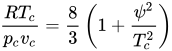
For this equation at the [[critical points | critical point]] one has | |||
:<math>\frac{RT_c}{p_cv_c} = \frac{8}{3}\left( 1 + \frac{\psi^2}{T_c^2}\right)</math> | |||
==References== | ==References== | ||
<references/> | <references/> | ||
[[category: Equations of state]] | [[category: Equations of state]] | ||
Revision as of 17:00, 2 December 2009
The Boynton and Bramley equation of state is given by [1]
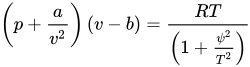
where is a characteristic temperature. and where:

- is the pressure,
- is the volume,
- is the absolute temperature,
- is the molar gas constant; , with being the Avogadro constant and being the Boltzmann constant.
- and are constants that introduce the effects of attraction and volume respectively and depend on the substance in question.


For this equation at the critical point one has