Clausius equation of state: Difference between revisions
Carl McBride (talk | contribs) m (Added comment on derivation of a, b, and c) |
Carl McBride (talk | contribs) m (Rewording + internal link) |
||
| Line 3: | Line 3: | ||
:<math>\left[ p + \frac{a}{T(v+c)^2}\right] (v-b) =RT.</math> | :<math>\left[ p + \frac{a}{T(v+c)^2}\right] (v-b) =RT.</math> | ||
At the [[critical points | critical point]] one has <math>\left.\frac{\partial p}{\partial v}\right|_{T=T_c}=0 </math>, and <math>\left.\frac{\partial^2 p}{\partial v^2}\right|_{T=T_c}=0 </math>, which leads to | |||
:<math>a = v_c - \frac{RT_c}{4P_c}</math> | :<math>a = v_c - \frac{RT_c}{4P_c}</math> | ||
Revision as of 14:23, 20 October 2009
The Clausius equation of state, proposed in 1880 by Rudolf Julius Emanuel Clausius [1] is given by (Equations 3 and 4 in [2])
- Failed to parse (SVG (MathML can be enabled via browser plugin): Invalid response ("Math extension cannot connect to Restbase.") from server "https://wikimedia.org/api/rest_v1/":): {\displaystyle \left[ p + \frac{a}{T(v+c)^2}\right] (v-b) =RT.}
At the critical point one has Failed to parse (SVG (MathML can be enabled via browser plugin): Invalid response ("Math extension cannot connect to Restbase.") from server "https://wikimedia.org/api/rest_v1/":): {\displaystyle \left.\frac{\partial p}{\partial v}\right|_{T=T_c}=0 } , and Failed to parse (SVG (MathML can be enabled via browser plugin): Invalid response ("Math extension cannot connect to Restbase.") from server "https://wikimedia.org/api/rest_v1/":): {\displaystyle \left.\frac{\partial^2 p}{\partial v^2}\right|_{T=T_c}=0 } , which leads to
- Failed to parse (SVG (MathML can be enabled via browser plugin): Invalid response ("Math extension cannot connect to Restbase.") from server "https://wikimedia.org/api/rest_v1/":): {\displaystyle a = v_c - \frac{RT_c}{4P_c}}
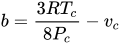
and
- Failed to parse (SVG (MathML can be enabled via browser plugin): Invalid response ("Math extension cannot connect to Restbase.") from server "https://wikimedia.org/api/rest_v1/":): {\displaystyle c= \frac{27R^2T_c^2}{64P_c}}
where Failed to parse (SVG (MathML can be enabled via browser plugin): Invalid response ("Math extension cannot connect to Restbase.") from server "https://wikimedia.org/api/rest_v1/":): {\displaystyle p} is the pressure, Failed to parse (SVG (MathML can be enabled via browser plugin): Invalid response ("Math extension cannot connect to Restbase.") from server "https://wikimedia.org/api/rest_v1/":): {\displaystyle T} is the temperature, Failed to parse (SVG (MathML can be enabled via browser plugin): Invalid response ("Math extension cannot connect to Restbase.") from server "https://wikimedia.org/api/rest_v1/":): {\displaystyle v } is the volume per mol, and Failed to parse (SVG (MathML can be enabled via browser plugin): Invalid response ("Math extension cannot connect to Restbase.") from server "https://wikimedia.org/api/rest_v1/":): {\displaystyle R} is the molar gas constant. Failed to parse (SVG (MathML can be enabled via browser plugin): Invalid response ("Math extension cannot connect to Restbase.") from server "https://wikimedia.org/api/rest_v1/":): {\displaystyle T_c} is the critical temperature and Failed to parse (SVG (MathML can be enabled via browser plugin): Invalid response ("Math extension cannot connect to Restbase.") from server "https://wikimedia.org/api/rest_v1/":): {\displaystyle P_c} is the pressure at the critical point, and Failed to parse (SVG (MathML can be enabled via browser plugin): Invalid response ("Math extension cannot connect to Restbase.") from server "https://wikimedia.org/api/rest_v1/":): {\displaystyle v_c } is the critical volume per mol.