Hard ellipsoid model: Difference between revisions
Carl McBride (talk | contribs) m (Added a photo of an oblate ellipsoid.) |
Carl McBride (talk | contribs) m (→Geometric properties: Updated an external link.) |
||
| Line 46: | Line 46: | ||
[[Mathematica]] notebook file for | [[Mathematica]] notebook file for | ||
[http:// | [http://ender.quim.ucm.es/SR_B2_B3_ellipsoids.nb calculating the surface area and mean radius of curvature of an ellipsoid] | ||
==Maximum packing fraction== | ==Maximum packing fraction== | ||
Using [[event-driven molecular dynamics]], it has been found that the maximally random jammed (MRJ) [[packing fraction]] for hard ellipsoids is <math>\phi=0.7707</math> for | Using [[event-driven molecular dynamics]], it has been found that the maximally random jammed (MRJ) [[packing fraction]] for hard ellipsoids is <math>\phi=0.7707</math> for | ||
Revision as of 13:23, 28 November 2008


Hard ellipsoids represent a natural choice for an anisotropic model. Ellipsoids can be produced from an affine transformation of the hard sphere model. However, in difference to the hard sphere model, which has fluid and solid phases, the hard ellipsoid model is also able to produce a nematic phase.
Interaction Potential
The general ellipsoid, also called a triaxial ellipsoid, is a quadratic surface which is given in Cartesian coordinates by
- Failed to parse (SVG (MathML can be enabled via browser plugin): Invalid response ("Math extension cannot connect to Restbase.") from server "https://wikimedia.org/api/rest_v1/":): {\displaystyle \frac{x^2}{a^2} + \frac{y^2}{b^2} + \frac{z^2}{c^2} = 1}
where Failed to parse (SVG (MathML can be enabled via browser plugin): Invalid response ("Math extension cannot connect to Restbase.") from server "https://wikimedia.org/api/rest_v1/":): {\displaystyle a} , Failed to parse (SVG (MathML can be enabled via browser plugin): Invalid response ("Math extension cannot connect to Restbase.") from server "https://wikimedia.org/api/rest_v1/":): {\displaystyle b } and Failed to parse (SVG (MathML can be enabled via browser plugin): Invalid response ("Math extension cannot connect to Restbase.") from server "https://wikimedia.org/api/rest_v1/":): {\displaystyle c} define the lengths of the axis.
Overlap algorithm
The most widely used overlap algorithm is that of Perram and Wertheim:
Geometric properties
The mean radius of curvature is given by (Refs. 5 and 6)
- Failed to parse (SVG (MathML can be enabled via browser plugin): Invalid response ("Math extension cannot connect to Restbase.") from server "https://wikimedia.org/api/rest_v1/":): {\displaystyle R= \frac{a}{2} \left[ \sqrt{\frac{1+\epsilon_b}{1+\epsilon_c}} + \sqrt \epsilon_c \left\{ \frac{1}{\epsilon_c} F(\varphi , k_1) + E(\varphi,k_1) \right\}\right], }
and the surface area is given by
- Failed to parse (SVG (MathML can be enabled via browser plugin): Invalid response ("Math extension cannot connect to Restbase.") from server "https://wikimedia.org/api/rest_v1/":): {\displaystyle S= 2 \pi a^2 \left[ 1+ \sqrt {\epsilon_c(1+\epsilon_b)} \left\{ \frac{1}{\epsilon_c} F(\varphi , k_2) + E(\varphi,k_2)\right\} \right], }
where Failed to parse (SVG (MathML can be enabled via browser plugin): Invalid response ("Math extension cannot connect to Restbase.") from server "https://wikimedia.org/api/rest_v1/":): {\displaystyle F(\varphi,k)} is an elliptic integral of the first kind and Failed to parse (SVG (MathML can be enabled via browser plugin): Invalid response ("Math extension cannot connect to Restbase.") from server "https://wikimedia.org/api/rest_v1/":): {\displaystyle E(\varphi,k)} is an elliptic integral of the second kind, with the amplitude being
- Failed to parse (SVG (MathML can be enabled via browser plugin): Invalid response ("Math extension cannot connect to Restbase.") from server "https://wikimedia.org/api/rest_v1/":): {\displaystyle \varphi = \tan^{-1} (\sqrt \epsilon_c),}
and the moduli
- Failed to parse (SVG (MathML can be enabled via browser plugin): Invalid response ("Math extension cannot connect to Restbase.") from server "https://wikimedia.org/api/rest_v1/":): {\displaystyle k_1= \sqrt{\frac{\epsilon_c-\epsilon_b}{\epsilon_c}},}
and
- Failed to parse (SVG (MathML can be enabled via browser plugin): Invalid response ("Math extension cannot connect to Restbase.") from server "https://wikimedia.org/api/rest_v1/":): {\displaystyle k_2= \sqrt{\frac{\epsilon_b (1+\epsilon_c)}{\epsilon_c(1+\epsilon_b)}},}
where the anisotropy parameters, Failed to parse (SVG (MathML can be enabled via browser plugin): Invalid response ("Math extension cannot connect to Restbase.") from server "https://wikimedia.org/api/rest_v1/":): {\displaystyle \epsilon_b} and Failed to parse (SVG (MathML can be enabled via browser plugin): Invalid response ("Math extension cannot connect to Restbase.") from server "https://wikimedia.org/api/rest_v1/":): {\displaystyle \epsilon_c} , are
- Failed to parse (SVG (MathML can be enabled via browser plugin): Invalid response ("Math extension cannot connect to Restbase.") from server "https://wikimedia.org/api/rest_v1/":): {\displaystyle \epsilon_b = \left( \frac{b}{a} \right)^2 -1,}
and
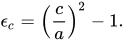
The volume of the ellipsoid is given by the well known
- Failed to parse (SVG (MathML can be enabled via browser plugin): Invalid response ("Math extension cannot connect to Restbase.") from server "https://wikimedia.org/api/rest_v1/":): {\displaystyle V = \frac{4 \pi}{3}abc.}
Mathematica notebook file for calculating the surface area and mean radius of curvature of an ellipsoid
Maximum packing fraction
Using event-driven molecular dynamics, it has been found that the maximally random jammed (MRJ) packing fraction for hard ellipsoids is Failed to parse (SVG (MathML can be enabled via browser plugin): Invalid response ("Math extension cannot connect to Restbase.") from server "https://wikimedia.org/api/rest_v1/":): {\displaystyle \phi=0.7707} for models whose maximal aspect ratio is greater than Failed to parse (SVG (MathML can be enabled via browser plugin): Invalid response ("Math extension cannot connect to Restbase.") from server "https://wikimedia.org/api/rest_v1/":): {\displaystyle \sqrt{3}} .
- Aleksandar Donev, Ibrahim Cisse, David Sachs, Evan A. Variano, Frank H. Stillinger, Robert Connelly, Salvatore Torquato, and P. M. Chaikin "Improving the Density of Jammed Disordered Packings Using Ellipsoids", Science 303 pp. 990-993 (2004)
- Aleksandar Donev, Frank H. Stillinger, P. M. Chaikin and Salvatore Torquato "Unusually Dense Crystal Packings of Ellipsoids", Physical Review Letters 92 255506 (2004)
Equation of state
- Main article: Hard ellipsoid equation of state
Virial coefficients
- Main article: Hard ellipsoids: virial coefficients
Related models
- Hard ellipse model (2-dimensional ellipsoids)
References
- D. Frenkel and B. M. Mulder "The hard ellipsoid-of-revolution fluid I. Monte Carlo simulations", Molecular Physics 55 pp. 1171-1192 (1985)
- Michael P. Allen "Computer simulation of a biaxial liquid crystal", Liquid Crystals 8 pp. 499-511 (1990)
- Philip J. Camp and Michael P. Allen "Phase diagram of the hard biaxial ellipsoid fluid", Journal of Chemical Physics 106 pp. 6681- (1997)
- Carl McBride and Enrique Lomba "Hard biaxial ellipsoids revisited: Numerical results", Fluid Phase Equilibria 255 pp. 37-45 (2007)
- G. S. Singh and B. Kumar "Geometry of hard ellipsoidal fluids and their virial coefficients", Journal of Chemical Physics 105 pp. 2429-2435 (1996)
- G. S. Singh and B. Kumar "Molecular Fluids and Liquid Crystals in Convex-Body Coordinate Systems", Annals of Physics 294 pp. 24-47 (2001)