Potts model: Difference between revisions
Jump to navigation
Jump to search
m (stubb removed) |
Carl McBride (talk | contribs) m (Trivial tidy up.) |
||
| Line 1: | Line 1: | ||
The '''Potts model''' was proposed by Renfrey B. Potts in 1952 (Ref. 1). The Potts model is a generalisation of the [[Ising Models | Ising model]] to more than two components. For a general discussion on Potts models see Refs. 2 and 3. | |||
The '''Potts model''' was proposed by Renfrey B. Potts in 1952 (Ref. 1). The Potts model is a generalisation of the [[Ising Models | Ising model]] to more than two components. | |||
For a general discussion on Potts models see | |||
In practice one has a lattice system. The sites of the lattice can be occupied by | In practice one has a lattice system. The sites of the lattice can be occupied by | ||
particles of different | particles of different ''species'', <math> S=1,2, \cdots, q </math>. | ||
The energy of the system, <math> E </math>, is defined as: | The energy of the system, <math> E </math>, is defined as: | ||
:<math> E = - K \sum_{ | :<math> E = - K \sum_{ \langle ij \rangle } \delta (S_i,S_j) </math> | ||
where <math> K </math> is the coupling constant, <math> | where <math> K </math> is the coupling constant, <math> \langle ij \rangle </math> indicates | ||
that the sum is | that the sum is performed exclusively over pairs of nearest neighbour sites, and <math> \delta(S_i,S_j) </math> is the [[Kronecker delta|Kronecker delta]]. | ||
Note that the particular case <math> q=2 </math> is equivalent to the [[Ising Models | Ising model]] | |||
==See also== | ==See also== | ||
*[[Ashkin-Teller model]] | *[[Ashkin-Teller model]] | ||
Revision as of 17:38, 4 July 2008
The Potts model was proposed by Renfrey B. Potts in 1952 (Ref. 1). The Potts model is a generalisation of the Ising model to more than two components. For a general discussion on Potts models see Refs. 2 and 3. In practice one has a lattice system. The sites of the lattice can be occupied by particles of different species, .

The energy of the system, , is defined as:

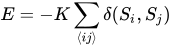
where is the coupling constant, indicates that the sum is performed exclusively over pairs of nearest neighbour sites, and is the Kronecker delta. Note that the particular case is equivalent to the Ising model


See also
References
- Renfrey B. Potts "Some generalized order-disorder transformations", Proceedings of the Cambridge Philosophical Society 48 pp. 106−109 (1952)
- F. Y. Wu "The Potts model", Reviews of Modern Physics 54 pp. 235-268 (1982)
- F. Y. Wu "Erratum: The Potts model", Reviews of Modern Physics 55 p. 315 (1983)