Ising model
The Ising model [1] (also known as the Lenz-Ising model) is commonly defined over an ordered lattice. Each site of the lattice can adopt two states, Failed to parse (SVG (MathML can be enabled via browser plugin): Invalid response ("Math extension cannot connect to Restbase.") from server "https://wikimedia.org/api/rest_v1/":): {\displaystyle S \in \{-1, +1 \}} . Note that sometimes these states are referred to as spins and the values are referred to as down and up respectively. The energy of the system is the sum of pair interactions between nearest neighbors.
- Failed to parse (SVG (MathML can be enabled via browser plugin): Invalid response ("Math extension cannot connect to Restbase.") from server "https://wikimedia.org/api/rest_v1/":): {\displaystyle \frac{U}{k_B T} = - K \sum_{\langle ij \rangle} S_i S_j }
where Failed to parse (SVG (MathML can be enabled via browser plugin): Invalid response ("Math extension cannot connect to Restbase.") from server "https://wikimedia.org/api/rest_v1/":): {\displaystyle k_B} is the Boltzmann constant, Failed to parse (SVG (MathML can be enabled via browser plugin): Invalid response ("Math extension cannot connect to Restbase.") from server "https://wikimedia.org/api/rest_v1/":): {\displaystyle T} is the temperature, Failed to parse (SVG (MathML can be enabled via browser plugin): Invalid response ("Math extension cannot connect to Restbase.") from server "https://wikimedia.org/api/rest_v1/":): {\displaystyle \langle ij \rangle } indicates that the sum is performed over nearest neighbors, and Failed to parse (SVG (MathML can be enabled via browser plugin): Invalid response ("Math extension cannot connect to Restbase.") from server "https://wikimedia.org/api/rest_v1/":): {\displaystyle S_i } indicates the state of the i-th site, and Failed to parse (SVG (MathML can be enabled via browser plugin): Invalid response ("Math extension cannot connect to Restbase.") from server "https://wikimedia.org/api/rest_v1/":): {\displaystyle K } is the coupling constant.
For a detailed and very readable history of the Lenz-Ising model see the following references:[2] [3] [4].
1-dimensional Ising model[edit]
- Main article: 1-dimensional Ising model
The 1-dimensional Ising model has an exact solution.
2-dimensional Ising model[edit]
The 2-dimensional square lattice Ising model was solved by Lars Onsager in 1944 [5] [6] [7] after Rudolf Peierls had previously shown that, contrary to the one-dimensional case, the two-dimensional model must have a phase transition [8] [9].
Critical temperature[edit]
The critical temperature of the 2D Ising model is given by [5]
- Failed to parse (SVG (MathML can be enabled via browser plugin): Invalid response ("Math extension cannot connect to Restbase.") from server "https://wikimedia.org/api/rest_v1/":): {\displaystyle \sinh \left( \frac{2S}{k_BT_c} \right) \sinh \left( \frac{2S'}{k_BT_c} \right) =1}
where Failed to parse (SVG (MathML can be enabled via browser plugin): Invalid response ("Math extension cannot connect to Restbase.") from server "https://wikimedia.org/api/rest_v1/":): {\displaystyle S} is the interaction energy in the Failed to parse (SVG (MathML can be enabled via browser plugin): Invalid response ("Math extension cannot connect to Restbase.") from server "https://wikimedia.org/api/rest_v1/":): {\displaystyle (0,1)} direction, and is the interaction energy in the Failed to parse (SVG (MathML can be enabled via browser plugin): Invalid response ("Math extension cannot connect to Restbase.") from server "https://wikimedia.org/api/rest_v1/":): {\displaystyle (1,0)} direction. If these interaction energies are the same one has

- Failed to parse (SVG (MathML can be enabled via browser plugin): Invalid response ("Math extension cannot connect to Restbase.") from server "https://wikimedia.org/api/rest_v1/":): {\displaystyle k_BT_c = \frac{2S}{ \operatorname{arcsinh}(1)} \approx 2.269 S}
Critical exponents[edit]
The critical exponents are as follows:
- Heat capacity exponent Failed to parse (SVG (MathML can be enabled via browser plugin): Invalid response ("Math extension cannot connect to Restbase.") from server "https://wikimedia.org/api/rest_v1/":): {\displaystyle \alpha = 0} (Baxter Eq. 7.12.12)
- Magnetic order parameter exponent (Baxter Eq. 7.12.14)
- Susceptibility exponent Failed to parse (SVG (MathML can be enabled via browser plugin): Invalid response ("Math extension cannot connect to Restbase.") from server "https://wikimedia.org/api/rest_v1/":): {\displaystyle \gamma = \frac{7}{4} } (Baxter Eq. 7.12.15)

(see also: Ising universality class)
3-dimensional Ising model[edit]
Sorin Istrail has shown that the solution of Ising's model cannot be extended into three dimensions for any lattice [10] [11] In three dimensions, the critical exponents are not known exactly. However, Monte Carlo simulations, renormalisation group analysis and conformal bootstrap techniques provide accurate estimates [12]:
- Failed to parse (SVG (MathML can be enabled via browser plugin): Invalid response ("Math extension cannot connect to Restbase.") from server "https://wikimedia.org/api/rest_v1/":): {\displaystyle \nu=0.63012(16) }
- Failed to parse (SVG (MathML can be enabled via browser plugin): Invalid response ("Math extension cannot connect to Restbase.") from server "https://wikimedia.org/api/rest_v1/":): {\displaystyle \alpha=0.1096(5) }
- Failed to parse (SVG (MathML can be enabled via browser plugin): Invalid response ("Math extension cannot connect to Restbase.") from server "https://wikimedia.org/api/rest_v1/":): {\displaystyle \beta= 0.32653(10) }
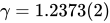
- Failed to parse (SVG (MathML can be enabled via browser plugin): Invalid response ("Math extension cannot connect to Restbase.") from server "https://wikimedia.org/api/rest_v1/":): {\displaystyle \delta=4.7893(8) }
- Failed to parse (SVG (MathML can be enabled via browser plugin): Invalid response ("Math extension cannot connect to Restbase.") from server "https://wikimedia.org/api/rest_v1/":): {\displaystyle \eta =0.03639(15) }
with a critical temperature of Failed to parse (SVG (MathML can be enabled via browser plugin): Invalid response ("Math extension cannot connect to Restbase.") from server "https://wikimedia.org/api/rest_v1/":): {\displaystyle k_BT_c = 4.51152786~S } [13]
ANNNI model[edit]
The axial next-nearest neighbour Ising (ANNNI) model [14] is used to study spatially modulated structures in alloys, adsorbates, ferroelectrics, magnetic systems, and polytypes.
Cellular automata[edit]
The Ising model can be studied using cellular automata [15][16][17][18].
See also[edit]
References[edit]
- ↑ Ernst Ising "Beitrag zur Theorie des Ferromagnetismus", Zeitschrift für Physik A Hadrons and Nuclei 31 pp. 253-258 (1925)
- ↑ S. G. Brush "History of the Lenz-Ising Model", Reviews of Modern Physics 39 pp. 883-893 (1967)
- ↑ Martin Niss "History of the Lenz-Ising Model 1920-1950: From Ferromagnetic to Cooperative Phenomena", Archive for History of Exact Sciences 59 pp. 267-318 (2005)
- ↑ Martin Niss "History of the Lenz–Ising Model 1950–1965: from irrelevance to relevance", Archive for History of Exact Sciences 63 pp. 243-287 (2009)
- ↑ 5.0 5.1 Lars Onsager "Crystal Statistics. I. A Two-Dimensional Model with an Order-Disorder Transition", Physical Review 65 pp. 117-149 (1944)
- ↑ M. Kac and J. C. Ward "A Combinatorial Solution of the Two-Dimensional Ising Model", Physical Review 88 pp. 1332-1337 (1952)
- ↑ Rodney J. Baxter "Exactly Solved Models in Statistical Mechanics", Academic Press (1982) ISBN 0120831821 Chapter 7 (freely available pdf)
- ↑ Rudolf Peierls "On Ising's model of ferromagnetism", Mathematical Proceedings of the Cambridge Philosophical Society 32 pp. 477-481 (1936)
- ↑ Robert B. Griffiths "Peierls Proof of Spontaneous Magnetization in a Two-Dimensional Ising Ferromagnet", Physical Review A 136 pp. 437-439 (1964)
- ↑ Three-dimensional proof for Ising model impossible, Sandia researcher claims to have shown
- ↑ Sorin Istrail "Statistical mechanics, three-dimensionality and NP-completeness: I. Universality of intracatability for the partition function of the Ising model across non-planar surfaces", Proceedings of the thirty-second annual ACM symposium on Theory of computing pp. 87-96 (2000)
- ↑ Massimo Campostrini, Andrea Pelissetto, Paolo Rossi, and Ettore Vicari "25th-order high-temperature expansion results for three-dimensional Ising-like systems on the simple-cubic lattice", Physical Review E 65 066127 (2002)
- ↑ A. L. Talapov and H. W. J Blöte "The magnetization of the 3D Ising model", Journal of Physics A: Mathematical and General 29 pp. 5727-5733 (1996)
- ↑ Walter Selke "The ANNNI model — Theoretical analysis and experimental application", Physics Reports 170 pp. 213-264 (1988)
- ↑ Gérard Y. Vichniac "Simulating physics with cellular automata", Physica D: Nonlinear Phenomena 10 pp. 96-116 (1984)
- ↑ Y. Pomeau "Invariant in cellular automata", Journal of Physics A 17 pp. L415-L418 (1984)
- ↑ H. J. Herrmann "Fast algorithm for the simulation of Ising models", Journal of Statistical Physics 45 pp. 145-151 (1986)
- ↑ Michael Creutz "Deterministic ising dynamics", Annals of Physics 167 pp. 62-72 (1986)
- Related reading