Chemical potential: Difference between revisions

From SklogWiki
Jump to navigation Jump to search
m (Changed references to Cite format.)
Line 25: Line 25:


==Kirkwood charging formula==
See Ref. 2
The Kirkwood charging formula is given by <ref>[http://dx.doi.org/10.1063/1.1749657  John G. Kirkwood "Statistical Mechanics of Fluid Mixtures", Journal of Chemical Physics '''3''' pp. 300-313 (1935)]</ref>


:<math>\beta \mu_{\rm ex} = \rho \int_0^1 d\lambda \int \frac{\partial \beta \Phi_{12} (r,\lambda)}{\partial \lambda} {\rm g}(r,\lambda) dr</math>
Line 36: Line 36:


==References==
==References==
#[http://dx.doi.org/10.1007/s10955-005-8067-x T. A. Kaplan "The Chemical Potential", Journal of Statistical Physics '''122''' pp. 1237-1260 (2006)]
<references/>
#[http://dx.doi.org/10.1063/1.1749657  John G. Kirkwood "Statistical Mechanics of Fluid Mixtures", Journal of Chemical Physics '''3''' pp. 300-313 (1935)]
'''Related reading'''
#[http://dx.doi.org/10.1119/1.17844      G. Cook and R. H. Dickerson "Understanding the chemical potential", American Journal of Physics '''63''' pp. 737-742 (1995)]
*[http://dx.doi.org/10.1119/1.17844      G. Cook and R. H. Dickerson "Understanding the chemical potential", American Journal of Physics '''63''' pp. 737-742 (1995)]
*[http://dx.doi.org/10.1007/s10955-005-8067-x T. A. Kaplan "The Chemical Potential", Journal of Statistical Physics '''122''' pp. 1237-1260 (2006)]
[[category:classical thermodynamics]]
[[category:classical thermodynamics]]
[[category:statistical mechanics]]
[[category:statistical mechanics]]

Revision as of 12:42, 11 November 2009

Classical thermodynamics

Definition:
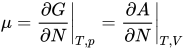
where Failed to parse (SVG (MathML can be enabled via browser plugin): Invalid response ("Math extension cannot connect to Restbase.") from server "https://wikimedia.org/api/rest_v1/":): {\displaystyle G} is the Gibbs energy function, leading to

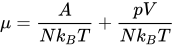
Failed to parse (SVG (MathML can be enabled via browser plugin): Invalid response ("Math extension cannot connect to Restbase.") from server "https://wikimedia.org/api/rest_v1/":): {\displaystyle \mu=\frac{A}{Nk_B T} + \frac{pV}{Nk_BT}}

where Failed to parse (SVG (MathML can be enabled via browser plugin): Invalid response ("Math extension cannot connect to Restbase.") from server "https://wikimedia.org/api/rest_v1/":): {\displaystyle A} is the Helmholtz energy function, Failed to parse (SVG (MathML can be enabled via browser plugin): Invalid response ("Math extension cannot connect to Restbase.") from server "https://wikimedia.org/api/rest_v1/":): {\displaystyle k_B} is the Boltzmann constant, Failed to parse (SVG (MathML can be enabled via browser plugin): Invalid response ("Math extension cannot connect to Restbase.") from server "https://wikimedia.org/api/rest_v1/":): {\displaystyle p} is the pressure, Failed to parse (SVG (MathML can be enabled via browser plugin): Invalid response ("Math extension cannot connect to Restbase.") from server "https://wikimedia.org/api/rest_v1/":): {\displaystyle T} is the temperature and Failed to parse (SVG (MathML can be enabled via browser plugin): Invalid response ("Math extension cannot connect to Restbase.") from server "https://wikimedia.org/api/rest_v1/":): {\displaystyle V} is the volume.

Statistical mechanics

The chemical potential is the derivative of the Helmholtz energy function with respect to the number of particles

Failed to parse (SVG (MathML can be enabled via browser plugin): Invalid response ("Math extension cannot connect to Restbase.") from server "https://wikimedia.org/api/rest_v1/":): {\displaystyle \mu= \left. \frac{\partial A}{\partial N}\right\vert_{T,V}=\frac{\partial (-k_B T \ln Z_N)}{\partial N} = -\frac{3}{2} k_BT \ln \left(\frac{2\pi m k_BT}{h^2}\right) + \frac{\partial \ln Q_N}{\partial N}}

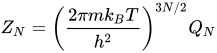
where Failed to parse (SVG (MathML can be enabled via browser plugin): Invalid response ("Math extension cannot connect to Restbase.") from server "https://wikimedia.org/api/rest_v1/":): {\displaystyle Z_N} is the partition function for a fluid of Failed to parse (SVG (MathML can be enabled via browser plugin): Invalid response ("Math extension cannot connect to Restbase.") from server "https://wikimedia.org/api/rest_v1/":): {\displaystyle N} identical particles

Failed to parse (SVG (MathML can be enabled via browser plugin): Invalid response ("Math extension cannot connect to Restbase.") from server "https://wikimedia.org/api/rest_v1/":): {\displaystyle Z_N= \left( \frac{2\pi m k_BT}{h^2} \right)^{3N/2} Q_N}

and Failed to parse (SVG (MathML can be enabled via browser plugin): Invalid response ("Math extension cannot connect to Restbase.") from server "https://wikimedia.org/api/rest_v1/":): {\displaystyle Q_N} is the configurational integral

Failed to parse (SVG (MathML can be enabled via browser plugin): Invalid response ("Math extension cannot connect to Restbase.") from server "https://wikimedia.org/api/rest_v1/":): {\displaystyle Q_N = \frac{1}{N!} \int ... \int \exp (-U_N/k_B T) dr_1...dr_N}

Kirkwood charging formula

The Kirkwood charging formula is given by [1]

Failed to parse (SVG (MathML can be enabled via browser plugin): Invalid response ("Math extension cannot connect to Restbase.") from server "https://wikimedia.org/api/rest_v1/":): {\displaystyle \beta \mu_{\rm ex} = \rho \int_0^1 d\lambda \int \frac{\partial \beta \Phi_{12} (r,\lambda)}{\partial \lambda} {\rm g}(r,\lambda) dr}

where Failed to parse (SVG (MathML can be enabled via browser plugin): Invalid response ("Math extension cannot connect to Restbase.") from server "https://wikimedia.org/api/rest_v1/":): {\displaystyle \Phi_{12}(r)} is the intermolecular pair potential and Failed to parse (SVG (MathML can be enabled via browser plugin): Invalid response ("Math extension cannot connect to Restbase.") from server "https://wikimedia.org/api/rest_v1/":): {\displaystyle {\rm g}(r)} is the pair correlation function.

See also

References

Related reading