Virial equation of state: Difference between revisions
Jump to navigation
Jump to search
Carl McBride (talk | contribs) No edit summary |
Carl McBride (talk | contribs) |
||
| Line 29: | Line 29: | ||
where ''f'' is the [[Mayer f-function]] (see also: [[Cluster integrals]]). | where ''f'' is the [[Mayer f-function]] (see also: [[Cluster integrals]]). | ||
See also: | |||
*[http://dx.doi.org/10.1080/002689796173453 M. S. Wertheim "Fluids of hard convex molecules III. The third virial coefficient", Molecular Physics '''89''' pp. 1005-1017 (1996)] | |||
==Convergence== | ==Convergence== | ||
See Ref. 3. | See Ref. 3. | ||
Revision as of 13:08, 30 August 2007
The virial equation of state is used to describe the behavior of diluted gases. It is usually written as an expansion of the compressibility factor, , in terms of either the density or the pressure. Such an expansion was first introduced by Kammerlingh Onnes. In the first case:

- .
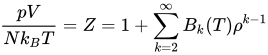
where
- is the pressure

- is the volume

- is the number of molecules

- is the (number) density

- is called the k-th virial coefficient

Virial coefficients
The second virial coefficient represents the initial departure from ideal-gas behavior

where is Avogadros number and and are volume elements of two different molecules in configuration space.


One can write the third virial coefficient as

where f is the Mayer f-function (see also: Cluster integrals). See also:
Convergence
See Ref. 3.
References
- H. Kammerlingh Onnes "", Communications from the Physical Laboratory Leiden 71 (1901)
- James A Beattie and Walter H Stockmayer "Equations of state", Reports on Progress in Physics 7 pp. 195-229 (1940)
- J. L. Lebowitz and O. Penrose "Convergence of Virial Expansions", Journal of Mathematical Physics 5 pp. 841-847 (1964)