Chemical potential: Difference between revisions
No edit summary |
Carl McBride (talk | contribs) m (→See also: Added an internal link) |
||
| Line 32: | Line 32: | ||
where <math>\Phi_{12}(r)</math> is the [[intermolecular pair potential]] and <math>{\rm g}(r)</math> is the [[Pair distribution function | pair correlation function]]. | where <math>\Phi_{12}(r)</math> is the [[intermolecular pair potential]] and <math>{\rm g}(r)</math> is the [[Pair distribution function | pair correlation function]]. | ||
==See also== | ==See also== | ||
*[[Constant chemical potential molecular dynamics (CμMD)]] | |||
*[[Ideal gas: Chemical potential]] | *[[Ideal gas: Chemical potential]] | ||
*[[Overlapping distribution method]] | |||
*[[Widom test-particle method]] | *[[Widom test-particle method]] | ||
==References== | ==References== | ||
Revision as of 14:11, 16 April 2015
Classical thermodynamics
Definition:
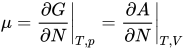
where is the Gibbs energy function, leading to


where Failed to parse (SVG (MathML can be enabled via browser plugin): Invalid response ("Math extension cannot connect to Restbase.") from server "https://wikimedia.org/api/rest_v1/":): {\displaystyle A} is the Helmholtz energy function, Failed to parse (SVG (MathML can be enabled via browser plugin): Invalid response ("Math extension cannot connect to Restbase.") from server "https://wikimedia.org/api/rest_v1/":): {\displaystyle k_B} is the Boltzmann constant, Failed to parse (SVG (MathML can be enabled via browser plugin): Invalid response ("Math extension cannot connect to Restbase.") from server "https://wikimedia.org/api/rest_v1/":): {\displaystyle p} is the pressure, Failed to parse (SVG (MathML can be enabled via browser plugin): Invalid response ("Math extension cannot connect to Restbase.") from server "https://wikimedia.org/api/rest_v1/":): {\displaystyle T} is the temperature and Failed to parse (SVG (MathML can be enabled via browser plugin): Invalid response ("Math extension cannot connect to Restbase.") from server "https://wikimedia.org/api/rest_v1/":): {\displaystyle V} is the volume.
Statistical mechanics
The chemical potential is the derivative of the Helmholtz energy function with respect to the number of particles
- Failed to parse (SVG (MathML can be enabled via browser plugin): Invalid response ("Math extension cannot connect to Restbase.") from server "https://wikimedia.org/api/rest_v1/":): {\displaystyle \mu= \left. \frac{\partial A}{\partial N}\right\vert_{T,V}=\frac{\partial (-k_B T \ln Z_N)}{\partial N} = - k_B T \left[ \frac{3}{2} \ln \left(\frac{2\pi m k_BT}{h^2}\right) + \frac{\partial \ln Q_N}{\partial N} \right]}
where Failed to parse (SVG (MathML can be enabled via browser plugin): Invalid response ("Math extension cannot connect to Restbase.") from server "https://wikimedia.org/api/rest_v1/":): {\displaystyle Z_N} is the partition function for a fluid of Failed to parse (SVG (MathML can be enabled via browser plugin): Invalid response ("Math extension cannot connect to Restbase.") from server "https://wikimedia.org/api/rest_v1/":): {\displaystyle N} identical particles
- Failed to parse (SVG (MathML can be enabled via browser plugin): Invalid response ("Math extension cannot connect to Restbase.") from server "https://wikimedia.org/api/rest_v1/":): {\displaystyle Z_N= \left( \frac{2\pi m k_BT}{h^2} \right)^{3N/2} Q_N}
and Failed to parse (SVG (MathML can be enabled via browser plugin): Invalid response ("Math extension cannot connect to Restbase.") from server "https://wikimedia.org/api/rest_v1/":): {\displaystyle Q_N} is the configurational integral
- Failed to parse (SVG (MathML can be enabled via browser plugin): Invalid response ("Math extension cannot connect to Restbase.") from server "https://wikimedia.org/api/rest_v1/":): {\displaystyle Q_N = \frac{1}{N!} \int ... \int \exp (-U_N/k_B T) dr_1...dr_N}
Kirkwood charging formula
The Kirkwood charging formula is given by [1]
- Failed to parse (SVG (MathML can be enabled via browser plugin): Invalid response ("Math extension cannot connect to Restbase.") from server "https://wikimedia.org/api/rest_v1/":): {\displaystyle \beta \mu_{\rm ex} = \rho \int_0^1 d\lambda \int \frac{\partial \beta \Phi_{12} (r,\lambda)}{\partial \lambda} {\rm g}(r,\lambda) dr}
where Failed to parse (SVG (MathML can be enabled via browser plugin): Invalid response ("Math extension cannot connect to Restbase.") from server "https://wikimedia.org/api/rest_v1/":): {\displaystyle \Phi_{12}(r)} is the intermolecular pair potential and Failed to parse (SVG (MathML can be enabled via browser plugin): Invalid response ("Math extension cannot connect to Restbase.") from server "https://wikimedia.org/api/rest_v1/":): {\displaystyle {\rm g}(r)} is the pair correlation function.
See also
- Constant chemical potential molecular dynamics (CμMD)
- Ideal gas: Chemical potential
- Overlapping distribution method
- Widom test-particle method
References
Related reading
- G. Cook and R. H. Dickerson "Understanding the chemical potential", American Journal of Physics 63 pp. 737-742 (1995)
- T. A. Kaplan "The Chemical Potential", Journal of Statistical Physics 122 pp. 1237-1260 (2006)
- Federico G. Pazzona, Pierfranco Demontis, and Giuseppe B. Suffritti "Chemical potential evaluation in NVT lattice-gas simulations", Journal of Chemical Physics 137 154106 (2012)