Second virial coefficient: Difference between revisions
Carl McBride (talk | contribs) m (Added the Admur and Mason mixing rule) |
Carl McBride (talk | contribs) m (→References: Added a recent publication) |
||
| Line 75: | Line 75: | ||
*[http://dx.doi.org/10.1063/1.1750922 W. H. Stockmayer "Second Virial Coefficients of Polar Gases", Journal of Chemical Physics '''9''' pp. 398- (1941)] | *[http://dx.doi.org/10.1063/1.1750922 W. H. Stockmayer "Second Virial Coefficients of Polar Gases", Journal of Chemical Physics '''9''' pp. 398- (1941)] | ||
*[http://dx.doi.org/10.1063/1.481106 G. A. Vliegenthart and H. N. W. Lekkerkerker "Predicting the gas–liquid critical point from the second virial coefficient", Journal of Chemical Physics '''112''' pp. 5364-5369 (2000)] | *[http://dx.doi.org/10.1063/1.481106 G. A. Vliegenthart and H. N. W. Lekkerkerker "Predicting the gas–liquid critical point from the second virial coefficient", Journal of Chemical Physics '''112''' pp. 5364-5369 (2000)] | ||
*[http://dx.doi.org/10.1080/00268976.2016.1263763 Michael Rouha and Ivo Nezbeda "Second virial coefficients: a route to combining rules?", Molecular Physics '''115''' pp. 1191-1199 (2017)] | |||
[[Category: Virial coefficients]] | [[Category: Virial coefficients]] | ||
Revision as of 16:29, 19 May 2017
The second virial coefficient is usually written as B or as Failed to parse (SVG (MathML can be enabled via browser plugin): Invalid response ("Math extension cannot connect to Restbase.") from server "https://wikimedia.org/api/rest_v1/":): {\displaystyle B_2} . The second virial coefficient represents the initial departure from ideal-gas behaviour. The second virial coefficient, in three dimensions, is given by
- Failed to parse (SVG (MathML can be enabled via browser plugin): Invalid response ("Math extension cannot connect to Restbase.") from server "https://wikimedia.org/api/rest_v1/":): {\displaystyle B_{2}(T)= - \frac{1}{2} \int \left( \exp\left(-\frac{\Phi_{12}({\mathbf r})}{k_BT}\right) -1 \right) 4 \pi r^2 dr }
where Failed to parse (SVG (MathML can be enabled via browser plugin): Invalid response ("Math extension cannot connect to Restbase.") from server "https://wikimedia.org/api/rest_v1/":): {\displaystyle \Phi_{12}({\mathbf r})} is the intermolecular pair potential, T is the temperature and is the Boltzmann constant. Notice that the expression within the parenthesis of the integral is the Mayer f-function.

In practice the integral is often very hard to integrate analytically for anything other than, say, the hard sphere model, thus one numerically evaluates
- Failed to parse (SVG (MathML can be enabled via browser plugin): Invalid response ("Math extension cannot connect to Restbase.") from server "https://wikimedia.org/api/rest_v1/":): {\displaystyle B_{2}(T)= - \frac{1}{2} \int \left( \left\langle \exp\left(-\frac{\Phi_{12}({\mathbf r})}{k_BT}\right)\right\rangle -1 \right) 4 \pi r^2 dr }
calculating
- Failed to parse (SVG (MathML can be enabled via browser plugin): Invalid response ("Math extension cannot connect to Restbase.") from server "https://wikimedia.org/api/rest_v1/":): {\displaystyle \left\langle \exp\left(-\frac{\Phi_{12}({\mathbf r})}{k_BT}\right)\right\rangle}
for each Failed to parse (SVG (MathML can be enabled via browser plugin): Invalid response ("Math extension cannot connect to Restbase.") from server "https://wikimedia.org/api/rest_v1/":): {\displaystyle r} using the numerical integration scheme proposed by Harold Conroy [1][2].
Isihara-Hadwiger formula
The Isihara-Hadwiger formula was discovered simultaneously and independently by Isihara [3] [4] [5] and the Swiss mathematician Hadwiger in 1950 [6] [7] [8] The second virial coefficient for any hard convex body is given by the exact relation
- Failed to parse (SVG (MathML can be enabled via browser plugin): Invalid response ("Math extension cannot connect to Restbase.") from server "https://wikimedia.org/api/rest_v1/":): {\displaystyle B_2=RS+V}
or
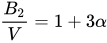
where
- Failed to parse (SVG (MathML can be enabled via browser plugin): Invalid response ("Math extension cannot connect to Restbase.") from server "https://wikimedia.org/api/rest_v1/":): {\displaystyle \alpha = \frac{RS}{3V}}
where Failed to parse (SVG (MathML can be enabled via browser plugin): Invalid response ("Math extension cannot connect to Restbase.") from server "https://wikimedia.org/api/rest_v1/":): {\displaystyle V} is the volume, Failed to parse (SVG (MathML can be enabled via browser plugin): Invalid response ("Math extension cannot connect to Restbase.") from server "https://wikimedia.org/api/rest_v1/":): {\displaystyle S} , the surface area, and Failed to parse (SVG (MathML can be enabled via browser plugin): Invalid response ("Math extension cannot connect to Restbase.") from server "https://wikimedia.org/api/rest_v1/":): {\displaystyle R} the mean radius of curvature.
Hard spheres
For the hard sphere model one has [9]

leading to
- Failed to parse (SVG (MathML can be enabled via browser plugin): Invalid response ("Math extension cannot connect to Restbase.") from server "https://wikimedia.org/api/rest_v1/":): {\displaystyle B_{2}= \frac{2\pi\sigma^3}{3}}
Note that Failed to parse (SVG (MathML can be enabled via browser plugin): Invalid response ("Math extension cannot connect to Restbase.") from server "https://wikimedia.org/api/rest_v1/":): {\displaystyle B_{2}} for the hard sphere is independent of temperature. See also: Hard sphere: virial coefficients.
Van der Waals equation of state
For the Van der Waals equation of state one has:
- Failed to parse (SVG (MathML can be enabled via browser plugin): Invalid response ("Math extension cannot connect to Restbase.") from server "https://wikimedia.org/api/rest_v1/":): {\displaystyle B_{2}(T)= b -\frac{a}{RT} }
For the derivation click here.
Excluded volume
The second virial coefficient can be computed from the expression
- Failed to parse (SVG (MathML can be enabled via browser plugin): Invalid response ("Math extension cannot connect to Restbase.") from server "https://wikimedia.org/api/rest_v1/":): {\displaystyle B_{2}= \frac{1}{2} \iint v_{\mathrm {excluded}} (\Omega,\Omega') f(\Omega) f(\Omega')~ {\mathrm d}\Omega {\mathrm d}\Omega'}
where Failed to parse (SVG (MathML can be enabled via browser plugin): Invalid response ("Math extension cannot connect to Restbase.") from server "https://wikimedia.org/api/rest_v1/":): {\displaystyle v_{\mathrm {excluded}}} is the excluded volume.
Admur and Mason mixing rule
For the second virial coefficient of a mixture [10]
- Failed to parse (SVG (MathML can be enabled via browser plugin): Invalid response ("Math extension cannot connect to Restbase.") from server "https://wikimedia.org/api/rest_v1/":): {\displaystyle B_{ij} = \frac{\left(B_{ii}^{1/3}+B_{jj}^{1/3}\right)^3}{8}}
See also
References
- ↑ Harold Conroy "Molecular Schrödinger Equation. VIII. A New Method for the Evaluation of Multidimensional Integrals", Journal of Chemical Physics 47 pp. 5307 (1967)
- ↑ I. Nezbeda, J. Kolafa and S. Labík "The spherical harmonic expansion coefficients and multidimensional integrals in theories of liquids", Czechoslovak Journal of Physics 39 pp. 65-79 (1989)
- ↑ Akira Isihara "Determination of Molecular Shape by Osmotic Measurement", Journal of Chemical Physics 18 pp. 1446-1449 (1950)
- ↑ Akira Isihara and Tsuyoshi Hayashida "Theory of High Polymer Solutions. I. Second Virial Coefficient for Rigid Ovaloids Model", Journal of the Physical Society of Japan 6 pp. 40-45 (1951)
- ↑ Akira Isihara and Tsuyoshi Hayashida "Theory of High Polymer Solutions. II. Special Forms of Second Osmotic Coefficient", Journal of the Physical Society of Japan 6 pp. 46-50 (1951)
- ↑ H. Hadwiger "Einige Anwendungen eines Funkticnalsatzes fur konvexe Körper in der räumichen Integralgeometrie" Mh. Math. 54 pp. 345- (1950)
- ↑ H. Hadwiger "Der kinetische Radius nichtkugelförmiger Moleküle" Experientia 7 pp. 395-398 (1951)
- ↑ H. Hadwiger "Altes und Neues über Konvexe Körper" Birkäuser Verlag (1955)
- ↑ Donald A. McQuarrie "Statistical Mechanics", University Science Books (2000) ISBN 978-1-891389-15-3 Eq. 12-40
- ↑ I. Amdur and E. A. Mason "Properties of Gases at Very High Temperatures", Physics of Fluids 1 pp. 370-383 (1958)
Related reading
- W. H. Stockmayer "Second Virial Coefficients of Polar Gases", Journal of Chemical Physics 9 pp. 398- (1941)
- G. A. Vliegenthart and H. N. W. Lekkerkerker "Predicting the gas–liquid critical point from the second virial coefficient", Journal of Chemical Physics 112 pp. 5364-5369 (2000)
- Michael Rouha and Ivo Nezbeda "Second virial coefficients: a route to combining rules?", Molecular Physics 115 pp. 1191-1199 (2017)