Temperature: Difference between revisions
Carl McBride (talk | contribs) m (→Temperature scale: Added a historical note) |
Carl McBride (talk | contribs) m (→References: Added a recent publication) |
||
| Line 37: | Line 37: | ||
==References== | ==References== | ||
<references/> | <references/> | ||
'''Related reading''' | |||
*[http://dx.doi.org/10.1063/1.3486557 Grey Sh. Boltachev and Jürn W. P. Schmelzer "On the definition of temperature and its fluctuations in small systems", Journal of Chemical Physics '''133''' 134509 (2010)] | |||
[[category: Classical thermodynamics]] | [[category: Classical thermodynamics]] | ||
[[category: statistical mechanics]] | [[category: statistical mechanics]] | ||
[[category: Non-equilibrium thermodynamics]] | [[category: Non-equilibrium thermodynamics]] | ||
Revision as of 11:13, 8 October 2010
The temperature of a system in classical thermodynamics is intimately related to the zeroth law of thermodynamics; two systems having to have the same temperature if they are to be in thermal equilibrium (i.e. there is no net heat flow between them). However, it is most useful to have a temperature scale. By making use of the ideal gas law one can define an absolute temperature

however, perhaps a better definition of temperature is
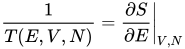
where is the entropy.

Temperature scale
Temperature has the SI units (Système International d'Unités) of kelvin (K) (named in honour of William Thomson, Baron Kelvin of Largs [1]) The kelvin is the fraction 1/273.16 of the thermodynamic temperature of the triple point of water[2] [3].
Non-SI temperature scales
Rankine temperature scale
0°R corresponds to 0 kelvin, and 1.8 degrees Rankine is equivalent to 1 kevlin [4]. The Rankine temperature scale is named after William John Macquorn Rankine.
Kinetic temperature
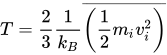
where is the Boltzmann constant. The kinematic temperature so defined is related to the equipartition theorem; for more details, see Configuration integral.

Configurational temperature
Non-equilibrium temperature
Inverse temperature
It is frequently convenient to define a so-called inverse temperature, , such that


Negative temperature
See also
References
- ↑ William Thomson "On an Absolute Thermometric Scale, founded on Carnot's Theory of the Motive Power of Heat, and calculated from the Results of Regnault's Experiments on the Pressure and Latent Heat of Steam", Philosophical Magazine October pp. (1848)
- ↑ H. Preston-Thomas "The International Temperature Scale of 1990 (ITS-90)", Metrologia 27 pp. 3-10 (1990)
- ↑ H. Preston-Thomas "ERRATUM: The International Temperature Scale of 1990 (ITS-90)", Metrologia 27 p. 107 (1990)
- ↑ NIST guide to SI Units
- ↑ Hans Henrik Rugh "Dynamical Approach to Temperature", Physical Review Letters 78 pp. 772-774 (1997)
- ↑ András Baranyai "On the configurational temperature of simple fluids", Journal of Chemical Physics 112 pp. 3964-3966 (2000)
- ↑ Alexander V. Popov and Rigoberto Hernandez "Ontology of temperature in nonequilibrium systems", Journal of Chemical Physics 126 244506 (2007)
- ↑ J.-L. Garden, J. Richard, and H. Guillou "Temperature of systems out of thermodynamic equilibrium", Journal of Chemical Physics 129 044508 (2008)
Related reading