Virial equation of state: Difference between revisions
Carl McBride (talk | contribs) m (Added reference by Ursell) |
No edit summary |
||
| (3 intermediate revisions by one other user not shown) | |||
| Line 11: | Line 11: | ||
*<math> V </math> is the volume | *<math> V </math> is the volume | ||
*<math> N </math> is the number of molecules | *<math> N </math> is the number of molecules | ||
*<math>T</math> is the [[temperature]] | *<math> T </math> is the [[temperature]] | ||
*<math>k_B</math> is the [[Boltzmann constant]] | *<math>k_B</math> is the [[Boltzmann constant]] | ||
*<math> \rho \equiv \frac{N}{V} </math> is the (number) density | *<math> \rho \equiv \frac{N}{V} </math> is the (number) density | ||
| Line 28: | Line 28: | ||
where ''f'' is the [[Mayer f-function]] (see also: [[Cluster integrals]]). | where ''f'' is the [[Mayer f-function]] (see also: [[Cluster integrals]]). | ||
See also | See also <ref>[http://dx.doi.org/10.1080/002689796173453 M. S. Wertheim "Fluids of hard convex molecules III. The third virial coefficient", Molecular Physics '''89''' pp. 1005-1017 (1996)]</ref> | ||
==Convergence== | ==Convergence== | ||
For a commentary on the convergence of the virial equation of state see <ref>[http://dx.doi.org/10.1063/1.1704186 J. L. Lebowitz and O. Penrose "Convergence of Virial Expansions", Journal of Mathematical Physics '''5''' pp. 841-847 (1964)]</ref> and section 3 of <ref>[http://dx.doi.org/10.1088/0953-8984/20/28/283102 A. J. Masters "Virial expansions", Journal of Physics: Condensed Matter '''20''' 283102 (2008)]</ref> | For a commentary on the convergence of the virial equation of state see <ref>[http://dx.doi.org/10.1063/1.1704186 J. L. Lebowitz and O. Penrose "Convergence of Virial Expansions", Journal of Mathematical Physics '''5''' pp. 841-847 (1964)]</ref> and section 3 of <ref>[http://dx.doi.org/10.1088/0953-8984/20/28/283102 A. J. Masters "Virial expansions", Journal of Physics: Condensed Matter '''20''' 283102 (2008)]</ref>. | ||
==Quantum virial coefficients== | |||
Using the [[path integral formulation]] one can also calculate the virial coefficients of quantum systems <ref>[http://dx.doi.org/10.1063/1.3573564 Giovanni Garberoglio and Allan H. Harvey "Path-integral calculation of the third virial coefficient of quantum gases at low temperatures", Journal of Chemical Physics 134, 134106 (2011)]</ref>. | |||
==References== | ==References== | ||
<references/> | <references/> | ||
| Line 38: | Line 39: | ||
*[http://dx.doi.org/10.1088/0034-4885/7/1/312 James A Beattie and Walter H Stockmayer "Equations of state", Reports on Progress in Physics '''7''' pp. 195-229 (1940)] | *[http://dx.doi.org/10.1088/0034-4885/7/1/312 James A Beattie and Walter H Stockmayer "Equations of state", Reports on Progress in Physics '''7''' pp. 195-229 (1940)] | ||
*Edward Allen Mason and Thomas Harley Spurling "The virial equation of state", Pergamon Press (1969) ISBN 0080132928 | *Edward Allen Mason and Thomas Harley Spurling "The virial equation of state", Pergamon Press (1969) ISBN 0080132928 | ||
*[http://dx.doi.org/10.1063/1.4929392 Nathaniel S. Barlow, Andrew J. Schultz, Steven J. Weinstein and David A. Kofke "Analytic continuation of the virial series through the critical point using parametric approximants", Journal of Chemical Physics '''143''' 071103 (2015)] | |||
*[https://doi.org/10.1063/1.5016165 Harold W. Hatch, Sally Jiao, Nathan A. Mahynski, Marco A. Blanco, and Vincent K. Shen "Communication: Predicting virial coefficients and alchemical transformations by extrapolating Mayer-sampling Monte Carlo simulations", Journal of Chemical Physics '''147''' 231102 (2017)] | |||
[[category:equations of state]] | [[category:equations of state]] | ||
Latest revision as of 15:51, 17 November 2020
The virial equation of state is used to describe the behavior of diluted gases. It is usually written as an expansion of the compressibility factor, , in terms of either the density or the pressure. Such an expansion was first introduced in 1885 by Thiesen [1] and extensively studied by Heike Kamerlingh Onnes [2] [3], and mathematically by Ursell [4]. One has

- .
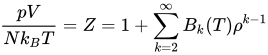
where
- is the pressure
- is the volume
- is the number of molecules
- is the temperature
- is the Boltzmann constant
- is the (number) density
- is called the k-th virial coefficient


Virial coefficients[edit]
The second virial coefficient represents the initial departure from ideal-gas behaviour

where is Avogadros number and and are volume elements of two different molecules in configuration space.


One can write the third virial coefficient as

where f is the Mayer f-function (see also: Cluster integrals). See also [5]
Convergence[edit]
For a commentary on the convergence of the virial equation of state see [6] and section 3 of [7].
Quantum virial coefficients[edit]
Using the path integral formulation one can also calculate the virial coefficients of quantum systems [8].
References[edit]
- ↑ M. Thiesen "Untersuchungen über die Zustandsgleichung", Annalen der Physik 24 pp. 467-492 (1885)
- ↑ H. Kammerlingh Onnes "Expression of the equation of state of gases and liquids by means of series", Communications from the Physical Laboratory of the University of Leiden 71 pp. 3-25 (1901)
- ↑ H. Kammerlingh Onnes "Expression of the equation of state of gases and liquids by means of series", Proceedings of the Koninklijke Nederlandse Akademie van Wetenschappen 4 pp. 125-147 (1902)
- ↑ H. D. Ursell "The evaluation of Gibbs' phase-integral for imperfect gases", Mathematical Proceedings of the Cambridge Philosophical Society 23 pp. 685-697 (1927)
- ↑ M. S. Wertheim "Fluids of hard convex molecules III. The third virial coefficient", Molecular Physics 89 pp. 1005-1017 (1996)
- ↑ J. L. Lebowitz and O. Penrose "Convergence of Virial Expansions", Journal of Mathematical Physics 5 pp. 841-847 (1964)
- ↑ A. J. Masters "Virial expansions", Journal of Physics: Condensed Matter 20 283102 (2008)
- ↑ Giovanni Garberoglio and Allan H. Harvey "Path-integral calculation of the third virial coefficient of quantum gases at low temperatures", Journal of Chemical Physics 134, 134106 (2011)
Related reading
- James A Beattie and Walter H Stockmayer "Equations of state", Reports on Progress in Physics 7 pp. 195-229 (1940)
- Edward Allen Mason and Thomas Harley Spurling "The virial equation of state", Pergamon Press (1969) ISBN 0080132928
- Nathaniel S. Barlow, Andrew J. Schultz, Steven J. Weinstein and David A. Kofke "Analytic continuation of the virial series through the critical point using parametric approximants", Journal of Chemical Physics 143 071103 (2015)
- Harold W. Hatch, Sally Jiao, Nathan A. Mahynski, Marco A. Blanco, and Vincent K. Shen "Communication: Predicting virial coefficients and alchemical transformations by extrapolating Mayer-sampling Monte Carlo simulations", Journal of Chemical Physics 147 231102 (2017)