Harmonic repulsion potential: Difference between revisions
Jump to navigation
Jump to search
Carl McBride (talk | contribs) m (Added internal link to plot of potential) |
Carl McBride (talk | contribs) (Added a recent publication) |
||
| (One intermediate revision by the same user not shown) | |||
| Line 1: | Line 1: | ||
The '''Harmonic repulsion potential''' is given by (<ref>[http://dx.doi.org/10.1103/PhysRevLett.103.245701 Ning Xu, Thomas K. Haxton, Andrea J. Liu, and Sidney R. Nagel "Equivalence of Glass Transition and Colloidal Glass Transition in the Hard-Sphere Limit", Physical Review Letters '''103''' 245701 (2009)]</ref> Eq. 2): | The '''Harmonic repulsion potential''', designed for studies of [[Polymers |polymer]] [[micelles]], [[dendrimers]], and [[Colloids |colloidal particles]], is given by (<ref>[http://dx.doi.org/10.1103/PhysRevLett.103.245701 Ning Xu, Thomas K. Haxton, Andrea J. Liu, and Sidney R. Nagel "Equivalence of Glass Transition and Colloidal Glass Transition in the Hard-Sphere Limit", Physical Review Letters '''103''' 245701 (2009)]</ref> Eq. 2): | ||
:<math> | :<math> | ||
| Line 18: | Line 18: | ||
==References== | ==References== | ||
<references/> | <references/> | ||
;Related reading | |||
*[http://dx.doi.org/10.1063/1.5002536 V. A. Levashov "Crystalline structures of particles interacting through the harmonic-repulsive pair potential", Journal of Chemical Physics '''147''' 114503 (2017)] | |||
[[category: models]] | [[category: models]] | ||
Latest revision as of 11:31, 25 September 2017
The Harmonic repulsion potential, designed for studies of polymer micelles, dendrimers, and colloidal particles, is given by ([1] Eq. 2):

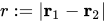
where is the intermolecular pair potential, is the distance between site 1 and site 2. represents a length scale and an energy. For example, for the potential looks like



Phase diagram[edit]
The phase diagram in the pressure-temperature plane has been calculated by Zhu and Lu [2].
See also[edit]
References[edit]
- ↑ Ning Xu, Thomas K. Haxton, Andrea J. Liu, and Sidney R. Nagel "Equivalence of Glass Transition and Colloidal Glass Transition in the Hard-Sphere Limit", Physical Review Letters 103 245701 (2009)
- ↑ You-Liang Zhu and Zhong-Yuan Lu "Phase diagram of spherical particles interacted with harmonic repulsions", Journal of Chemical Physics 134 044903 (2011)
- Related reading