Berthelot equation of state: Difference between revisions
Jump to navigation
Jump to search
Carl McBride (talk | contribs) m (Recalculated a, b, and R) |
Carl McBride (talk | contribs) mNo edit summary |
||
| (7 intermediate revisions by the same user not shown) | |||
| Line 1: | Line 1: | ||
The '''Berthelot equation of state''' <ref>[http://dx.doi.org/10.1051/jphystap:018990080026300 D. J. Berthelot "Sur Une Méthode Purement Physique Pour La Détermination des Poids Moléculaires des Gaz et des Poids Atomiques de Leurs Éléments", J. Phys., '''8''' pp. 263-274 (1899)]</ref> can be written as | The '''Berthelot equation of state''' <ref>[http://dx.doi.org/10.1051/jphystap:018990080026300 D. J. Berthelot "Sur Une Méthode Purement Physique Pour La Détermination des Poids Moléculaires des Gaz et des Poids Atomiques de Leurs Éléments", J. Phys., '''8''' pp. 263-274 (1899)]</ref><ref>D. Berthelot "", Travaux et Mémoires du Bureau international des Poids et Mesures '''Tome XIII''' (Paris: Gauthier-Villars, 1907)</ref> | ||
can be written as | |||
:<math>RT = \left( p + \frac{a}{Tv^2} \right) \left( v - b\right)</math>. | :<math>RT = \left( p + \frac{a}{Tv^2} \right) \left( v - b\right)</math>. | ||
At the [[critical points | critical point]] one has <math>\left.\frac{\partial p}{\partial v}\right|_{T=T_c}=0 </math>, and <math>\left.\frac{\partial^2 p}{\partial v^2}\right|_{T=T_c}=0 </math>, | At the [[critical points | critical point]] one has <math>\left.\frac{\partial p}{\partial v}\right|_{T=T_c}=0 </math>, and <math>\left.\frac{\partial^2 p}{\partial v^2}\right|_{T=T_c}=0 </math>, | ||
:<math>a = | which leads to (Eqs. 4.1 - 4.3 <ref>[http://dx.doi.org/10.1021/ed039p464 Antony F. Saturno "Daniel Berthelot's equation of state", Journal of Chemical Education '''39''' (9) pp. 464-465 (1962)]</ref><ref> [http://www.ucm.es/info/molecsim/Berthelot_EOS.sws SAGE Notebook Worksheet] for use in the open-source mathematics software [http://www.sagemath.org/ SAGE]</ref>) | ||
:<math>a = 3 T_c p_c v_c^2</math> | |||
:<math>b= \frac{v_c}{3}</math> | :<math>b= \frac{v_c}{3}</math> | ||
and | and giving a critical [[compressibility factor]] of | ||
:<math>Z_c = \frac{p_cv_c}{RT_c} = \frac{3}{8} = 0.375 </math> | |||
where <math>p</math> is the [[pressure]], <math>T</math> is the [[temperature]] and <math>R</math> is the [[molar gas constant]]. <math>T_c</math> is the [[critical points | critical]] temperature, <math>p_c</math> is the pressure and <math>v_c</math> is the volume at the critical point. | |||
==Low pressure variant== | |||
Berthelot also proposed an [[Equations of state |equation of state]] for use at low pressures{{reference needed}}: | |||
:<math>p = \frac{RT}{v} \left( 1 + \frac{9}{128} \frac{pT_c}{p_c T} \left( 1- \frac{6T_c^2}{T^2} \right) \right)</math> | |||
==References== | ==References== | ||
<references/> | <references/> | ||
[[category: equations of state]] | [[category: equations of state]] | ||
Latest revision as of 15:31, 8 January 2014
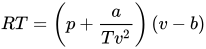
The Berthelot equation of state [1][2] can be written as
- .
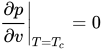
At the critical point one has , and ,
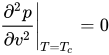
which leads to (Eqs. 4.1 - 4.3 [3][4])


and giving a critical compressibility factor of
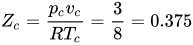
where is the pressure, Failed to parse (SVG (MathML can be enabled via browser plugin): Invalid response ("Math extension cannot connect to Restbase.") from server "https://wikimedia.org/api/rest_v1/":): {\displaystyle T}
is the temperature and is the molar gas constant. is the critical temperature, is the pressure and is the volume at the critical point.


Low pressure variant[edit]
Berthelot also proposed an equation of state for use at low pressures[?]

References[edit]
- ↑ D. J. Berthelot "Sur Une Méthode Purement Physique Pour La Détermination des Poids Moléculaires des Gaz et des Poids Atomiques de Leurs Éléments", J. Phys., 8 pp. 263-274 (1899)
- ↑ D. Berthelot "", Travaux et Mémoires du Bureau international des Poids et Mesures Tome XIII (Paris: Gauthier-Villars, 1907)
- ↑ Antony F. Saturno "Daniel Berthelot's equation of state", Journal of Chemical Education 39 (9) pp. 464-465 (1962)
- ↑ SAGE Notebook Worksheet for use in the open-source mathematics software SAGE