Kern and Frenkel patchy model: Difference between revisions
Carl McBride (talk | contribs) m (partial save) |
No edit summary |
||
| (23 intermediate revisions by 5 users not shown) | |||
| Line 1: | Line 1: | ||
The '''Kern and Frenkel''' <ref>[http://dx.doi.org/10.1063/1.1569473 Norbert Kern and Daan Frenkel "Fluid–fluid coexistence in colloidal systems with short-ranged strongly directional attraction", Journal of Chemical Physics 118, 9882 (2003)]</ref> [[Patchy particles |patchy model]] is an amalgamation of the [[hard sphere model]] with | The '''Kern and Frenkel''' <ref>[http://dx.doi.org/10.1063/1.1569473 Norbert Kern and Daan Frenkel "Fluid–fluid coexistence in colloidal systems with short-ranged strongly directional attraction", Journal of Chemical Physics 118, 9882 (2003)]</ref> [[Patchy particles |patchy model]] published in 2003 is an amalgamation of the [[hard sphere model]] with | ||
attractive [[Square well model | square well]] patches (HSSW). The potential has an angular aspect, given by (Eq. 1) | attractive [[Square well model | square well]] patches (HSSW). The model was originally developed by Bol (1982),<ref>[http://dx.doi.org/10.1080/00268978200100461 W. Bol "Monte Carlo simulations of fluid systems of waterlike molecules", Molecular Physics '''45''' pp. 605-616 (1982)]</ref> and later Chapman (1988) <ref name="Chapman">[W.G. Chapman, Doctoral Thesis, Cornell University (1988)]</ref> <ref>[G. Jackson, W.G. Chapman, K.E. Gubbins, Molecular Physics 65, 1-31 (1988)]</ref> reinvented the model as the basis for numerous articles describing properties of associating particles from molecular simulation and theory. The computational advantage of Bol's model is that only a simple dot product is required to determine if a particle is in the bonding orientation. | ||
The potential has an angular aspect, given by (Eq. 1) | |||
:<math>\Phi_{ij}({\mathbf r}_{ij}; \tilde{{\mathbf \Omega}}_i, \tilde{{\mathbf \Omega}}_j) =\Phi_{ij}^{ \mathrm{HSSW}}({\mathbf r}_{ij}) \cdot f(\tilde{{\mathbf \Omega}}_i, \tilde{{\mathbf \Omega}}_j) </math> | :<math>\Phi_{ij}({\mathbf r}_{ij}; \tilde{ {\mathbf \Omega}}_i, \tilde{ {\mathbf \Omega}}_j) =\Phi_{ij}^{ \mathrm{HSSW}}({\mathbf r}_{ij}) \cdot f(\tilde{ {\mathbf \Omega}}_i, \tilde{ {\mathbf \Omega}}_j) </math> | ||
| Line 19: | Line 20: | ||
:<math> | :<math> | ||
f_{ij} \left(\hat{ {\mathbf r}}_{ij}; \tilde{{\mathbf \Omega}}_i, \tilde{{\mathbf \Omega}}_j \right) = | f_{ij} \left(\hat{ {\mathbf r}}_{ij}; \tilde{ {\mathbf \Omega}}_i, \tilde{ {\mathbf \Omega}}_j \right) = | ||
\left\{ \begin{array}{clc} | \left\{ \begin{array}{clc} | ||
1 & \mathrm{if} & \left\{ \begin{array}{ccc} & (\hat{e}_\alpha\cdot\hat{r}_{ij} \ | 1 & \mathrm{if} & \left\{ \begin{array}{ccc} & (\hat{e}_\alpha\cdot\hat{r}_{ij} \geq \cos \delta) & \mathrm{for~some~patch~\alpha~on~}i \\ | ||
\mathrm{and} & (\hat{e}_\beta\cdot\hat{r}_{ji} \ | \mathrm{and} & (\hat{e}_\beta\cdot\hat{r}_{ji} \geq \cos \delta) & \mathrm{for~some~patch~\beta~on~}j \end{array} \right. \\ | ||
0 & \mathrm{otherwise} & \end{array} \right. | 0 & \mathrm{otherwise} & \end{array} \right. | ||
</math> | </math> | ||
where <math>\delta</math> is the solid angle of a patch (<math>\alpha, \beta, ...</math>) whose axis is <math>\hat{e}</math> (see Fig. 1 of Ref. 1), forming a conical segment. | |||
==Multiple patches== | |||
The "two-patch" and "four-patch" Bol (Chapman or Kern and Frenkel) model was extensively studied by Chapman and co-workers for bulk and interfacial systems using hard sphere and Lennard-Jones reference systems. Later other groups, including Sciortino and co-workers, considered stronger association energies for the "two-patch" hard sphere reference <ref name="bianchi">[http://dx.doi.org/10.1063/1.2730797 F. Sciortino, E. Bianchi, J. Douglas and P. Tartaglia "Self-assembly of patchy particles into polymer chains: A parameter-free comparison between Wertheim theory and Monte Carlo simulation", Journal of Chemical Physics '''126''' 194903 (2007)]</ref><ref>[http://dx.doi.org/10.1063/1.3415490 Achille Giacometti, Fred Lado, Julio Largo, Giorgio Pastore, and Francesco Sciortino "Effects of patch size and number within a simple model of patchy colloids", Journal of Chemical Physics 132, 174110 (2010)]</ref><ref name="rovigatti">[http://dx.doi.org/10.1063/1.4737930 José Maria Tavares, Lorenzo Rovigatti, and Francesco Sciortino "Quantitative description of the self-assembly of patchy particles into chains and rings", Journal of Chemical Physics '''137''' 044901 (2012)]</ref>. | |||
==Four patches== | |||
:''Main article: [[Anisotropic particles with tetrahedral symmetry]]'' | |||
==Single-bond-per-patch-condition== | |||
If the two parameters <math>\delta</math> and <math>\lambda</math> fullfil the condition | |||
:<math> | |||
\sin{\delta} \leq \dfrac{1}{2(1+\lambda\sigma)} | |||
</math> | |||
then the patch cannot be involved in more than one bond. Enforcing this condition makes it possible to compare the simulations results with [[Wertheim's first order thermodynamic perturbation theory (TPT1)| Wertheim theory]] <ref name="Chapman"/><ref name="bianchi"/><ref name="rovigatti"/> | |||
==Hard ellipsoid model== | |||
The [[hard ellipsoid model]] has also been used as the 'nucleus' of the Kern and Frenkel patchy model <ref>[http://dx.doi.org/10.1063/1.4969074 T. N. Carpency, J. D. Gunton and J. M. Rickman "Phase behavior of patchy spheroidal fluids", Journal of Chemical Physics '''145''' 214904 (2016)]</ref>. | |||
==References== | ==References== | ||
<references/> | <references/> | ||
;Related reading | |||
*[http://dx.doi.org/10.1063/1.3689308 Christoph Gögelein, Flavio Romano, Francesco Sciortino, and Achille Giacometti "Fluid-fluid and fluid-solid transitions in the Kern-Frenkel model from Barker-Henderson thermodynamic perturbation theory", Journal of Chemical Physics '''136''' 094512 (2012)] | |||
*[http://dx.doi.org/10.1063/1.4722477 Emanuela Bianchi, Günther Doppelbauer, Laura Filion, Marjolein Dijkstra, and Gerhard Kahl "Predicting patchy particle crystals: Variable box shape simulations and evolutionary algorithms", Journal of Chemical Physics '''136''' 214102 (2012)] | |||
*[http://dx.doi.org/10.1063/1.4960423 Z. Preisler, T. Vissers, F. Smallenburg and F. Sciortino "Crystals of Janus colloids at various interaction ranges", Journal of Chemical Physics '''145''' 064513 (2016)] | |||
[[category: models]] | [[category: models]] | ||
Latest revision as of 02:41, 21 September 2023
The Kern and Frenkel [1] patchy model published in 2003 is an amalgamation of the hard sphere model with attractive square well patches (HSSW). The model was originally developed by Bol (1982),[2] and later Chapman (1988) [3] [4] reinvented the model as the basis for numerous articles describing properties of associating particles from molecular simulation and theory. The computational advantage of Bol's model is that only a simple dot product is required to determine if a particle is in the bonding orientation.
The potential has an angular aspect, given by (Eq. 1)

where the radial component is given by the square well model (Eq. 2)
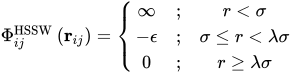
and the orientational component is given by (Eq. 3)

where is the solid angle of a patch (Failed to parse (SVG (MathML can be enabled via browser plugin): Invalid response ("Math extension cannot connect to Restbase.") from server "https://wikimedia.org/api/rest_v1/":): {\displaystyle \alpha, \beta, ...} ) whose axis is Failed to parse (SVG (MathML can be enabled via browser plugin): Invalid response ("Math extension cannot connect to Restbase.") from server "https://wikimedia.org/api/rest_v1/":): {\displaystyle \hat{e}} (see Fig. 1 of Ref. 1), forming a conical segment.

Multiple patches[edit]
The "two-patch" and "four-patch" Bol (Chapman or Kern and Frenkel) model was extensively studied by Chapman and co-workers for bulk and interfacial systems using hard sphere and Lennard-Jones reference systems. Later other groups, including Sciortino and co-workers, considered stronger association energies for the "two-patch" hard sphere reference [5][6][7].
Four patches[edit]
- Main article: Anisotropic particles with tetrahedral symmetry
Single-bond-per-patch-condition[edit]
If the two parameters Failed to parse (SVG (MathML can be enabled via browser plugin): Invalid response ("Math extension cannot connect to Restbase.") from server "https://wikimedia.org/api/rest_v1/":): {\displaystyle \delta} and fullfil the condition

- Failed to parse (SVG (MathML can be enabled via browser plugin): Invalid response ("Math extension cannot connect to Restbase.") from server "https://wikimedia.org/api/rest_v1/":): {\displaystyle \sin{\delta} \leq \dfrac{1}{2(1+\lambda\sigma)} }
then the patch cannot be involved in more than one bond. Enforcing this condition makes it possible to compare the simulations results with Wertheim theory [3][5][7]
Hard ellipsoid model[edit]
The hard ellipsoid model has also been used as the 'nucleus' of the Kern and Frenkel patchy model [8].
References[edit]
- ↑ Norbert Kern and Daan Frenkel "Fluid–fluid coexistence in colloidal systems with short-ranged strongly directional attraction", Journal of Chemical Physics 118, 9882 (2003)
- ↑ W. Bol "Monte Carlo simulations of fluid systems of waterlike molecules", Molecular Physics 45 pp. 605-616 (1982)
- ↑ 3.0 3.1 [W.G. Chapman, Doctoral Thesis, Cornell University (1988)]
- ↑ [G. Jackson, W.G. Chapman, K.E. Gubbins, Molecular Physics 65, 1-31 (1988)]
- ↑ 5.0 5.1 F. Sciortino, E. Bianchi, J. Douglas and P. Tartaglia "Self-assembly of patchy particles into polymer chains: A parameter-free comparison between Wertheim theory and Monte Carlo simulation", Journal of Chemical Physics 126 194903 (2007)
- ↑ Achille Giacometti, Fred Lado, Julio Largo, Giorgio Pastore, and Francesco Sciortino "Effects of patch size and number within a simple model of patchy colloids", Journal of Chemical Physics 132, 174110 (2010)
- ↑ 7.0 7.1 José Maria Tavares, Lorenzo Rovigatti, and Francesco Sciortino "Quantitative description of the self-assembly of patchy particles into chains and rings", Journal of Chemical Physics 137 044901 (2012)
- ↑ T. N. Carpency, J. D. Gunton and J. M. Rickman "Phase behavior of patchy spheroidal fluids", Journal of Chemical Physics 145 214904 (2016)
- Related reading
- Christoph Gögelein, Flavio Romano, Francesco Sciortino, and Achille Giacometti "Fluid-fluid and fluid-solid transitions in the Kern-Frenkel model from Barker-Henderson thermodynamic perturbation theory", Journal of Chemical Physics 136 094512 (2012)
- Emanuela Bianchi, Günther Doppelbauer, Laura Filion, Marjolein Dijkstra, and Gerhard Kahl "Predicting patchy particle crystals: Variable box shape simulations and evolutionary algorithms", Journal of Chemical Physics 136 214102 (2012)
- Z. Preisler, T. Vissers, F. Smallenburg and F. Sciortino "Crystals of Janus colloids at various interaction ranges", Journal of Chemical Physics 145 064513 (2016)