Diffusion: Difference between revisions
No edit summary |
Carl McBride (talk | contribs) (Added a recent publication) |
||
| (8 intermediate revisions by 3 users not shown) | |||
| Line 1: | Line 1: | ||
Diffusion is the process behind Brownian motion. It was described | '''Diffusion''' is the process behind [[Brownian motion]]. It was described | ||
by [[Albert Einstein]] in one of his annus mirabilis | by [[Albert Einstein]] in one of his ''annus mirabilis'' papers of 1905. | ||
The diffusion equation | What follows applies to homogeneous systems, see [[diffusion at interfaces]] | ||
for a non-homogeneous case. | |||
The diffusion equation that describes this process is | |||
:<math>\frac{\partial P(r,t)}{\partial t}= D \nabla^2 P(z,t),</math> | :<math>\frac{\partial P(r,t)}{\partial t}= D \nabla^2 P(z,t),</math> | ||
where <math>D</math> is the (self-)'''diffusion coefficient'''. | where <math>D</math> is the (self-)'''diffusion coefficient'''. | ||
For initial conditions for a Dirac delta function at the origin, and | For initial conditions for a [[Dirac delta distribution |Dirac delta function]] at the origin, and | ||
boundary conditions that force the vanishing of <math>P(r,t)</math> | boundary conditions that force the vanishing of <math>P(r,t)</math> | ||
and its gradient at large distances, the solution factorizes as <math>P(r,t)=P(x,t)P(y,t)P(z,t)</math>, | and its gradient at large distances, the solution factorizes as <math>P(r,t)=P(x,t)P(y,t)P(z,t)</math>, | ||
with a spreading Gaussian for each of the Cartesian components: | with a spreading [[Gaussian distribution |Gaussian]] for each of the Cartesian components: | ||
:<math> P(x,t)=\frac{1}{\sqrt{4\pi D t}} \exp | :<math> P(x,t)=\frac{1}{\sqrt{4\pi D t}} \exp | ||
\left[ - \frac{x^2}{4 D t} \right]. </math> | \left[ - \frac{x^2}{4 D t} \right]. </math> | ||
| Line 13: | Line 16: | ||
==Einstein relation== | ==Einstein relation== | ||
It follows from the previous equation that, for each of the Cartesian components, e.g. <math>x</math>: | |||
:<math>D = \lim_{t \rightarrow \infty} \frac{1}{ | :<math>D = \lim_{t \rightarrow \infty} \frac{1}{2t} \langle \vert x_i(t) - x_i(0) \vert^2\rangle </math>, | ||
for every particle <math>i</math>. Therefore, an average over all particles can be employed in | |||
order to improve statistics. The same applies to time averaging: in equilibrium the average | |||
from <math>0</math> to <math>t</math> must equal the average from <math>\tau</math> to <math>t+\tau</math>, | |||
so several time segments from the same simulation may be averaged for a given interval [2]. | |||
Adding all components, the following also applies: | |||
:<math>D = \lim_{t \rightarrow \infty} \frac{1}{6t } \langle \vert \mathbf{r}_i(t) - \mathbf{r}_i(0) \vert^2\rangle </math> | |||
==Green-Kubo relation== | ==Green-Kubo relation== | ||
:''Main article: [[Green-Kubo relations]]'' | |||
:<math>D = \frac{1}{3} \int_0^\infty \langle v_i(t) \cdot v_i(0)\rangle ~dt</math> | :<math>D = \frac{1}{3} \int_0^\infty \langle v_i(t) \cdot v_i(0)\rangle ~dt</math> | ||
where <math>v_i(t)</math> is the center of mass | where <math>v_i(t)</math> is the center of mass velocity of molecule <math>i</math>. Note | ||
that this connect the diffusion coefficient with the velocity [[autocorrelation]]. | |||
==See also== | |||
*[[Rotational diffusion]] | |||
==References== | |||
<references/> | |||
;Related reading | |||
*[http://books.google.es/books?id=XmyO2oRUg0cC&dq=understanding+molecular+simulations&psp=1 Daan Frenkel and Berend Smit "Understanding Molecular Simulation: From Algorithms to Applications". Academic Press 2002] | |||
*[http://dx.doi.org/10.1063/1.1786579 Karsten Meier, Arno Laesecke, and Stephan Kabelac "Transport coefficients of the Lennard-Jones model fluid. II Self-diffusion" J. Chem. Phys. '''121''' pp. 9526-9535 (2004)] | |||
*[http://dx.doi.org/10.1080/00268970701348758 G. L. Aranovich and M. D. Donohue "Limitations and generalizations of the classical phenomenological model for diffusion in fluids", Molecular Physics '''105''' 1085-1093 (2007)] | |||
*[http://dx.doi.org/10.1080/00268976.2013.837534 P.-A. Artola and B. Rousseau "Thermal diffusion in simple liquid mixtures: what have we learnt from molecular dynamics simulations?", Molecular Physics '''111''' pp. 3394-3403 (2013)] | |||
*[http://dx.doi.org/10.1063/1.4921958 Sunghan Roh, Juyeon Yi and Yong Woon Kim "Analysis of diffusion trajectories of anisotropic objects", Journal of Chemical Physics '''142''' 214302 (2015)] | |||
[[Category: Non-equilibrium thermodynamics]] | [[Category: Non-equilibrium thermodynamics]] | ||
Latest revision as of 12:05, 23 June 2015
Diffusion is the process behind Brownian motion. It was described by Albert Einstein in one of his annus mirabilis papers of 1905. What follows applies to homogeneous systems, see diffusion at interfaces for a non-homogeneous case.
The diffusion equation that describes this process is
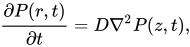
where is the (self-)diffusion coefficient. For initial conditions for a Dirac delta function at the origin, and boundary conditions that force the vanishing of and its gradient at large distances, the solution factorizes as , with a spreading Gaussian for each of the Cartesian components:



![{\displaystyle P(x,t)={\frac {1}{\sqrt {4\pi Dt}}}\exp \left[-{\frac {x^{2}}{4Dt}}\right].}](https://wikimedia.org/api/rest_v1/media/math/render/svg/c56512f82267336bdb222fb60aa27f46ed71dea4)
Einstein relation[edit]
It follows from the previous equation that, for each of the Cartesian components, e.g. :

- ,

for every particle . Therefore, an average over all particles can be employed in order to improve statistics. The same applies to time averaging: in equilibrium the average from to must equal the average from to , so several time segments from the same simulation may be averaged for a given interval [2]. Adding all components, the following also applies:



Green-Kubo relation[edit]
- Main article: Green-Kubo relations
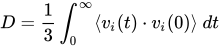
where is the center of mass velocity of molecule . Note that this connect the diffusion coefficient with the velocity autocorrelation.

See also[edit]
References[edit]
- Related reading
- Daan Frenkel and Berend Smit "Understanding Molecular Simulation: From Algorithms to Applications". Academic Press 2002
- Karsten Meier, Arno Laesecke, and Stephan Kabelac "Transport coefficients of the Lennard-Jones model fluid. II Self-diffusion" J. Chem. Phys. 121 pp. 9526-9535 (2004)
- G. L. Aranovich and M. D. Donohue "Limitations and generalizations of the classical phenomenological model for diffusion in fluids", Molecular Physics 105 1085-1093 (2007)
- P.-A. Artola and B. Rousseau "Thermal diffusion in simple liquid mixtures: what have we learnt from molecular dynamics simulations?", Molecular Physics 111 pp. 3394-3403 (2013)
- Sunghan Roh, Juyeon Yi and Yong Woon Kim "Analysis of diffusion trajectories of anisotropic objects", Journal of Chemical Physics 142 214302 (2015)