Surface tension
The surface tension, , is a measure of the work required to create an interface between two bulk phases.

Thermodynamics
In the Canonical ensemble the surface tension is formally given as:
- ;
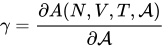
where
- Failed to parse (SVG (MathML can be enabled via browser plugin): Invalid response ("Math extension cannot connect to Restbase.") from server "https://wikimedia.org/api/rest_v1/":): {\displaystyle A} is the Helmholtz energy function
- Failed to parse (SVG (MathML can be enabled via browser plugin): Invalid response ("Math extension cannot connect to Restbase.") from server "https://wikimedia.org/api/rest_v1/":): {\displaystyle N } is the number of particles
- Failed to parse (SVG (MathML can be enabled via browser plugin): Invalid response ("Math extension cannot connect to Restbase.") from server "https://wikimedia.org/api/rest_v1/":): {\displaystyle V } is the volume
- Failed to parse (SVG (MathML can be enabled via browser plugin): Invalid response ("Math extension cannot connect to Restbase.") from server "https://wikimedia.org/api/rest_v1/":): {\displaystyle T } is the temperature
- Failed to parse (SVG (MathML can be enabled via browser plugin): Invalid response ("Math extension cannot connect to Restbase.") from server "https://wikimedia.org/api/rest_v1/":): {\displaystyle {\mathcal A} } is the surface area
Computer Simulation
Different techniques may be used to compute this quantity, such as the traditional stress tensor route. More recently, several methods have been proposed which avoid the some times difficult calculation of the stress tensor, e.g., the test area method and wandering interface method. A review can be found in the paper by Gloor et al. [1].
Liquid-Vapour Interfaces of one component systems
Binder procedure
Here, only an outline of the procedure is presented, more details can be found in [2]. For given conditions of volume and temperature, the Helmholtz energy function is computed as a function of the number of molecules, Failed to parse (SVG (MathML can be enabled via browser plugin): Invalid response ("Math extension cannot connect to Restbase.") from server "https://wikimedia.org/api/rest_v1/":): {\displaystyle A(N;V,T)} . The calculation is usually carried out using Monte Carlo simulation using periodic boundary conditions If liquid-vapour equilibrium occurs, a plot of the chemical potential, Failed to parse (SVG (MathML can be enabled via browser plugin): Invalid response ("Math extension cannot connect to Restbase.") from server "https://wikimedia.org/api/rest_v1/":): {\displaystyle \mu \equiv (\partial A/\partial N)_{V,T} } , as a function of Failed to parse (SVG (MathML can be enabled via browser plugin): Invalid response ("Math extension cannot connect to Restbase.") from server "https://wikimedia.org/api/rest_v1/":): {\displaystyle N } shows a loop. Using basic thermodynamic procedures (Maxwell's equal area construction) it is possible to compute the densities of the two phases; Failed to parse (SVG (MathML can be enabled via browser plugin): Invalid response ("Math extension cannot connect to Restbase.") from server "https://wikimedia.org/api/rest_v1/":): {\displaystyle \rho_v, \rho_l } at liquid-vapour equilibrium. Considering the thermodynamic limit for densities Failed to parse (SVG (MathML can be enabled via browser plugin): Invalid response ("Math extension cannot connect to Restbase.") from server "https://wikimedia.org/api/rest_v1/":): {\displaystyle \rho } with Failed to parse (SVG (MathML can be enabled via browser plugin): Invalid response ("Math extension cannot connect to Restbase.") from server "https://wikimedia.org/api/rest_v1/":): {\displaystyle \rho_v < \rho < \rho_l } the Helmholtz energy function will be:
- Failed to parse (SVG (MathML can be enabled via browser plugin): Invalid response ("Math extension cannot connect to Restbase.") from server "https://wikimedia.org/api/rest_v1/":): {\displaystyle A(N) = - p_{eq} V + \mu_{eq} N + \gamma {\mathcal A}(N) }
where the quantities with the subindex "eq" are those corresponding to the fluid-phase equilibrium situation. From the previous equation one can write
- Failed to parse (SVG (MathML can be enabled via browser plugin): Invalid response ("Math extension cannot connect to Restbase.") from server "https://wikimedia.org/api/rest_v1/":): {\displaystyle \Omega (N) \equiv A(N) - \mu_{eq} N = - p_{eq} V + \gamma {\mathcal A}(N) } .
For appropriate values of Failed to parse (SVG (MathML can be enabled via browser plugin): Invalid response ("Math extension cannot connect to Restbase.") from server "https://wikimedia.org/api/rest_v1/":): {\displaystyle N } one can estimate the value of the surface area, Failed to parse (SVG (MathML can be enabled via browser plugin): Invalid response ("Math extension cannot connect to Restbase.") from server "https://wikimedia.org/api/rest_v1/":): {\displaystyle {\mathcal A} } (See MacDowell et al. [3]), and compute Failed to parse (SVG (MathML can be enabled via browser plugin): Invalid response ("Math extension cannot connect to Restbase.") from server "https://wikimedia.org/api/rest_v1/":): {\displaystyle \gamma } directly as:
- Failed to parse (SVG (MathML can be enabled via browser plugin): Invalid response ("Math extension cannot connect to Restbase.") from server "https://wikimedia.org/api/rest_v1/":): {\displaystyle \gamma = \frac{ \Omega(N) + p_{eq} V } { {\mathcal A}(N) } = \frac{ \Omega(N) - \frac{1}{2}(\Omega(N_l)+\Omega(N_v)) }{{\mathcal A}(N)} }
where Failed to parse (SVG (MathML can be enabled via browser plugin): Invalid response ("Math extension cannot connect to Restbase.") from server "https://wikimedia.org/api/rest_v1/":): {\displaystyle N_l } and Failed to parse (SVG (MathML can be enabled via browser plugin): Invalid response ("Math extension cannot connect to Restbase.") from server "https://wikimedia.org/api/rest_v1/":): {\displaystyle N_v } are given by: Failed to parse (SVG (MathML can be enabled via browser plugin): Invalid response ("Math extension cannot connect to Restbase.") from server "https://wikimedia.org/api/rest_v1/":): {\displaystyle N_l = V \cdot \rho_l } and Failed to parse (SVG (MathML can be enabled via browser plugin): Invalid response ("Math extension cannot connect to Restbase.") from server "https://wikimedia.org/api/rest_v1/":): {\displaystyle N_v = V \cdot \rho_v }
Explicit interfaces
In these methods one performs a direct simulation of the two-phase system. Periodic boundary conditions are usually employed. Simulation boxes are elongated in one direction, and the interfaces are built (and expected to stay) perpendicular to such a direction. Taking into account the canonical ensemble definition (see above), one computes the change in the Helmholtz energy function when a small (differential) change of the surface area is performed at constant Failed to parse (SVG (MathML can be enabled via browser plugin): Invalid response ("Math extension cannot connect to Restbase.") from server "https://wikimedia.org/api/rest_v1/":): {\displaystyle V, T, } and Failed to parse (SVG (MathML can be enabled via browser plugin): Invalid response ("Math extension cannot connect to Restbase.") from server "https://wikimedia.org/api/rest_v1/":): {\displaystyle N } . The explicit equations can be written in terms of the diagonal components of the pressure tensor of the system. Mechanical arguments can also be invoked to arrive at equivalent conclusions (see Ref [1] for a detailed discussion of these issues).
System-size analysis
The system-size dependence of the results for Failed to parse (SVG (MathML can be enabled via browser plugin): Invalid response ("Math extension cannot connect to Restbase.") from server "https://wikimedia.org/api/rest_v1/":): {\displaystyle \gamma } have to be taken into account in order to obtain accurate results for model systems. Spurious effects that occur due to small system sizes can appear in the explicit interface methods. (See P.Orea et al. [4]).
Mixtures
Different ensembles can be used to compute the surface tension between two phases in the case of mixtures (See for example see Y. Zhang et al. [5]). The simulation techniques are essentially the same as those for one-component systems, but different ensembles can be more adequate. For instance, for binary mixtures (with components 1 and 2), the isothermal-isobaric ensemble, Failed to parse (SVG (MathML can be enabled via browser plugin): Invalid response ("Math extension cannot connect to Restbase.") from server "https://wikimedia.org/api/rest_v1/":): {\displaystyle N_1,N_2,p.T } is a more natural ensemble to compute Failed to parse (SVG (MathML can be enabled via browser plugin): Invalid response ("Math extension cannot connect to Restbase.") from server "https://wikimedia.org/api/rest_v1/":): {\displaystyle \gamma } using explicit interface techniques (See Ref. [6] as an example). In the case of the Binder technique the analysis can be carried out by fixing the total number of particles: Failed to parse (SVG (MathML can be enabled via browser plugin): Invalid response ("Math extension cannot connect to Restbase.") from server "https://wikimedia.org/api/rest_v1/":): {\displaystyle N \equiv N_1 + N_2 } , the pressure, Failed to parse (SVG (MathML can be enabled via browser plugin): Invalid response ("Math extension cannot connect to Restbase.") from server "https://wikimedia.org/api/rest_v1/":): {\displaystyle p } , and the temperature Failed to parse (SVG (MathML can be enabled via browser plugin): Invalid response ("Math extension cannot connect to Restbase.") from server "https://wikimedia.org/api/rest_v1/":): {\displaystyle T } . Then one will have to compute the variation of the adequate thermodynamic potential as a function of the composition, e.g. Failed to parse (SVG (MathML can be enabled via browser plugin): Invalid response ("Math extension cannot connect to Restbase.") from server "https://wikimedia.org/api/rest_v1/":): {\displaystyle x_1 = N_1/N } .
See also
References
- ↑ 1.0 1.1 Guy J. Gloor, George Jackson, Felipe J. Blas and Enrique de Miguel "Test-area simulation method for the direct determination of the interfacial tension of systems with continuous or discontinuous potentials", Journal of Chemical Physics 123 134703 (2005)
- ↑ K. Binder "Monte Carlo calculation of the surface tension for two- and three-dimensional lattice-gas models", Physical Review A 25 pp. 1699 - 1709 (1982)
- ↑ L. G. MacDowell, V. K. Shen, and J. R. Errington "Nucleation and cavitation of spherical, cylindrical, and slablike droplets and bubbles in small systems", Journal of Chemical Physics 125 034705 (2006)
- ↑ Pedro Orea, Jorge López-Lemus, and José Alejandre, "Oscillatory surface tension due to finite-size effects", Journal of Chemical Physics 123 114702 (6 pages) (2005)
- ↑ Yuhong Zhang, Scott E. Feller, Bernard R. Brooks, and Richard W. Pastor, "Computer simulation of liquid/liquid interfaces. I. Theory and application to octane/water", Journal of Chemical Physics, 103, pp. 10252-10266 (1995)
- ↑ E. de Miguel, N. G. Almarza, and G. Jackson, "Surface tension of the Widom-Rowlinson model", Journal of Chemical Physics, 127, 034707 (10 pages) (2007)
- Related reading
- John G. Kirkwood and Frank P. Buff "The Statistical Mechanical Theory of Surface Tension", Journal of Chemical Physics 17 pp. 338-343 (1949)
- Charles H. Bennett "Efficient estimation of free energy differences from Monte Carlo data", Journal of Computational Physics 22 pp. 245-268 (1976)
- J. Miyazaki, J. A. Barker and G. M. Pound "A new Monte Carlo method for calculating surface tension", Journal of Chemical Physics 64 pp. 3364-3369 (1976)
- A. Maslechko, K. Glavatskiy, V.L. Kulinskii "Surface tension of molecular liquids: Lattice gas approach", Journal of Molecular Liquids 235 pp. 119-125 (2017)
- Stephan Werth, Martin Horsch and Hans Hasse "Molecular simulation of the surface tension of 33 multi-site models for real fluids", Journal of Molecular Liquids 235 pp. 126-134 (2017)