Parallel hard cubes
Parallel hard cubes are a simple particle model used in statistical mechanics. They were introduced by B. T. Geilikman [1] in 1950. The virial equation of state (pressure as a power series in the density) was studied by Zwanzig, Temperley, Hoover, and De Rocco [2][3]. The latter two authors computed seven-term series for the models [3]. Both the sixth and seventh terms in the hard-cube series are negative, a counter-intuitive result for repulsive interactions. In 1998 E. A. Jagla [4] investigated the melting transition for both parallel and rotating cube models, finding a qualitative difference in the nature of the transition for the two models. In that same year Martinez-Raton and Cuesta described cubes and mixtures of cubes (See Mixtures [3]).
Usefulness of the Model
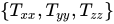
Parallel hard cubes have another use, beyond providing a simple model for which seven terms in the Mayers' virial series can be evaluated. In 2009 the Hoovers pointed out [5] that these models can be used as "ideal gas thermometers" capable of measuring the tensor temperature components . Kinetic theory shows that particles colliding with a hard-cube Maxwell-Boltzmann ideal gas at temperature will lose or gain energy according to whether the particle kinetic temperature exceeds or not. The independence of the temperature components for the hard parallel cubes (or squares in two dimensions) allows them to serve as gedanken-experiment thermometers for all three temperature components.

Mixtures
References
- ↑ B. T. Geilikman "", Proceedings of the Academy of Science of the USSR 70 pp. 25- (1950)
- ↑ Robert W. Zwanzig "Virial Coefficients of "Parallel Square" and "Parallel Cube" Gases", Journal of Chemical Physics 24 pp. 855-856 (1956)
- ↑ 3.0 3.1 3.2 William G. Hoover and Andrew G. De Rocco, "Sixth and Seventh Virial Coefficients for the Parallel Hard-Cube Model", Journal of Chemical Physics 36 pp. 3141- (1962)
- ↑ E. A. Jagla "Melting of hard cubes", Physical Review E 58 pp. 4701-4705 (1998)
- ↑ Wm. G. Hoover and C. G. Hoover "Nonlinear stresses and temperatures in transient adiabatic and shear flows via nonequilibrium molecular dynamics: Three definitions of temperature", Physical Review E 79 046705 (2009)
- ↑ José A. Cuesta "Fluid Mixtures of Parallel Hard Cubes", Physical Review Letters 76 pp. 3742-3745 (1996)
- ↑ José A. Cuesta and Yuri Martínez-Ratón "Fundamental measure theory for mixtures of parallel hard cubes. I. General formalism", Journal of Chemical Physics 107 pp. 6379- (1997)
- ↑ Yuri Martínez-Ratón and José A. Cuesta "Fundamental measure theory for mixtures of parallel hard cubes. II. Phase behavior of the one-component fluid and of the binary mixture", Journal of Chemical Physics 111 pp. 317- (1999)
- Related reading
- William G. Hoover, "High-Density Equation of State of Hard Parallel Squares and Cubes", Journal of Chemical Physics 40 pp. 937- (1964)
- T. R. Kirkpatrick "Ordering in the parallel hard hypercube gas", Journal of Chemical Physics 85 pp. 3515-3519 (1986)
- José A. Cuesta and Yuri Martínez-Ratón "Dimensional Crossover of the Fundamental-Measure Functional for Parallel Hard Cubes", Physical Review Letters 78 pp. 3681-3684 (1997)
- S. Belli, M. Dijkstra, and R. van Roij "Free minimization of the fundamental measure theory functional: Freezing of parallel hard squares and cubes", Journal of Chemical Physics 137 124506 (2012)