Order parameters
An order parameter is some observable physical quantity that is able to distinguish between two distinct phases. The choice of order parameter is not necessarily unique.
Solid-liquid transition[edit]
Possible choices:
- Fourier transform of the density
- Shear modulus
Isotropic-nematic transition[edit]
The uniaxial order parameter is zero for an isotropic fluid and one for a perfectly aligned system. First one calculates a director vector [1]

where is a second rank tensor, is a unit vector along the molecular long axis, and is the Kronecker delta. Diagonalisation of this tensor gives three eigenvalues , and , and is the eigenvector associated with the largest eigenvalue (). From this director vector the nematic order parameter is calculated from [2]


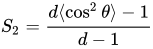
where d is the dimensionality of the system.
i.e. in three dimensions [3]

where is known as the uniaxial order parameter. Here is the second order Legendre polynomial, is the angle between a molecular axes and the director , and the angle brackets indicate an ensemble average.


Tetrahedral order parameter[edit]
See also[edit]
References[edit]
- ↑ R. Eppenga and D. Frenkel "Monte Carlo study of the isotropic and nematic phases of infinitely thin hard platelets", Molecular Physics 52 pp. 1303-1334 (1984)
- ↑ Anna A. Mercurieva, Tatyana M. Birshtein "Liquid-crystalline ordering in two-dimensional systems with discrete symmetry", Die Makromolekulare Chemie, Theory and Simulations 1 pp. 205-214 (1992)
- ↑ Mark R. Wilson "Determination of order parameters in realistic atom-based models of liquid crystal systems", Journal of Molecular Liquids 68 pp. 23-31 (1996)
- ↑ P. -L. Chau and A. J. Hardwick "A new order parameter for tetrahedral configurations", Molecular Physics 93 pp. 511-518 (1998)
- Related reading
- Joseph P. Straley "Ordered phases of a liquid of biaxial particles", Physical Review A 10 pp. 1881 - 1887 (1974)
- Denis Merlet, James W. Emsley, Philippe Lesot and Jacques Courtieu "The relationship between molecular symmetry and second-rank orientational order parameters for molecules in chiral liquid crystalline solvents", Journal of Chemical Physics 111 pp. 6890-6896 (1999)
- Erik E. Santiso and Bernhardt L. Trout "A general set of order parameters for molecular crystals", Journal of Chemical Physics 134 064109 (2011)