Hard disk model

|
This article is a 'stub' page, it has no, or next to no, content. It is here at the moment to help form part of the structure of SklogWiki. If you add sufficient material to this article then please remove the {{Stub-general}} template from this page. |
Hard disks are hard spheres in two dimensions. The hard disk intermolecular pair potential is given by
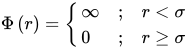
where is the intermolecular pair potential between two disks at a distance , and is the diameter of the disk.


Equations of state
- Main article: Equations of state for hard disks
Virial coefficients
- Main article: Hard sphere: virial coefficients
External links
- Hard disks and spheres computer code on SMAC-wiki.
References
- Nicholas Metropolis, Arianna W. Rosenbluth, Marshall N. Rosenbluth, Augusta H. Teller and Edward Teller, "Equation of State Calculations by Fast Computing Machines", Journal of Chemical Physics 21 pp.1087-1092 (1953)
- Ya G Sinai "Dynamical systems with elastic reflections", Russian Mathematical Surveys 25 pp. 137-189 (1970)
- Katherine J. Strandburg, John A. Zollweg, and G. V. Chester "Bond-angular order in two-dimensional Lennard-Jones and hard-disk systems", Physical Review B 30 pp. 2755 - 2759 (1984)
- Carl McBride and Carlos Vega "Fluid solid equilibrium for two dimensional tangent hard disk chains from Wertheim's perturbation theory", Journal of Chemical Physics 116 pp. 1757-1759 (2002)
- Nándor Simányi "Proof of the Boltzmann-Sinai ergodic hypothesis for typical hard disk systems", Inventiones Mathematicae 154 pp. 123-178 (2003)