Potts model

|
This article is a 'stub' page, it has no, or next to no, content. It is here at the moment to help form part of the structure of SklogWiki. If you add sufficient material to this article then please remove the {{Stub-general}} template from this page. |
The Potts model was proposed by Renfrey B. Potts in 1952 (Ref. 1). The Potts model is a generalisation of the Ising model to more than two components.
For a general discussion on Potts models see Ref.2.
In practice one has a lattice system. The sites of the lattice can be occupied by particles of different species, .

The energy of the system, , is defined as:

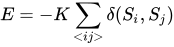
where is the coupling constant, indicates that the sum is done exclusively over pairs of nearest neighbor sites, and is the Kronecker delta.


The particular case is equivalent to the Ising model

See also
References
- Renfrey B. Potts "Some generalized order-disorder transformations", Proceedings of the Cambridge Philosophical Society 48 pp. 106−109 (1952)
- F. Y. Wu "The Potts model", Reviews of Modern Physics 54 pp. 235-268 (1982)
- F. Y. Wu "Erratum: The Potts model", Reviews of Modern Physics 55 p. 315 (1983)