Partition function
The canonical ensemble partition function of a system in contact with a thermal bath at temperature is the normalization constant of the Boltzmann distribution function, and therefore its expression is given by

- Failed to parse (Conversion error. Server ("https://wikimedia.org/api/rest_") reported: "Cannot get mml. Server problem."): {\displaystyle \left.Z\right.={\mathrm {Tr} }\{e^{-\beta H}\}}
where H is the Hamiltonian, or as
- Failed to parse (Conversion error. Server ("https://wikimedia.org/api/rest_") reported: "Cannot get mml. Server problem."): {\displaystyle Z(T)=\int \Omega (E)\exp(-E/k_{B}T)\,dE} ,
where is the density of states with energy and the Boltzmann constant. The symbol Z is from the German Zustandssumme meaning "sum over states".


Helmholtz energy function
The partition function of a system is related to the Helmholtz energy function through the formula
- Failed to parse (Conversion error. Server ("https://wikimedia.org/api/rest_") reported: "Cannot get mml. Server problem."): {\displaystyle \left.A\right.=-k_{B}T\log Z.}
This connection can be derived from the fact that Failed to parse (Conversion error. Server ("https://wikimedia.org/api/rest_") reported: "Cannot get mml. Server problem."): {\displaystyle k_{B}\log \Omega (E)} is the entropy of a system with total energy . This is an extensive magnitude in the sense that, for large systems (i.e. in the thermodynamic limit, when the number of particles Failed to parse (Conversion error. Server ("https://wikimedia.org/api/rest_") reported: "Cannot get mml. Server problem."): {\displaystyle N\to \infty } or the volume Failed to parse (Conversion error. Server ("https://wikimedia.org/api/rest_") reported: "Cannot get mml. Server problem."): {\displaystyle V\to \infty } ), it is proportional to or . In other words, if we assume Failed to parse (SVG (MathML can be enabled via browser plugin): Invalid response ("Math extension cannot connect to Restbase.") from server "https://wikimedia.org/api/rest_v1/":): {\displaystyle N} large, then


- Failed to parse (SVG (MathML can be enabled via browser plugin): Invalid response ("Math extension cannot connect to Restbase.") from server "https://wikimedia.org/api/rest_v1/":): {\displaystyle \left.k_B\right. \log\Omega(E)=Ns(e),}
where Failed to parse (SVG (MathML can be enabled via browser plugin): Invalid response ("Math extension cannot connect to Restbase.") from server "https://wikimedia.org/api/rest_v1/":): {\displaystyle s(e)} is the entropy per particle in the thermodynamic limit, which is a function of the energy per particle Failed to parse (SVG (MathML can be enabled via browser plugin): Invalid response ("Math extension cannot connect to Restbase.") from server "https://wikimedia.org/api/rest_v1/":): {\displaystyle e=E/N} . We can therefore write
- Failed to parse (SVG (MathML can be enabled via browser plugin): Invalid response ("Math extension cannot connect to Restbase.") from server "https://wikimedia.org/api/rest_v1/":): {\displaystyle \left.Z(T)\right.=N\int \exp\{N(s(e)-e/T)/k_B\}\,de.}
Since Failed to parse (SVG (MathML can be enabled via browser plugin): Invalid response ("Math extension cannot connect to Restbase.") from server "https://wikimedia.org/api/rest_v1/":): {\displaystyle N} is large, this integral can be performed through steepest descent, and we obtain
- Failed to parse (SVG (MathML can be enabled via browser plugin): Invalid response ("Math extension cannot connect to Restbase.") from server "https://wikimedia.org/api/rest_v1/":): {\displaystyle \left.Z(T)\right.=N\exp\{N(s(e_0)-e_0/k_BT)\}} ,
where Failed to parse (SVG (MathML can be enabled via browser plugin): Invalid response ("Math extension cannot connect to Restbase.") from server "https://wikimedia.org/api/rest_v1/":): {\displaystyle e_0} is the value that maximizes the argument in the exponential; in other words, the solution to
- Failed to parse (SVG (MathML can be enabled via browser plugin): Invalid response ("Math extension cannot connect to Restbase.") from server "https://wikimedia.org/api/rest_v1/":): {\displaystyle \left.s'(e_0)\right.=1/T.}
This is the thermodynamic formula for the inverse temperature provided Failed to parse (SVG (MathML can be enabled via browser plugin): Invalid response ("Math extension cannot connect to Restbase.") from server "https://wikimedia.org/api/rest_v1/":): {\displaystyle e_0} is the mean energy per particle of the system. On the other hand, the argument in the exponential is
- Failed to parse (Conversion error. Server ("https://wikimedia.org/api/rest_") reported: "Cannot get mml. Server problem."): {\displaystyle {\frac {1}{k_{B}T}}(TS(E_{0})-E_{0})=-{\frac {A}{k_{B}T}}}
the thermodynamic definition of the Helmholtz energy function. Thus, when Failed to parse (SVG (MathML can be enabled via browser plugin): Invalid response ("Math extension cannot connect to Restbase.") from server "https://wikimedia.org/api/rest_v1/":): {\displaystyle N} is large,
- Failed to parse (SVG (MathML can be enabled via browser plugin): Invalid response ("Math extension cannot connect to Restbase.") from server "https://wikimedia.org/api/rest_v1/":): {\displaystyle \left.A\right.=-k_BT\log Z(T).}
Connection with thermodynamics
We have the aforementioned Helmholtz energy function,
- Failed to parse (SVG (MathML can be enabled via browser plugin): Invalid response ("Math extension cannot connect to Restbase.") from server "https://wikimedia.org/api/rest_v1/":): {\displaystyle \left.A\right.=-k_BT\log Z(T)}
we also have the internal energy, which is given by
- Failed to parse (SVG (MathML can be enabled via browser plugin): Invalid response ("Math extension cannot connect to Restbase.") from server "https://wikimedia.org/api/rest_v1/":): {\displaystyle U=k_B T^{2} \left. \frac{\partial \log Z(T)}{\partial T} \right\vert_{N,V}}
and the pressure, which is given by
- .
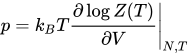
These equations provide a link between classical thermodynamics and statistical mechanics