Andersen thermostat
The Andersen thermostat (Ref. 1, section IV) couples the system to a heat bath via stochastic forces that modify the kinetic energy of the atoms or molecules. The time between collisions, or the number of collisions in some (short) time interval is decided randomly, with the following Poisson distribution (Ref. 1 Eq. 4.1):
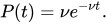
where is the stochastic collision frequency. Between collisions the system evolves at constant energy, i.e. business as usual. Upon a 'collision event' the new momentum of the lucky atom (or molecule) is chosen at random from a Boltzmann distribution at temperature . In principle can adopt any value. However, there does exist an optimum choice (Ref. 1 Eq. 4.9):


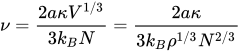
where is a dimensionless constant, is the thermal conductivity, is the volume, Failed to parse (SVG (MathML can be enabled via browser plugin): Invalid response ("Math extension cannot connect to Restbase.") from server "https://wikimedia.org/api/rest_v1/":): {\displaystyle k_B} is the Boltzmann constant, and Failed to parse (SVG (MathML can be enabled via browser plugin): Invalid response ("Math extension cannot connect to Restbase.") from server "https://wikimedia.org/api/rest_v1/":): {\displaystyle \rho} is the number density of particles; Failed to parse (SVG (MathML can be enabled via browser plugin): Invalid response ("Math extension cannot connect to Restbase.") from server "https://wikimedia.org/api/rest_v1/":): {\displaystyle \rho:=N/V} .


Note: the Andersen thermostat should only be used for time-independent properties. Dynamic properties, such as the diffusion, should not be calculated if the system is thermostated using the Andersen algorithm (Ref. 2)
See also
References
- Hans C. Andersen "Molecular dynamics simulations at constant pressure and/or temperature", Journal of Chemical Physics 72 pp. 2384-2393 (1980)
- H. Tanaka, Koichiro Nakanishi, and Nobuatsu Watanabe "Constant temperature molecular dynamics calculation on Lennard-Jones fluid and its application to water", Journal of Chemical Physics 78 pp. 2626-2634 (1983)