Charge equilibration for molecular dynamics simulations

|
This article is a 'stub' page, it has no, or next to no, content. It is here at the moment to help form part of the structure of SklogWiki. If you add sufficient material to this article then please remove the {{Stub-general}} template from this page. |
Charge equilibration (QEq) for molecular dynamics simulations [1] [2] is a technique for calculating the distribution of charges within a (large) molecule. This distribution can change with time to match changes in the local environment.
Electronegativity and electronic hardness
The atomic electronegativity is given by [3]
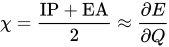
where IP is the ionisation potential, and EA is the electron affinity. The electronic hardness is given by [4]
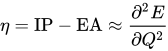
Charge equilibration energy
Using the above expressions one has the following expression for the total electrostatic energy ([2] Eq. 6)
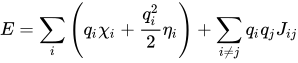
The last term is a "shielded" Coulombic interaction.
Split-charge formalism
Fluctuating-charge formalism
QTPIE
See also
References
- ↑ Wilfried J. Mortier, Karin Van Genechten, Johann Gasteiger "Electronegativity equalization: application and parametrization", Journal of the American Chemical Society 107 pp. 829-835 (1985)
- ↑ 2.0 2.1 Anthony K. Rappe and William A. Goddard III "Charge equilibration for molecular dynamics simulations", Journal of Physical Chemistry 95 pp. 3358-3363 (1991)
- ↑ Robert S. Mulliken "A New Electroaffinity Scale; Together with Data on Valence States and on Valence Ionization Potentials and Electron Affinities", Journal of Chemical Physics 2 pp. 782-793 (1934)
- ↑ Robert G. Parr and Ralph G. Pearson "Absolute hardness: companion parameter to absolute electronegativity", Journal of the American Chemical Society 105 pp. 7512-7516 (1983)
- ↑ Razvan A. Nistor, Jeliazko G. Polihronov, Martin H. Müser, and Nicholas J. Mosey "A generalization of the charge equilibration method for nonmetallic materials", Journal of Chemical Physics 125 094108 (2006)
- ↑ Jiahao Chen and Todd J. Martínez "QTPIE: Charge transfer with polarization current equalization. A fluctuating charge model with correct asymptotics", Chemical Physics Letters 438 pp. 315-320 (2007)