Virial equation of state
The virial equation of state is used to describe the behavior of diluted gases. It is usually written as an expansion of the compresiblity factor, , in terms of either the density or the pressure. Such an expansion was first introduced by Kammerlingh Onnes. In the first case:

- .
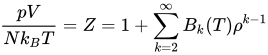
where
- is the pressure

- Failed to parse (SVG (MathML can be enabled via browser plugin): Invalid response ("Math extension cannot connect to Restbase.") from server "https://wikimedia.org/api/rest_v1/":): {\displaystyle V } is the volume
- Failed to parse (SVG (MathML can be enabled via browser plugin): Invalid response ("Math extension cannot connect to Restbase.") from server "https://wikimedia.org/api/rest_v1/":): {\displaystyle N } is the number of molecules
- Failed to parse (SVG (MathML can be enabled via browser plugin): Invalid response ("Math extension cannot connect to Restbase.") from server "https://wikimedia.org/api/rest_v1/":): {\displaystyle \rho \equiv \frac{N}{V} } is the (number) density
- Failed to parse (SVG (MathML can be enabled via browser plugin): Invalid response ("Math extension cannot connect to Restbase.") from server "https://wikimedia.org/api/rest_v1/":): {\displaystyle B_k\left( T \right) } is called the k-th virial coefficient
Virial coefficients
The second virial coefficient represents the initial departure from ideal-gas behavior

where Failed to parse (SVG (MathML can be enabled via browser plugin): Invalid response ("Math extension cannot connect to Restbase.") from server "https://wikimedia.org/api/rest_v1/":): {\displaystyle N_0} is Avogadros number and Failed to parse (SVG (MathML can be enabled via browser plugin): Invalid response ("Math extension cannot connect to Restbase.") from server "https://wikimedia.org/api/rest_v1/":): {\displaystyle d\tau_1} and Failed to parse (SVG (MathML can be enabled via browser plugin): Invalid response ("Math extension cannot connect to Restbase.") from server "https://wikimedia.org/api/rest_v1/":): {\displaystyle d\tau_2} are volume elements of two different molecules in configuration space.
One can write the third virial coefficient as
- Failed to parse (SVG (MathML can be enabled via browser plugin): Invalid response ("Math extension cannot connect to Restbase.") from server "https://wikimedia.org/api/rest_v1/":): {\displaystyle B_{3}(T)= - \frac{1}{3V} \int \int \int f_{12} f_{13} f_{23} dr_1 dr_2 dr_3}
where f is the Mayer f-function.
References
- H. Kammerlingh Onnes "", Communications from the Physical Laboratory Leiden 71 (1901)
- James A Beattie and Walter H Stockmayer "Equations of state", Reports on Progress in Physics 7 pp. 195-229 (1940)