Virial equation of state
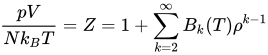
The virial equation of state is used to describe the behavior of diluted gases. It is usually written as an expansion of the compresiblity factor, Failed to parse (SVG (MathML can be enabled via browser plugin): Invalid response ("Math extension cannot connect to Restbase.") from server "https://wikimedia.org/api/rest_v1/":): {\displaystyle Z } , in terms of either the density or the pressure. In the first case:
- Failed to parse (SVG (MathML can be enabled via browser plugin): Invalid response ("Math extension cannot connect to Restbase.") from server "https://wikimedia.org/api/rest_v1/":): {\displaystyle \frac{p V}{N k_B T } = Z = 1 + \sum_{k=2}^{\infty} B_k(T) \rho^{k-1}} .
where
- is the pressure
- Failed to parse (SVG (MathML can be enabled via browser plugin): Invalid response ("Math extension cannot connect to Restbase.") from server "https://wikimedia.org/api/rest_v1/":): {\displaystyle V } is the volume
- Failed to parse (SVG (MathML can be enabled via browser plugin): Invalid response ("Math extension cannot connect to Restbase.") from server "https://wikimedia.org/api/rest_v1/":): {\displaystyle N } is the number of molecules
- Failed to parse (SVG (MathML can be enabled via browser plugin): Invalid response ("Math extension cannot connect to Restbase.") from server "https://wikimedia.org/api/rest_v1/":): {\displaystyle \rho \equiv \frac{N}{V} } is the (number) density
- Failed to parse (SVG (MathML can be enabled via browser plugin): Invalid response ("Math extension cannot connect to Restbase.") from server "https://wikimedia.org/api/rest_v1/":): {\displaystyle B_k\left( T \right) } is called the k-th virial coefficient
Virial coefficients
The second virial coefficient represents the initial departure from ideal-gas behavior

where Failed to parse (SVG (MathML can be enabled via browser plugin): Invalid response ("Math extension cannot connect to Restbase.") from server "https://wikimedia.org/api/rest_v1/":): {\displaystyle N_0} is Avogadros number and Failed to parse (SVG (MathML can be enabled via browser plugin): Invalid response ("Math extension cannot connect to Restbase.") from server "https://wikimedia.org/api/rest_v1/":): {\displaystyle d\tau_1} and Failed to parse (SVG (MathML can be enabled via browser plugin): Invalid response ("Math extension cannot connect to Restbase.") from server "https://wikimedia.org/api/rest_v1/":): {\displaystyle d\tau_2} are volume elements of two different molecules in configuration space. The integration is to be performed over all available phase-space; that is, over the volume of the containing vessel. For the special case where the molecules posses spherical symmetry, so that Failed to parse (SVG (MathML can be enabled via browser plugin): Invalid response ("Math extension cannot connect to Restbase.") from server "https://wikimedia.org/api/rest_v1/":): {\displaystyle u} depends not on orientation, but only on the separation of a pair of molecules, the equation can be simplified to
- Failed to parse (SVG (MathML can be enabled via browser plugin): Invalid response ("Math extension cannot connect to Restbase.") from server "https://wikimedia.org/api/rest_v1/":): {\displaystyle B_{2}(T)= - \frac{1}{2} \int_0^\infty \left(\langle \exp\left(-\frac{u(r)}{k_BT}\right)\rangle -1 \right) 4 \pi r^2 dr}
Using the Mayer f-function
- Failed to parse (SVG (MathML can be enabled via browser plugin): Invalid response ("Math extension cannot connect to Restbase.") from server "https://wikimedia.org/api/rest_v1/":): {\displaystyle f_{ij}=f(r_{ij})= \exp\left(-\frac{u(r)}{k_BT}\right) -1 }
one can write the third virial coefficient more compactly as

- Failed to parse (SVG (MathML can be enabled via browser plugin): Invalid response ("Math extension cannot connect to Restbase.") from server "https://wikimedia.org/api/rest_v1/":): {\displaystyle B_{3}(T)= - \frac{1}{3V} \int \int \int f_{12} f_{13} f_{23} dr_1 dr_2 dr_3 }