Buckingham potential
The Buckingham potential is given by [1]
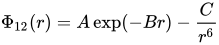
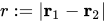
where is the intermolecular pair potential, , and , and are constants.



The Buckingham potential describes the exchange repulsion, which originates from the Pauli exclusion principle, by a more realistic exponential function of distance, in contrast to the inverse twelfth power used by the Lennard-Jones potential. However, since the Buckingham potential remains finite even at very small distances, it runs the risk of an un-physical "Buckingham catastrophe" at short range when used in simulations of charged systems. This occurs when the electrostatic attraction artificially overcomes the repulsive barrier. The Lennard-Jones potential is also about 4 times quicker to compute [2] and so is more frequently used in computer simulations.
See also
References
- ↑ R. A. Buckingham "The Classical Equation of State of Gaseous Helium, Neon and Argon", Proceedings of the Royal Society of London. Series A, Mathematical and Physical Sciences 168 pp. 264-283 (1938)
- ↑ David N. J. White "A computationally efficient alternative to the Buckingham potential for molecular mechanics calculations", Journal of Computer-Aided Molecular Design 11 pp.517-521 (1997)
- Related reading