1-dimensional hard rods: Difference between revisions
Carl McBride (talk | contribs) m (Added a detail to the introduction) |
Carl McBride (talk | contribs) m (Added some related publications.) |
||
| Line 1: | Line 1: | ||
'''1-dimensional hard rods''' consist of non-overlapping line segments of length <math>\sigma</math> who all occupy the same line which has length <math>L</math>. One could also think of this model as being a string of [[hard sphere model | hard spheres]] confined to 1 dimension (not to be confused with [[3-dimensional hard rods]]). The model is given by the [[intermolecular pair potential]]: | '''1-dimensional hard rods''' (sometimes known as a ''Tonks Gas'' <ref>[http://dx.doi.org/10.1103/PhysRev.50.955 Lewi Tonks "The Complete Equation of State of One, Two and Three-Dimensional Gases of Hard Elastic Spheres", Physical Review '''50''' pp. 955- (1936)]</ref>) consist of non-overlapping line segments of length <math>\sigma</math> who all occupy the same line which has length <math>L</math>. One could also think of this model as being a string of [[hard sphere model | hard spheres]] confined to 1 dimension (not to be confused with [[3-dimensional hard rods]]). The model is given by the [[intermolecular pair potential]]: | ||
: <math> \Phi_{12} (x_i,x_j) = \left\{ \begin{array}{lll} 0 & ; & |x_i-x_j| > \sigma \\ | : <math> \Phi_{12} (x_i,x_j) = \left\{ \begin{array}{lll} 0 & ; & |x_i-x_j| > \sigma \\ | ||
| Line 9: | Line 9: | ||
\infty &; & {\mathrm {elsewhere}}. \end{array} \right. </math> | \infty &; & {\mathrm {elsewhere}}. \end{array} \right. </math> | ||
== Canonical Ensemble: Configuration Integral == | == Canonical Ensemble: Configuration Integral == | ||
The [[statistical mechanics]] of this system can be solved exactly | The [[statistical mechanics]] of this system can be solved exactly. | ||
Consider a system of length <math> \left. L \right. </math> defined in the range <math> \left[ 0, L \right] </math>. The aim is to compute the [[partition function]] of a system of <math> \left. N \right. </math> hard rods of length <math> \left. \sigma \right. </math>. | Consider a system of length <math> \left. L \right. </math> defined in the range <math> \left[ 0, L \right] </math>. The aim is to compute the [[partition function]] of a system of <math> \left. N \right. </math> hard rods of length <math> \left. \sigma \right. </math>. | ||
Consider that the particles are ordered according to their label: <math> x_0 < x_1 < x_2 < \cdots < x_{N-1} </math>; | Consider that the particles are ordered according to their label: <math> x_0 < x_1 < x_2 < \cdots < x_{N-1} </math>; | ||
| Line 51: | Line 51: | ||
== Equation of state == | == Equation of state == | ||
Using the [[thermodynamic relations]], the [[pressure]] (''linear tension'' in this case) <math> \left. p \right. </math> can | Using the [[thermodynamic relations]], the [[pressure]] (''linear tension'' in this case) <math> \left. p \right. </math> can | ||
be written as: | be written as: | ||
| Line 66: | Line 65: | ||
== Isobaric ensemble: an alternative derivation == | == Isobaric ensemble: an alternative derivation == | ||
Adapted from Reference | Adapted from Reference <ref>J. M. Ziman ''Models of Disorder: The Theoretical Physics of Homogeneously Disordered Systems'', Cambridge University Press (1979) ISBN 0521292808</ref>. If the rods are ordered according to their label: <math> x_0 < x_1 < x_2 < \cdots < x_{N-1} </math> the canonical [[partition function]] can also be written as: | ||
: <math> | : <math> | ||
Z= | Z= | ||
| Line 127: | Line 126: | ||
<math>s=p/k T</math>. Therefore, the [[Gibbs energy function]] is simply <math>G=-kT\log Z'(p/kT) </math>, which easily evaluated to be <math>G=kT N \log(p/kT)+p\sigma N</math>. The [[chemical potential]] is <math>\mu=G/N</math>, and by means of thermodynamic identities such as <math>\rho=\partial p/\partial \mu</math> one arrives at the same equation of state as the one given above. | <math>s=p/k T</math>. Therefore, the [[Gibbs energy function]] is simply <math>G=-kT\log Z'(p/kT) </math>, which easily evaluated to be <math>G=kT N \log(p/kT)+p\sigma N</math>. The [[chemical potential]] is <math>\mu=G/N</math>, and by means of thermodynamic identities such as <math>\rho=\partial p/\partial \mu</math> one arrives at the same equation of state as the one given above. | ||
==Confined hard rods== | ==Confined hard rods== | ||
<ref>[http://dx.doi.org/10.1080/00268978600101521 A. Robledo and J. S. Rowlinson "The distribution of hard rods on a line of finite length", Molecular Physics '''58''' pp. 711-721 (1986)]</ref> | |||
==References== | ==References== | ||
<references/> | |||
'''Related reading''' | |||
*[http://dx.doi.org/10.1016/0031-8914(49)90059-2 L. van Hove "Quelques Propriétés Générales De L'intégrale De Configuration D'un Système De Particules Avec Interaction", Physica, '''15''' pp. 951-961 (1949)] | |||
*[http://dx.doi.org/10.1016/0031-8914(50)90072-3 L. van Hove, "Sur L'intégrale de Configuration Pour Les Systèmes De Particules À Une Dimension", Physica, '''16''' pp. 137-143 (1950)] | |||
*[http://dx.doi.org/10.1063/1.1699116 Zevi W. Salsburg, Robert W. Zwanzig, and John G. Kirkwood "Molecular Distribution Functions in a One-Dimensional Fluid", Journal of Chemical Physics '''21''' pp. 1098-1107 (1953)] | |||
*[http://dx.doi.org/10.1063/1.1699263 Robert L. Sells, C. W. Harris, and Eugene Guth "The Pair Distribution Function for a One-Dimensional Gas", Journal of Chemical Physics '''21''' pp. 1422-1423 (1953)] | |||
*[http://dx.doi.org/10.3390/e10030248 Paolo V. Giaquinta "Entropy and Ordering of Hard Rods in One Dimension", Entropy '''10''' pp. 248-260 (2008)] | |||
[[Category:Models]] | [[Category:Models]] | ||
[[Category:Statistical mechanics]] | [[Category:Statistical mechanics]] | ||
Revision as of 18:27, 14 December 2009
1-dimensional hard rods (sometimes known as a Tonks Gas [1]) consist of non-overlapping line segments of length Failed to parse (SVG (MathML can be enabled via browser plugin): Invalid response ("Math extension cannot connect to Restbase.") from server "https://wikimedia.org/api/rest_v1/":): {\displaystyle \sigma} who all occupy the same line which has length Failed to parse (SVG (MathML can be enabled via browser plugin): Invalid response ("Math extension cannot connect to Restbase.") from server "https://wikimedia.org/api/rest_v1/":): {\displaystyle L} . One could also think of this model as being a string of hard spheres confined to 1 dimension (not to be confused with 3-dimensional hard rods). The model is given by the intermolecular pair potential:

where Failed to parse (SVG (MathML can be enabled via browser plugin): Invalid response ("Math extension cannot connect to Restbase.") from server "https://wikimedia.org/api/rest_v1/":): {\displaystyle \left. x_k \right. } is the position of the center of the k-th rod, along with an external potential; the whole length of the rod must be inside the range:
- Failed to parse (SVG (MathML can be enabled via browser plugin): Invalid response ("Math extension cannot connect to Restbase.") from server "https://wikimedia.org/api/rest_v1/":): {\displaystyle V_{0}(x_i) = \left\{ \begin{array}{lll} 0 & ; & \sigma/2 < x < L - \sigma/2 \\ \infty &; & {\mathrm {elsewhere}}. \end{array} \right. }
Canonical Ensemble: Configuration Integral
The statistical mechanics of this system can be solved exactly. Consider a system of length Failed to parse (SVG (MathML can be enabled via browser plugin): Invalid response ("Math extension cannot connect to Restbase.") from server "https://wikimedia.org/api/rest_v1/":): {\displaystyle \left. L \right. } defined in the range Failed to parse (SVG (MathML can be enabled via browser plugin): Invalid response ("Math extension cannot connect to Restbase.") from server "https://wikimedia.org/api/rest_v1/":): {\displaystyle \left[ 0, L \right] } . The aim is to compute the partition function of a system of hard rods of length Failed to parse (SVG (MathML can be enabled via browser plugin): Invalid response ("Math extension cannot connect to Restbase.") from server "https://wikimedia.org/api/rest_v1/":): {\displaystyle \left. \sigma \right. } . Consider that the particles are ordered according to their label: Failed to parse (SVG (MathML can be enabled via browser plugin): Invalid response ("Math extension cannot connect to Restbase.") from server "https://wikimedia.org/api/rest_v1/":): {\displaystyle x_0 < x_1 < x_2 < \cdots < x_{N-1} } ; taking into account the pair potential we can write the canonical partition function (configuration integral) of a system of Failed to parse (SVG (MathML can be enabled via browser plugin): Invalid response ("Math extension cannot connect to Restbase.") from server "https://wikimedia.org/api/rest_v1/":): {\displaystyle N } particles as:

- Failed to parse (SVG (MathML can be enabled via browser plugin): Invalid response ("Math extension cannot connect to Restbase.") from server "https://wikimedia.org/api/rest_v1/":): {\displaystyle \frac{ Z \left( N,L \right)}{N!} = \int_{\sigma/2}^{L+\sigma/2-N\sigma} d x_0 \int_{x_0+\sigma}^{L+\sigma/2-N\sigma+\sigma} d x_1 \cdots \int_{x_{i-1}+\sigma}^{L+\sigma/2-N\sigma+i \sigma} d x_i \cdots \int_{x_{N-2}+\sigma}^{L+\sigma/2-N\sigma+(N-1)\sigma} d x_{N-1}. }
Variable change: ; we get:
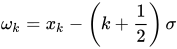
- Failed to parse (SVG (MathML can be enabled via browser plugin): Invalid response ("Math extension cannot connect to Restbase.") from server "https://wikimedia.org/api/rest_v1/":): {\displaystyle \frac{ Z \left( N,L \right)}{N!} = \int_{0}^{L-N\sigma} d \omega_0 \int_{\omega_0}^{L-N\sigma} d \omega_1 \cdots \int_{\omega_{i-1}}^{L-N\sigma} d \omega_i \cdots \int_{\omega_{N-2}}^{L-N\sigma} d \omega_{N-1}. }
Therefore:
- Failed to parse (SVG (MathML can be enabled via browser plugin): Invalid response ("Math extension cannot connect to Restbase.") from server "https://wikimedia.org/api/rest_v1/":): {\displaystyle \frac{ Z \left( N,L \right)}{N!} = \frac{ (L-N\sigma )^{N} }{N!}. }
- Failed to parse (SVG (MathML can be enabled via browser plugin): Invalid response ("Math extension cannot connect to Restbase.") from server "https://wikimedia.org/api/rest_v1/":): {\displaystyle Q(N,L) = \frac{ (L-N \sigma )^N}{\Lambda^N N!}. }
Thermodynamics
- Failed to parse (SVG (MathML can be enabled via browser plugin): Invalid response ("Math extension cannot connect to Restbase.") from server "https://wikimedia.org/api/rest_v1/":): {\displaystyle \left. A(N,L,T) = - k_B T \log Q \right. }
In the thermodynamic limit (i.e. with Failed to parse (SVG (MathML can be enabled via browser plugin): Invalid response ("Math extension cannot connect to Restbase.") from server "https://wikimedia.org/api/rest_v1/":): {\displaystyle \rho = \frac{N}{L} } , remaining finite):

- Failed to parse (SVG (MathML can be enabled via browser plugin): Invalid response ("Math extension cannot connect to Restbase.") from server "https://wikimedia.org/api/rest_v1/":): {\displaystyle A \left( N,L,T \right) = N k_B T \left[ \log \left( \frac{ N \Lambda} { L - N \sigma }\right) - 1 \right]. }
Equation of state
Using the thermodynamic relations, the pressure (linear tension in this case) Failed to parse (SVG (MathML can be enabled via browser plugin): Invalid response ("Math extension cannot connect to Restbase.") from server "https://wikimedia.org/api/rest_v1/":): {\displaystyle \left. p \right. } can be written as:
- Failed to parse (SVG (MathML can be enabled via browser plugin): Invalid response ("Math extension cannot connect to Restbase.") from server "https://wikimedia.org/api/rest_v1/":): {\displaystyle p = - \left( \frac{ \partial A}{\partial L} \right)_{N,T} = \frac{ N k_B T}{L - N \sigma}; }
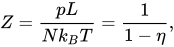
where Failed to parse (SVG (MathML can be enabled via browser plugin): Invalid response ("Math extension cannot connect to Restbase.") from server "https://wikimedia.org/api/rest_v1/":): {\displaystyle \eta \equiv \frac{ N \sigma}{L} } ; is the fraction of volume (i.e. length) occupied by the rods.
Isobaric ensemble: an alternative derivation
Adapted from Reference [2]. If the rods are ordered according to their label: Failed to parse (SVG (MathML can be enabled via browser plugin): Invalid response ("Math extension cannot connect to Restbase.") from server "https://wikimedia.org/api/rest_v1/":): {\displaystyle x_0 < x_1 < x_2 < \cdots < x_{N-1} } the canonical partition function can also be written as:
- Failed to parse (SVG (MathML can be enabled via browser plugin): Invalid response ("Math extension cannot connect to Restbase.") from server "https://wikimedia.org/api/rest_v1/":): {\displaystyle Z= \int_0^{x_1} d x_0 \int_0^{x_2} d x_1 \cdots \int_0^{L} d x_{N-1} f(x_1-x_0) f(x_2-x_1) \cdots f(L-x_{N-1}), }
where Failed to parse (SVG (MathML can be enabled via browser plugin): Invalid response ("Math extension cannot connect to Restbase.") from server "https://wikimedia.org/api/rest_v1/":): {\displaystyle N!} does not appear one would have Failed to parse (SVG (MathML can be enabled via browser plugin): Invalid response ("Math extension cannot connect to Restbase.") from server "https://wikimedia.org/api/rest_v1/":): {\displaystyle N!} analogous expressions by permuting the label of the (distinguishable) rods. Failed to parse (SVG (MathML can be enabled via browser plugin): Invalid response ("Math extension cannot connect to Restbase.") from server "https://wikimedia.org/api/rest_v1/":): {\displaystyle f(x)} is the Boltzmann factor of the hard rods, which is Failed to parse (SVG (MathML can be enabled via browser plugin): Invalid response ("Math extension cannot connect to Restbase.") from server "https://wikimedia.org/api/rest_v1/":): {\displaystyle 0} if Failed to parse (SVG (MathML can be enabled via browser plugin): Invalid response ("Math extension cannot connect to Restbase.") from server "https://wikimedia.org/api/rest_v1/":): {\displaystyle x<\sigma} and Failed to parse (SVG (MathML can be enabled via browser plugin): Invalid response ("Math extension cannot connect to Restbase.") from server "https://wikimedia.org/api/rest_v1/":): {\displaystyle 1} otherwise.
A variable change to the distances between rods: results in

- Failed to parse (SVG (MathML can be enabled via browser plugin): Invalid response ("Math extension cannot connect to Restbase.") from server "https://wikimedia.org/api/rest_v1/":): {\displaystyle Z = \int_0^{\infty} d y_0 \int_0^{\infty} d y_1 \cdots \int_0^{\infty} d y_{N-1} f(y_1) f(y_2) \cdots f(y_{N-1}) \delta \left( \sum_{i=0}^{N-1} y_i-L \right): }
the distances can take any value as long as they are not below Failed to parse (SVG (MathML can be enabled via browser plugin): Invalid response ("Math extension cannot connect to Restbase.") from server "https://wikimedia.org/api/rest_v1/":): {\displaystyle \sigma} (as enforced by Failed to parse (SVG (MathML can be enabled via browser plugin): Invalid response ("Math extension cannot connect to Restbase.") from server "https://wikimedia.org/api/rest_v1/":): {\displaystyle f(y)} ) and as long as they add up to Failed to parse (SVG (MathML can be enabled via browser plugin): Invalid response ("Math extension cannot connect to Restbase.") from server "https://wikimedia.org/api/rest_v1/":): {\displaystyle L} (as enforced by the Dirac delta). Writing the later as the inverse Laplace transform of an exponential:
- Failed to parse (SVG (MathML can be enabled via browser plugin): Invalid response ("Math extension cannot connect to Restbase.") from server "https://wikimedia.org/api/rest_v1/":): {\displaystyle Z = \int_0^{\infty} d y_0 \int_0^{\infty} d y_1 \cdots \int_0^{\infty} d y_{N-1} f(y_1) f(y_2) \cdots f(y_{N-1}) \frac{1}{2\pi i } \int_{-\infty}^{\infty} ds \exp \left[ - s \left(\sum_{i=0}^{N-1} y_i-L \right)\right]. }
Exchanging integrals and expanding the exponential the Failed to parse (SVG (MathML can be enabled via browser plugin): Invalid response ("Math extension cannot connect to Restbase.") from server "https://wikimedia.org/api/rest_v1/":): {\displaystyle N} integrals decouple:
- Failed to parse (SVG (MathML can be enabled via browser plugin): Invalid response ("Math extension cannot connect to Restbase.") from server "https://wikimedia.org/api/rest_v1/":): {\displaystyle Z = \frac{1}{2\pi i } \int_{-\infty}^{\infty} ds e^{ L s } \left\{ \int_0^{\infty} d y f(y) e^{ - s y } \right\}^N. }
We may proceed to invert the Laplace transform (e.g. by means of the residues theorem), but this is not needed: we see our configuration integral is the inverse Laplace transform of another one,
- Failed to parse (SVG (MathML can be enabled via browser plugin): Invalid response ("Math extension cannot connect to Restbase.") from server "https://wikimedia.org/api/rest_v1/":): {\displaystyle Z'(s)= \left\{ \int_0^{\infty} d y f(y) e^{ - s y } \right\}^N, }
so that
- Failed to parse (SVG (MathML can be enabled via browser plugin): Invalid response ("Math extension cannot connect to Restbase.") from server "https://wikimedia.org/api/rest_v1/":): {\displaystyle Z'(s) = \int_0^{\infty} ds e^{ L s } Z(L). }
This is precisely the transformation from the configuration integral in the canonical (Failed to parse (SVG (MathML can be enabled via browser plugin): Invalid response ("Math extension cannot connect to Restbase.") from server "https://wikimedia.org/api/rest_v1/":): {\displaystyle N,T,L} ) ensemble to the isobaric () one, if one identifies Failed to parse (SVG (MathML can be enabled via browser plugin): Invalid response ("Math extension cannot connect to Restbase.") from server "https://wikimedia.org/api/rest_v1/":): {\displaystyle s=p/k T} . Therefore, the Gibbs energy function is simply Failed to parse (SVG (MathML can be enabled via browser plugin): Invalid response ("Math extension cannot connect to Restbase.") from server "https://wikimedia.org/api/rest_v1/":): {\displaystyle G=-kT\log Z'(p/kT) } , which easily evaluated to be Failed to parse (SVG (MathML can be enabled via browser plugin): Invalid response ("Math extension cannot connect to Restbase.") from server "https://wikimedia.org/api/rest_v1/":): {\displaystyle G=kT N \log(p/kT)+p\sigma N} . The chemical potential is Failed to parse (SVG (MathML can be enabled via browser plugin): Invalid response ("Math extension cannot connect to Restbase.") from server "https://wikimedia.org/api/rest_v1/":): {\displaystyle \mu=G/N} , and by means of thermodynamic identities such as one arrives at the same equation of state as the one given above.


Confined hard rods
References
- ↑ Lewi Tonks "The Complete Equation of State of One, Two and Three-Dimensional Gases of Hard Elastic Spheres", Physical Review 50 pp. 955- (1936)
- ↑ J. M. Ziman Models of Disorder: The Theoretical Physics of Homogeneously Disordered Systems, Cambridge University Press (1979) ISBN 0521292808
- ↑ A. Robledo and J. S. Rowlinson "The distribution of hard rods on a line of finite length", Molecular Physics 58 pp. 711-721 (1986)
Related reading
- L. van Hove "Quelques Propriétés Générales De L'intégrale De Configuration D'un Système De Particules Avec Interaction", Physica, 15 pp. 951-961 (1949)
- L. van Hove, "Sur L'intégrale de Configuration Pour Les Systèmes De Particules À Une Dimension", Physica, 16 pp. 137-143 (1950)
- Zevi W. Salsburg, Robert W. Zwanzig, and John G. Kirkwood "Molecular Distribution Functions in a One-Dimensional Fluid", Journal of Chemical Physics 21 pp. 1098-1107 (1953)
- Robert L. Sells, C. W. Harris, and Eugene Guth "The Pair Distribution Function for a One-Dimensional Gas", Journal of Chemical Physics 21 pp. 1422-1423 (1953)
- Paolo V. Giaquinta "Entropy and Ordering of Hard Rods in One Dimension", Entropy 10 pp. 248-260 (2008)