Heat capacity: Difference between revisions
m (→Debye: Added a formula.) |
Carl McBride (talk | contribs) m (Added a reference.) |
||
| Line 19: | Line 19: | ||
*[http://dx.doi.org/10.1063/1.1667469 Claudio A. Cerdeiriña, Diego González-Salgado, Luis Romani, María del Carmen Delgado, Luis A. Torres and Miguel Costas "Towards an understanding of the heat capacity of liquids. A simple two-state model for molecular association", Journal of Chemical Physics '''120''' pp. 6648-6659 (2004)] | *[http://dx.doi.org/10.1063/1.1667469 Claudio A. Cerdeiriña, Diego González-Salgado, Luis Romani, María del Carmen Delgado, Luis A. Torres and Miguel Costas "Towards an understanding of the heat capacity of liquids. A simple two-state model for molecular association", Journal of Chemical Physics '''120''' pp. 6648-6659 (2004)] | ||
==Solids== | ==Solids== | ||
====Dulong | ====Petit and Dulong==== | ||
<ref>Alexis-Thérèse Petit and Pierre-Louis Dulong "Recherches sur quelques points importants de la Théorie de la Chaleur", Annales de Chimie et de Physique '''10''' pp. 395-413 (1819)</ref> | |||
====Einstein==== | ====Einstein==== | ||
====Debye==== | ====Debye==== | ||
| Line 31: | Line 32: | ||
*[[Ideal gas: Heat capacity | Heat capacity of an ideal gas]] | *[[Ideal gas: Heat capacity | Heat capacity of an ideal gas]] | ||
==References== | ==References== | ||
<references/> | |||
[[category: classical thermodynamics]] | [[category: classical thermodynamics]] | ||
Revision as of 14:25, 5 November 2009
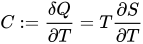
The heat capacity is defined as the differential of heat with respect to the temperature ,
- Failed to parse (SVG (MathML can be enabled via browser plugin): Invalid response ("Math extension cannot connect to Restbase.") from server "https://wikimedia.org/api/rest_v1/":): {\displaystyle C := \frac{\delta Q}{\partial T} = T \frac{\partial S}{\partial T}}
where Failed to parse (SVG (MathML can be enabled via browser plugin): Invalid response ("Math extension cannot connect to Restbase.") from server "https://wikimedia.org/api/rest_v1/":): {\displaystyle Q} is heat and Failed to parse (SVG (MathML can be enabled via browser plugin): Invalid response ("Math extension cannot connect to Restbase.") from server "https://wikimedia.org/api/rest_v1/":): {\displaystyle S} is the entropy.
At constant volume
From the first law of thermodynamics one has

- Failed to parse (SVG (MathML can be enabled via browser plugin): Invalid response ("Math extension cannot connect to Restbase.") from server "https://wikimedia.org/api/rest_v1/":): {\displaystyle \left.\delta Q\right. = dU + pdV}
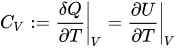
thus at constant volume, denoted by the subscript Failed to parse (SVG (MathML can be enabled via browser plugin): Invalid response ("Math extension cannot connect to Restbase.") from server "https://wikimedia.org/api/rest_v1/":): {\displaystyle V} , then ,
- Failed to parse (SVG (MathML can be enabled via browser plugin): Invalid response ("Math extension cannot connect to Restbase.") from server "https://wikimedia.org/api/rest_v1/":): {\displaystyle C_V := \left.\frac{\delta Q}{\partial T} \right\vert_V = \left. \frac{\partial U}{\partial T} \right\vert_V }
At constant pressure
At constant pressure (denoted by the subscript Failed to parse (SVG (MathML can be enabled via browser plugin): Invalid response ("Math extension cannot connect to Restbase.") from server "https://wikimedia.org/api/rest_v1/":): {\displaystyle p} ),
- Failed to parse (SVG (MathML can be enabled via browser plugin): Invalid response ("Math extension cannot connect to Restbase.") from server "https://wikimedia.org/api/rest_v1/":): {\displaystyle C_p := \left.\frac{\delta Q}{\partial T} \right\vert_p =\left.\frac{\partial H}{\partial T} \right\vert_p= \left. \frac{\partial U}{\partial T} \right\vert_p + p \left.\frac{\partial V}{\partial T} \right\vert_p}
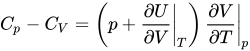
where Failed to parse (SVG (MathML can be enabled via browser plugin): Invalid response ("Math extension cannot connect to Restbase.") from server "https://wikimedia.org/api/rest_v1/":): {\displaystyle H} is the enthalpy. The difference between the heat capacity at constant pressure and the heat capacity at constant volume is given by
- Failed to parse (SVG (MathML can be enabled via browser plugin): Invalid response ("Math extension cannot connect to Restbase.") from server "https://wikimedia.org/api/rest_v1/":): {\displaystyle C_p -C_V = \left( p + \left. \frac{\partial U}{\partial V} \right\vert_T \right) \left. \frac{\partial V}{\partial T} \right\vert_p}
Liquids
Solids
Petit and Dulong
Einstein
Debye
A low temperatures on has
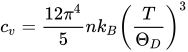
- Failed to parse (SVG (MathML can be enabled via browser plugin): Invalid response ("Math extension cannot connect to Restbase.") from server "https://wikimedia.org/api/rest_v1/":): {\displaystyle c_v = \frac{12 \pi^4}{5} n k_B \left( \frac{T}{\Theta_D} \right)^3}
where Failed to parse (SVG (MathML can be enabled via browser plugin): Invalid response ("Math extension cannot connect to Restbase.") from server "https://wikimedia.org/api/rest_v1/":): {\displaystyle k_B} is the Boltzmann constant, Failed to parse (SVG (MathML can be enabled via browser plugin): Invalid response ("Math extension cannot connect to Restbase.") from server "https://wikimedia.org/api/rest_v1/":): {\displaystyle T} is the temperature and Failed to parse (SVG (MathML can be enabled via browser plugin): Invalid response ("Math extension cannot connect to Restbase.") from server "https://wikimedia.org/api/rest_v1/":): {\displaystyle \Theta_D} is an empirical parameter known as the Debye temperature.
See also
References
- ↑ Alexis-Thérèse Petit and Pierre-Louis Dulong "Recherches sur quelques points importants de la Théorie de la Chaleur", Annales de Chimie et de Physique 10 pp. 395-413 (1819)