Talk:Capillary waves: Difference between revisions
(New page: ==Thermal capillary waves== Hello, now I'm writing the same article for [http://ru.wikipedia.org/wiki/%D0%A2%D0%B5%D0%BF%D0%BB%D0%BE%D0%B2%D1%8B%D0%B5_%D0%BA%D0%B0%D0%BF%D0%B8%D0%BB%D0%BB%...) |
No edit summary |
||
| Line 13: | Line 13: | ||
</math> | </math> | ||
And again we get the same result. What do you think of it? Is there a mistake? Please help, I'm really stuck with it. [http://en.wikipedia.org/wiki/User:Yrogirg Grigory Sarnitskiy]. [[Special:Contributions/91.76.179.101|91.76.179.101]] 19:45, 30 January 2009 (CET) | And again we get the same result. What do you think of it? Is there a mistake? Please help, I'm really stuck with it. [http://en.wikipedia.org/wiki/User:Yrogirg Grigory Sarnitskiy]. [[Special:Contributions/91.76.179.101|91.76.179.101]] 19:45, 30 January 2009 (CET) | ||
=== A quick comment === | |||
I may be wrong, but looking at your derivation it seems the boundary conditions are not correctly | |||
described. If the system is fixed to some immobile frame, only <math>\sin</math> terms should appear in the modes, not <math>\cos</math>. If, on the other hand, periodic boundary conditions are applied, the opposite applies: only <math>\cos</math>, not <math>\sin</math>. This may explain the factor of <math>2</math> that's missing... but I still have to think more carefully about this. --[[User:Dduque|Dduque]] 09:58, 3 February 2009 (CET) | |||
Revision as of 10:58, 3 February 2009
Thermal capillary waves
Hello, now I'm writing the same article for Russian wikipedia. While I was deducing the expression for mean square amplitude I found my result to be two times less than common one (that is in Molecular Theory of Capillarity and refered to in many articles). Could you please tell me weather I am right or not.
I claim that the mean energy of each mode is rather than . That's because each mode has to degrees of freedom Failed to parse (Conversion error. Server ("https://wikimedia.org/api/rest_") reported: "Cannot get mml. Server problem."): {\displaystyle A_{mn}} and Failed to parse (Conversion error. Server ("https://wikimedia.org/api/rest_") reported: "Cannot get mml. Server problem."): {\displaystyle B_{mn}} , since each wave is , with the energy of each mode proportional to . This obviously lead to the mean energy of each mode to be . That was the real notation and now lets turn to the complex notation.




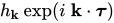
Each mode with the fixed wave vector is presented as , Failed to parse (Conversion error. Server ("https://wikimedia.org/api/rest_") reported: "Cannot get mml. Server problem."): {\displaystyle \mathbf {k} =({\frac {2\pi }{L}}m,{\frac {2\pi }{L}}n),\;m,n\in \mathbb {Z} } — wave vector, — Failed to parse (SVG (MathML can be enabled via browser plugin): Invalid response ("Math extension cannot connect to Restbase.") from server "https://wikimedia.org/api/rest_v1/":): {\displaystyle (x,y)} vector. The energy is proportional to Failed to parse (SVG (MathML can be enabled via browser plugin): Invalid response ("Math extension cannot connect to Restbase.") from server "https://wikimedia.org/api/rest_v1/":): {\displaystyle h_\mathbf{k}^*h_\mathbf{k}} (indeed it is Failed to parse (SVG (MathML can be enabled via browser plugin): Invalid response ("Math extension cannot connect to Restbase.") from server "https://wikimedia.org/api/rest_v1/":): {\displaystyle E_\mathbf{k}=\frac{\sigma L^2}{2} \left( \frac{2}{a_c^2} + \mathbf{k}^2 \right) h^*_\mathbf{k} h_\mathbf{k}} ). According to equipartition:

- Failed to parse (SVG (MathML can be enabled via browser plugin): Invalid response ("Math extension cannot connect to Restbase.") from server "https://wikimedia.org/api/rest_v1/":): {\displaystyle \left \langle x_i \frac{\partial H}{\partial x_j} \right \rangle = \delta_{ij} k_B T, }
we obtain:
![{\displaystyle \left\langle h_{\mathbf {k} }\,{\frac {\partial }{\partial h_{\mathbf {k} }}}\left[{\frac {\sigma L^{2}}{2}}\left({\frac {2}{a_{c}^{2}}}+\mathbf {k} ^{2}\right)h_{\mathbf {k} }^{*}h_{\mathbf {k} }\right]\right\rangle =\left\langle h_{\mathbf {k} }\left[{\frac {\sigma L^{2}}{2}}\left({\frac {2}{a_{c}^{2}}}+\mathbf {k} ^{2}\right)h_{\mathbf {k} }^{*}\right]\right\rangle =\left\langle E_{\mathbf {k} }\right\rangle =k_{B}T.}](https://wikimedia.org/api/rest_v1/media/math/render/svg/ca206b7e6243e9d369d4d3c3b74a90dba54822be)
And again we get the same result. What do you think of it? Is there a mistake? Please help, I'm really stuck with it. Grigory Sarnitskiy. 91.76.179.101 19:45, 30 January 2009 (CET)
A quick comment
I may be wrong, but looking at your derivation it seems the boundary conditions are not correctly described. If the system is fixed to some immobile frame, only Failed to parse (SVG (MathML can be enabled via browser plugin): Invalid response ("Math extension cannot connect to Restbase.") from server "https://wikimedia.org/api/rest_v1/":): {\displaystyle \sin} terms should appear in the modes, not Failed to parse (SVG (MathML can be enabled via browser plugin): Invalid response ("Math extension cannot connect to Restbase.") from server "https://wikimedia.org/api/rest_v1/":): {\displaystyle \cos} . If, on the other hand, periodic boundary conditions are applied, the opposite applies: only Failed to parse (SVG (MathML can be enabled via browser plugin): Invalid response ("Math extension cannot connect to Restbase.") from server "https://wikimedia.org/api/rest_v1/":): {\displaystyle \cos} , not Failed to parse (SVG (MathML can be enabled via browser plugin): Invalid response ("Math extension cannot connect to Restbase.") from server "https://wikimedia.org/api/rest_v1/":): {\displaystyle \sin} . This may explain the factor of Failed to parse (SVG (MathML can be enabled via browser plugin): Invalid response ("Math extension cannot connect to Restbase.") from server "https://wikimedia.org/api/rest_v1/":): {\displaystyle 2} that's missing... but I still have to think more carefully about this. --Dduque 09:58, 3 February 2009 (CET)