Heat capacity: Difference between revisions
Carl McBride (talk | contribs) m (→At constant pressure: Corrected typo.) |
Carl McBride (talk | contribs) m (Added a couple of empty sections.) |
||
| Line 10: | Line 10: | ||
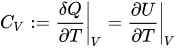
At constant volume (denoted by the subscript <math>V</math>), | At constant volume (denoted by the subscript <math>V</math>), | ||
:<math>C_V := \left.\frac{\delta Q}{\partial T} \right\vert_V = \left. \frac{\partial U}{\partial T} \right\vert_V </math> | :<math>C_V := \left.\frac{\delta Q}{\partial T} \right\vert_V = \left. \frac{\partial U}{\partial T} \right\vert_V </math> | ||
==At constant pressure== | ==At constant pressure== | ||
At constant pressure (denoted by the subscript <math>p</math>), | At constant pressure (denoted by the subscript <math>p</math>), | ||
| Line 20: | Line 17: | ||
The difference between the heat capacity at constant pressure and the heat capacity at constant volume is given by | The difference between the heat capacity at constant pressure and the heat capacity at constant volume is given by | ||
:<math>C_p -C_V = \left( p + \left. \frac{\partial U}{\partial V} \right\vert_T \right) \left. \frac{\partial V}{\partial T} \right\vert_p</math> | :<math>C_p -C_V = \left( p + \left. \frac{\partial U}{\partial V} \right\vert_T \right) \left. \frac{\partial V}{\partial T} \right\vert_p</math> | ||
==Solids: Debye theory== | |||
==References== | |||
[[category: classical thermodynamics]] | [[category: classical thermodynamics]] | ||
Revision as of 13:15, 2 December 2008
From the first law of thermodynamics one has
- Failed to parse (SVG (MathML can be enabled via browser plugin): Invalid response ("Math extension cannot connect to Restbase.") from server "https://wikimedia.org/api/rest_v1/":): {\displaystyle \left.\delta Q\right. = dU + pdV}
where Failed to parse (SVG (MathML can be enabled via browser plugin): Invalid response ("Math extension cannot connect to Restbase.") from server "https://wikimedia.org/api/rest_v1/":): {\displaystyle Q} is the heat, Failed to parse (SVG (MathML can be enabled via browser plugin): Invalid response ("Math extension cannot connect to Restbase.") from server "https://wikimedia.org/api/rest_v1/":): {\displaystyle U} is the internal energy, Failed to parse (SVG (MathML can be enabled via browser plugin): Invalid response ("Math extension cannot connect to Restbase.") from server "https://wikimedia.org/api/rest_v1/":): {\displaystyle p} is the pressure and is the volume. The heat capacity is given by the differential of the heat with respect to the temperature,

- Failed to parse (SVG (MathML can be enabled via browser plugin): Invalid response ("Math extension cannot connect to Restbase.") from server "https://wikimedia.org/api/rest_v1/":): {\displaystyle C := \frac{\delta Q}{\partial T}}
At constant volume
At constant volume (denoted by the subscript Failed to parse (SVG (MathML can be enabled via browser plugin): Invalid response ("Math extension cannot connect to Restbase.") from server "https://wikimedia.org/api/rest_v1/":): {\displaystyle V} ),
At constant pressure
At constant pressure (denoted by the subscript Failed to parse (SVG (MathML can be enabled via browser plugin): Invalid response ("Math extension cannot connect to Restbase.") from server "https://wikimedia.org/api/rest_v1/":): {\displaystyle p} ),
- Failed to parse (SVG (MathML can be enabled via browser plugin): Invalid response ("Math extension cannot connect to Restbase.") from server "https://wikimedia.org/api/rest_v1/":): {\displaystyle C_p := \left.\frac{\delta Q}{\partial T} \right\vert_p =\left.\frac{\partial H}{\partial T} \right\vert_p= \left. \frac{\partial U}{\partial T} \right\vert_p + p \left.\frac{\partial V}{\partial T} \right\vert_p}
where Failed to parse (SVG (MathML can be enabled via browser plugin): Invalid response ("Math extension cannot connect to Restbase.") from server "https://wikimedia.org/api/rest_v1/":): {\displaystyle H} is the enthalpy. The difference between the heat capacity at constant pressure and the heat capacity at constant volume is given by
- Failed to parse (SVG (MathML can be enabled via browser plugin): Invalid response ("Math extension cannot connect to Restbase.") from server "https://wikimedia.org/api/rest_v1/":): {\displaystyle C_p -C_V = \left( p + \left. \frac{\partial U}{\partial V} \right\vert_T \right) \left. \frac{\partial V}{\partial T} \right\vert_p}