Liouville's theorem: Difference between revisions
Jump to navigation
Jump to search
Carl McBride (talk | contribs) No edit summary |
Carl McBride (talk | contribs) No edit summary |
||
| Line 1: | Line 1: | ||
{{Stub-general}} | |||
'''Liouville's theorem''' is an expression of the conservation of volume of [[phase space]]: | '''Liouville's theorem''' is an expression of the conservation of volume of [[phase space]]: | ||
Revision as of 14:23, 19 November 2007

|
This article is a 'stub' page, it has no, or next to no, content. It is here at the moment to help form part of the structure of SklogWiki. If you add sufficient material to this article then please remove the {{Stub-general}} template from this page. |
Liouville's theorem is an expression of the conservation of volume of phase space:
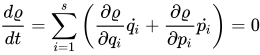
where is a distribution function , p is the generalised momenta and q are the generalised coordinates. With time a volume element can change shape, but phase points neither enter nor leave the volume.

