Liouville's theorem: Difference between revisions
Jump to navigation
Jump to search
Carl McBride (talk | contribs) No edit summary |
Carl McBride (talk | contribs) No edit summary |
||
| Line 5: | Line 5: | ||
where <math>\varrho</math> is a distribution function <math>\varrho(p,q)</math>, ''p'' is the generalised momenta and ''q'' are the | where <math>\varrho</math> is a distribution function <math>\varrho(p,q)</math>, ''p'' is the generalised momenta and ''q'' are the | ||
generalised coordinates. | generalised coordinates. | ||
With time a volume element can change shape, but phase points neither enter nor leave the volume. | |||
==References== | ==References== | ||
[[category: statistical mechanics]] | [[category: statistical mechanics]] | ||
Revision as of 15:13, 22 August 2007
Liouville's theorem is an expression of the conservation of volume of phase space:
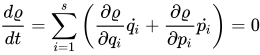
where is a distribution function , p is the generalised momenta and q are the generalised coordinates. With time a volume element can change shape, but phase points neither enter nor leave the volume.

