Reference hyper-netted chain: Difference between revisions
Carl McBride (talk | contribs) mNo edit summary |
Carl McBride (talk | contribs) mNo edit summary |
||
| Line 1: | Line 1: | ||
(Note: the reference-HNC (RHNC) is | (Note: the reference-HNC (RHNC) is sometimes referred to as the modified-HNC (MHNC) Ref.1). | ||
Rosenfeld and Ashcroft (1979) (Ref. 1) proposed the `anzatz of universality': | Rosenfeld and Ashcroft (1979) (Ref. 1) proposed the `anzatz of universality': | ||
{\it ``...the bridge functions.. ..constitute the same family of curves, irrespective of the assumed pair potential".} | {\it ``...the bridge functions.. ..constitute the same family of curves, irrespective of the assumed pair potential".} | ||
The basis of the method is to solve the modified HNC equation | The basis of the method is to solve the modified HNC equation | ||
(with inclusion of the one-parameter bridge functions | (with inclusion of the one-parameter bridge functions | ||
appropriate to hard spheres), and determine the only free parameter <math>\eta</math> | appropriate to hard spheres), and determine the only free parameter <math>\eta</math> | ||
(related to the hard-sphere diameter) by requiring thermodynamic consistency. | (related to the hard-sphere diameter) by requiring thermodynamic consistency. | ||
Fred Lado | Fred Lado (Ref. 2) and Rosenfeld and Ashcroft (1979) (Ref. 3) | ||
noticed that the OZ equation can always be written in the form | noticed that the OZ equation can always be written in the form | ||
:<math>\gamma_{12} = \rho \int_V (h_{13} - \gamma_{13}) h_{23} ~{\rm d}(3)</math> | :<math>\gamma_{12} = \rho \int_V (h_{13} - \gamma_{13}) h_{23} ~{\rm d}(3)</math> | ||
In view of this a hybrid solution between the HNC | In view of this a hybrid solution between the HNC | ||
approximation and the Malijevsky-Labik formula for hard spheres | approximation and the Malijevsky-Labik formula for hard spheres (Ref. 4 and 5) | ||
was proposed. The philosophy of this method is that the bridge functional of the | was proposed. The philosophy of this method is that the bridge functional of the | ||
liquid is fairly similar to that of the hard sphere fluid. | liquid is fairly similar to that of the hard sphere fluid. | ||
See also | (See also Ref.s 6 and 7) | ||
The RHNC closure is given by (Eq. 17 | The RHNC closure is given by (Eq. 17 Ref. 7) | ||
:<math> c\left(r\right) = h(r) - \ln [g(r) e^{\beta \phi(r)}] + B_0(r) </math> | :<math> c\left(r\right) = h(r) - \ln [g(r) e^{\beta \phi(r)}] + B_0(r) </math> | ||
along with the constraint (Eq. 18 | along with the constraint (Eq. 18 Ref. 7) | ||
:<math>\rho \int [g(r) - g_0(r)] \delta B_0(r) dr_3 = 0 </math> | :<math>\rho \int [g(r) - g_0(r)] \delta B_0(r) dr_3 = 0 </math> | ||
Incorporating a reference potential | Incorporating a reference potential <math>\phi_0(r)= \phi_0(r;\sigma,\epsilon)</math> | ||
this equation becomes (Eqs. 19a and 19b | this equation becomes (Eqs. 19a and 19b in Ref. 7) | ||
:<math>\rho \int [g(r) - g_0(r)] \sigma \frac{\partial B_0(r)}{\partial \sigma}dr_3 = 0 </math> | :<math>\rho \int [g(r) - g_0(r)] \sigma \frac{\partial B_0(r)}{\partial \sigma}dr_3 = 0 </math> | ||
and | and | ||
| Line 27: | Line 25: | ||
These are the conditions that will determine the optimum values of <math>\sigma</math> and <math>\epsilon</math> | These are the conditions that will determine the optimum values of <math>\sigma</math> and <math>\epsilon</math> | ||
that minimise the free energy. | that minimise the free energy. | ||
The RHNC satisfies the 'Hiroike' termodynamic relation test | The RHNC satisfies the 'Hiroike' termodynamic relation test Ref. 7 and 8, i.e. | ||
:<math>\left.\frac{\partial U}{\partial V}\right\vert_{T} = T \left.\frac{\partial p}{\partial T}\right\vert_{V} -p</math> | :<math>\left.\frac{\partial U}{\partial V}\right\vert_{T} = T \left.\frac{\partial p}{\partial T}\right\vert_{V} -p</math> | ||
For highly asymmetric mixtures see | For highly asymmetric mixtures see Ref. 9. | ||
==References== | ==References== | ||
#[PRA_1979_20_001208] | #[PRA_1979_20_001208] | ||
#[PRA_1973_08_002548] | |||
#[PRA_1979_20_001208] | |||
#[MP_1987_60_0663] | |||
#[MP_1989_67_0431] | |||
#[PLA_1982_89_0196] | |||
#[PRA_1983_28_002374] | |||
#[JPSJ_1957_12_00326] | |||
#[JCP_2005_123_174508] | |||
Revision as of 20:57, 19 February 2007
(Note: the reference-HNC (RHNC) is sometimes referred to as the modified-HNC (MHNC) Ref.1).
Rosenfeld and Ashcroft (1979) (Ref. 1) proposed the `anzatz of universality':
{\it ``...the bridge functions.. ..constitute the same family of curves, irrespective of the assumed pair potential".}
The basis of the method is to solve the modified HNC equation (with inclusion of the one-parameter bridge functions appropriate to hard spheres), and determine the only free parameter (related to the hard-sphere diameter) by requiring thermodynamic consistency. Fred Lado (Ref. 2) and Rosenfeld and Ashcroft (1979) (Ref. 3) noticed that the OZ equation can always be written in the form


In view of this a hybrid solution between the HNC approximation and the Malijevsky-Labik formula for hard spheres (Ref. 4 and 5) was proposed. The philosophy of this method is that the bridge functional of the liquid is fairly similar to that of the hard sphere fluid. (See also Ref.s 6 and 7) The RHNC closure is given by (Eq. 17 Ref. 7)
![{\displaystyle c\left(r\right)=h(r)-\ln[g(r)e^{\beta \phi (r)}]+B_{0}(r)}](https://wikimedia.org/api/rest_v1/media/math/render/svg/aa259e7d051e8ecaec4da29da253169cfd4993e2)
along with the constraint (Eq. 18 Ref. 7)
![{\displaystyle \rho \int [g(r)-g_{0}(r)]\delta B_{0}(r)dr_{3}=0}](https://wikimedia.org/api/rest_v1/media/math/render/svg/b2eda7dc8fa83500dc487b6a34ee6ccfb5ae21d4)
Incorporating a reference potential this equation becomes (Eqs. 19a and 19b in Ref. 7)

![{\displaystyle \rho \int [g(r)-g_{0}(r)]\sigma {\frac {\partial B_{0}(r)}{\partial \sigma }}dr_{3}=0}](https://wikimedia.org/api/rest_v1/media/math/render/svg/da8c607649ce4e0138f45cd2fbfdf43d3754649a)
and
![{\displaystyle \rho \int [g(r)-g_{0}(r)]\epsilon {\frac {\partial B_{0}(r)}{\partial \epsilon }}dr_{3}=0}](https://wikimedia.org/api/rest_v1/media/math/render/svg/524557fbe82d355db512fa0b96650ff807dcc727)
These are the conditions that will determine the optimum values of and that minimise the free energy. The RHNC satisfies the 'Hiroike' termodynamic relation test Ref. 7 and 8, i.e.


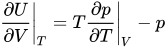
For highly asymmetric mixtures see Ref. 9.
References
- [PRA_1979_20_001208]
- [PRA_1973_08_002548]
- [PRA_1979_20_001208]
- [MP_1987_60_0663]
- [MP_1989_67_0431]
- [PLA_1982_89_0196]
- [PRA_1983_28_002374]
- [JPSJ_1957_12_00326]
- [JCP_2005_123_174508]