Third law of thermodynamics: Difference between revisions
Jump to navigation
Jump to search
Carl McBride (talk | contribs) m (Added original reference) |
Carl McBride (talk | contribs) (→References: Added a recent publication) |
||
| Line 22: | Line 22: | ||
;Related reading | ;Related reading | ||
*[http://dx.doi.org/10.1088/0305-4470/22/1/021 P. T. Landsberg "A comment on Nernst's theorem", Journal of Physics A: Mathematical and General '''22''' pp. 139-141 (1989)] | *[http://dx.doi.org/10.1088/0305-4470/22/1/021 P. T. Landsberg "A comment on Nernst's theorem", Journal of Physics A: Mathematical and General '''22''' pp. 139-141 (1989)] | ||
*[http://dx.doi.org/10.1038/ncomms14538 Lluís Masanes and Jonathan Oppenheim "A general derivation and quantification of the third law of thermodynamics", Nature Communications '''8''' 14538 (2017)] | |||
[[category: classical thermodynamics]] | [[category: classical thermodynamics]] | ||
[[category: quantum mechanics]] | [[category: quantum mechanics]] | ||
Latest revision as of 18:28, 14 March 2017
The third law of thermodynamics (or Nernst's theorem after the experimental work of Walther Nernst in 1906 [1]) states that the entropy of a system approaches a minimum (that of its ground state) as one approaches the temperature of absolute zero. One can write
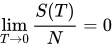
where is the number of particles. Note that there are systems whose ground state entropy is not zero, for example metastable states or glasses, or systems with weakly or non-coupled spins that are not subject to an ordering field.

Implications[edit]
The heat capacity (for either pressure or volume) tends to zero as one approaches absolute zero. From
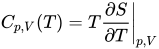
one has

thus as , otherwise the integrand would become infinite.


Similarly for the thermal expansion coefficient

References[edit]
- Related reading