Gay-Berne model: Difference between revisions
Jump to navigation
Jump to search
Carl McBride (talk | contribs) m (Added a recent publication) |
Carl McBride (talk | contribs) m (Added a See also section) |
||
| Line 52: | Line 52: | ||
==Phase diagram== | ==Phase diagram== | ||
:''Main article: [[Phase diagram of the Gay-Berne model]]'' | :''Main article: [[Phase diagram of the Gay-Berne model]]'' | ||
==See also== | |||
*[[Soft-core Gay-Berne model]] | |||
==References== | ==References== | ||
<references/> | <references/> | ||
Revision as of 14:23, 1 December 2016
The Gay-Berne model [1] is used extensively in simulations of liquid crystalline systems. The Gay-Berne model is an anisotropic form of the Lennard-Jones 12:6 potential.
![{\displaystyle U_{ij}^{\mathrm {L} J/GB}=4\epsilon _{0}^{\mathrm {L} J/GB}[\epsilon ^{\mathrm {L} J/GB}]^{\mu }({\mathbf {\hat {u}} }_{j},{\mathbf {\hat {r}} }_{ij})\times \left[\left({\frac {\sigma _{0}^{\mathrm {L} J/GB}}{r_{ij}-\sigma ^{\mathrm {L} J/GB}({\mathbf {\hat {u}} }_{j},{\mathbf {\hat {r}} }_{ij})+{\sigma _{0}}^{\mathrm {L} J/GB}}}\right)^{12}-\left({\frac {\sigma _{0}^{\mathrm {L} J/GB}}{r_{ij}-\sigma ^{\mathrm {L} J/GB}({\mathbf {\hat {u}} }_{j},{\mathbf {\hat {r}} }_{ij})+{\sigma _{0}}^{\mathrm {L} J/GB}}}\right)^{6}\right],}](https://wikimedia.org/api/rest_v1/media/math/render/svg/2772fe11a58f7457bf6d9b2d0c7647032a2019b8)
where, in the limit of one of the particles being spherical, gives:
![{\displaystyle \sigma ^{\mathrm {L} J/GB}({\mathbf {\hat {u}} }_{j},{\mathbf {\hat {r}} }_{ij})={\sigma _{0}}{[1-\chi \alpha ^{-2}{({\mathbf {\hat {r}} }_{ij}\cdot {\mathbf {\hat {u}} }_{j})}^{2}]}^{-1/2}}](https://wikimedia.org/api/rest_v1/media/math/render/svg/0f559304db8b0a3db5a0c82414e2d4289ea52e01)
and
![{\displaystyle \epsilon ^{\mathrm {L} J/GB}({\mathbf {\hat {u}} }_{j},{\mathbf {\hat {r}} }_{ij})={\epsilon _{0}}{[1-\chi \prime \alpha \prime ^{-2}{({\mathbf {\hat {r}} }_{ij}\cdot {\mathbf {\hat {u}} }_{j})}^{2}]}}](https://wikimedia.org/api/rest_v1/media/math/render/svg/278dbbf31474c1792aa835e8e9e9f9a3da8ab095)
with
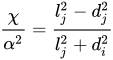
and
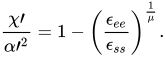
A modification of the Gay-Berne potential has recently been proposed that is said to result in a 10-20% improvement in computational speed, as well as accuracy [2].
Phase diagram
- Main article: Phase diagram of the Gay-Berne model
See also
References
- ↑ J. G. Gay and B. J. Berne "Modification of the overlap potential to mimic a linear site–site potential", Journal of Chemical Physics 74 pp. 3316-3319 (1981)
- ↑ Rasmus A. X. Persson "Note: Modification of the Gay-Berne potential for improved accuracy and speed", Journal of Chemical Physics 136 226101 (2012)
Related reading
- R. Berardi, C. Fava and C. Zannoni "A generalized Gay-Berne intermolecular potential for biaxial particles", Chemical Physics Letters 236 pp. 462-468 (1995)
- Douglas J. Cleaver, Christopher M. Care, Michael P. Allen, and Maureen P. Neal "Extension and generalization of the Gay-Berne potential" Physical Review E 54 pp. 559-567 (1996)
- Roberto Berardi, Carlo Fava, Claudio Zannoni "A Gay–Berne potential for dissimilar biaxial particles", Chemical Physics Letters 297 pp. 8-14 (1998)