Nosé-Hoover thermostat: Difference between revisions
Carl McBride (talk | contribs) m (→References: Added book ISBN) |
|||
| Line 21: | Line 21: | ||
*[http://dx.doi.org/10.1063/1.449071 D. J. Evans and B. L. Holian "The Nose–Hoover thermostat", Journal of Chemical Physics '''83''' pp. 4069-4074 (1985)] | *[http://dx.doi.org/10.1063/1.449071 D. J. Evans and B. L. Holian "The Nose–Hoover thermostat", Journal of Chemical Physics '''83''' pp. 4069-4074 (1985)] | ||
*[http://dx.doi.org/10.1063/1.2013227 Carlos Braga and Karl P. Travis "A configurational temperature Nosé-Hoover thermostat", Journal of Chemical Physics '''123''' 134101 (2005)] | *[http://dx.doi.org/10.1063/1.2013227 Carlos Braga and Karl P. Travis "A configurational temperature Nosé-Hoover thermostat", Journal of Chemical Physics '''123''' 134101 (2005)] | ||
* See http://williamhoover.info and Wm. G. Hoover and Carol G. Hoover | * See http://williamhoover.info and Wm. G. Hoover and Carol G. Hoover "Time Reversibility, Computer Simulations, Algorithms, Chaos", Advanced Series in Nonlinear Dynamics '''13''' World Scientific (2012) ISBN 978-981-4452-97-7 | ||
[[category: molecular dynamics]] | [[category: molecular dynamics]] | ||
Revision as of 13:17, 4 April 2014
The Nosé-Hoover thermostat[1] [2] [3] is a method for controlling the temperature in a molecular dynamics simulation. The Nosé-Hoover thermostat "strives" to reproduce the canonical phase-space distribution. It does this by modifying the equations of motion to include a non-Newtonian term in order to maintain the total kinetic energy constant. The modified equation of motion is given by (Ref. 3 Eq. 4)
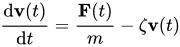
where is the thermodynamic friction coefficient, given by (Ref. 3 Eq. 5)

![{\displaystyle {\frac {{\mathrm {d} }\zeta (t)}{\mathrm {d} t}}={\frac {1}{Q}}\left[\sum m{\mathbf {v} }(t)^{2}-(X+1)k_{B}T\right]}](https://wikimedia.org/api/rest_v1/media/math/render/svg/039cc14a8a6a5471a4c428e173d1287bbf4a4a87)
where is a parameter that has the dimensions of energy(time)2 and determines the time-scale of the temperature fluctuation and is the number of degrees of freedom.


Problems
The Nosé-Hoover thermostat has problems with ergodicity for small or stiff systems. In order to compensate for this a modification using "chains" has been proposed [4].
Non-equilibrium
A version of the Nosé-Hoover thermostat has been developed for non-equilibrium simulations [5].
References
- ↑ Shuichi Nosé "A unified formulation of the constant temperature molecular dynamics methods" , Journal of Chemical Physics 81 pp. 511-519 (1984)
- ↑ Shuichi Nosé "A molecular dynamics method for simulations in the canonical ensemble", Molecular Physics 52 pp. 255-268 (1984)
- ↑ William G. Hoover "Canonical dynamics: Equilibrium phase-space distributions", Physical Review A 31 pp. 1695-1697 (1985)
- ↑ Glenn J. Martyna, Michael L. Klein and Mark Tuckerman "Nosé–Hoover chains: The canonical ensemble via continuous dynamics", Journal of Chemical Physics 97 pp. 2635- (1992)
- ↑ Ben Leimkuhler, Frédéric Legoll and Emad Noorizadeh "A temperature control technique for nonequilibrium molecular simulation", Journal of Chemical Physics 128 074105 (2008)
Related reading
- D. J. Evans and B. L. Holian "The Nose–Hoover thermostat", Journal of Chemical Physics 83 pp. 4069-4074 (1985)
- Carlos Braga and Karl P. Travis "A configurational temperature Nosé-Hoover thermostat", Journal of Chemical Physics 123 134101 (2005)
- See http://williamhoover.info and Wm. G. Hoover and Carol G. Hoover "Time Reversibility, Computer Simulations, Algorithms, Chaos", Advanced Series in Nonlinear Dynamics 13 World Scientific (2012) ISBN 978-981-4452-97-7