Joule-Thomson effect: Difference between revisions
Jump to navigation
Jump to search
m (Added a reference) |
|||
| Line 21: | Line 21: | ||
==Inversion temperature== | ==Inversion temperature== | ||
<ref>[http://dx.doi.org/10.1119/1.17417 Jacques-Olivier Goussard and Bernard Roulet "Free expansion for real gases", American Journal of Physics '''61''' pp. 845-848 (1993)]</ref> | <ref>[http://dx.doi.org/10.1119/1.17417 Jacques-Olivier Goussard and Bernard Roulet "Free expansion for real gases", American Journal of Physics '''61''' pp. 845-848 (1993)]</ref> | ||
<ref>[http://dx.doi.org/10.2174/1874396X00903010017 E. Albarran-Zavala, B. A. Espinoza-Elizarraraz, F. Angulo-Brown "Joule Inversion Temperatures for Some Simple Real Gases", The Open Thermodynamics Journal '''3''' pp. 17-22 (2009)] | |||
==References== | ==References== | ||
<references/> | <references/> | ||
Revision as of 16:21, 20 October 2009
The Joule-Thomson effect is also known as the Joule-Kelvin effect. This effect is present in non ideal gasses, where a change in temperature occurs upon expansion.
Joule-Thomson coefficient
The Joule-Thomson coefficient is given by
- Failed to parse (SVG (MathML can be enabled via browser plugin): Invalid response ("Math extension cannot connect to Restbase.") from server "https://wikimedia.org/api/rest_v1/":): {\displaystyle \mu_{\mathrm JT} = \left. \frac{\partial T}{\partial p} \right\vert_H}
where T is the temperature, p is the pressure and H is the enthalpy.
In terms of heat capacities one has
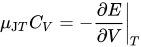
and
- Failed to parse (SVG (MathML can be enabled via browser plugin): Invalid response ("Math extension cannot connect to Restbase.") from server "https://wikimedia.org/api/rest_v1/":): {\displaystyle \mu_{\mathrm JT} C_p = -\left. \frac{\partial H}{\partial p} \right\vert_T }
In terms of the second virial coefficient at zero pressure one has
- Failed to parse (SVG (MathML can be enabled via browser plugin): Invalid response ("Math extension cannot connect to Restbase.") from server "https://wikimedia.org/api/rest_v1/":): {\displaystyle \mu_{\mathrm JT}\vert_{p=0} = ^0\!\!\phi = B_2(T) -T \frac{dB_2(T)}{dT}}
Inversion temperature
[1] <ref>E. Albarran-Zavala, B. A. Espinoza-Elizarraraz, F. Angulo-Brown "Joule Inversion Temperatures for Some Simple Real Gases", The Open Thermodynamics Journal 3 pp. 17-22 (2009)
References
Related reading