Ising model: Difference between revisions
Carl McBride (talk | contribs) m (Slight tidy up.) |
Carl McBride (talk | contribs) mNo edit summary |
||
| Line 7: | Line 7: | ||
between nearest neighbors. | between nearest neighbors. | ||
<math> \frac{U}{k_B T} = - K \sum_{\langle ij \rangle} S_i S_j </math> | :<math> \frac{U}{k_B T} = - K \sum_{\langle ij \rangle} S_i S_j </math> | ||
where <math> \langle ij \rangle </math> indicates that the sum is performed over nearest neighbors, and | where <math>k_B</math> is the [[Boltzmann constant]], <math>T</math> is the [[temperature]], <math> \langle ij \rangle </math> indicates that the sum is performed over nearest neighbors, and | ||
<math> S_i </math> indicates the state of the i-th site | <math> S_i </math> indicates the state of the i-th site, and <math> K </math> is the coupling constant. | ||
==1-dimensional Ising model== | ==1-dimensional Ising model== | ||
* [[1-dimensional Ising model]] (exact solution) | * [[1-dimensional Ising model]] (exact solution) | ||
Revision as of 17:28, 22 January 2008
The Ising model is also known as the Lenz-Ising model. For a history of the Lenz-Ising model see Refs. 1 and 2. The Ising model is commonly defined over an ordered lattice. Each site of the lattice can adopt two states: either UP (S=+1) or DOWN (S=-1).
The energy of the system is the sum of pair interactions between nearest neighbors.
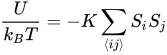
where is the Boltzmann constant, is the temperature, indicates that the sum is performed over nearest neighbors, and indicates the state of the i-th site, and is the coupling constant.


1-dimensional Ising model
- 1-dimensional Ising model (exact solution)
2-dimensional Ising model
Solved by Lars Onsager in 1944.
3-dimensional Ising model
Sorin Istrail has shown that the solution of Ising's model cannot be extended into three dimensions for any lattice:
- Three-dimensional proof for Ising model impossible, Sandia researcher claims to have shown
- Sorin Istrail "Statistical mechanics, three-dimensionality and NP-completeness: I. Universality of intracatability for the partition function of the Ising model across non-planar surfaces", Proceedings of the thirty-second annual ACM symposium on Theory of computing pp. 87 - 96 (2000)
ANNNI model
The axial next-nearest neighbour Ising (ANNNI) model is used to study alloys, adsorbates, ferroelectrics, magnetic systems, and polytypes.