Ideal gas: Heat capacity: Difference between revisions
Jump to navigation
Jump to search
Carl McBride (talk | contribs) m (Ideal gas: Specific heats moved to Ideal gas: Heat capacity) |
Carl McBride (talk | contribs) m (Slight re-write.) |
||
| Line 1: | Line 1: | ||
The [[heat capacity]] at constant volume is given by | |||
:<math>C_V = \left. \frac{\partial U}{\partial T} \right\vert_V </math> | |||
where <math>U</math> is the [[internal energy]]. Given that an [[ideal gas]] has no interatomic potential energy, the only term that is important is the [[Ideal gas: Energy | kinetic energy of an ideal gas]], which is equal to <math>3/2 RT</math>. Thus | |||
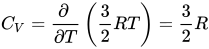
:<math>C_V = \frac{\partial ~ }{\partial T} \left( \frac{3}{2}RT \right) = \frac{3}{2} R </math> | |||
One has | |||
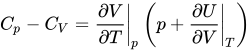
:<math>C_p - C_V = \left.\frac{\partial V}{\partial T}\right\vert_p \left(p + \left.\frac{\partial U}{\partial V}\right\vert_T \right) </math> | :<math>C_p - C_V = \left.\frac{\partial V}{\partial T}\right\vert_p \left(p + \left.\frac{\partial U}{\partial V}\right\vert_T \right) </math> | ||
| Line 4: | Line 15: | ||
:<math>\left.C_p -C_V \right.=R</math> | :<math>\left.C_p -C_V \right.=R</math> | ||
where <math>R</math> is the [[molar gas constant]]. | |||
==References== | ==References== | ||
#Donald A. McQuarrie "Statistical Mechanics" (1976) Eq. 1-1 | #Donald A. McQuarrie "Statistical Mechanics" (1976) Eq. 1-1 | ||
#Landau and Lifshitz Course of Theoretical Physics Volume 5 Statistical Physics 3rd Edition Part 1 Equation 42.11 | #Landau and Lifshitz Course of Theoretical Physics Volume 5 Statistical Physics 3rd Edition Part 1 Equation 42.11 | ||
[[Category: Ideal gas]] | [[Category: Ideal gas]] | ||
Revision as of 15:41, 4 December 2008
The heat capacity at constant volume is given by

where is the internal energy. Given that an ideal gas has no interatomic potential energy, the only term that is important is the kinetic energy of an ideal gas, which is equal to . Thus


One has
for an ideal gas this becomes:
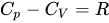
where is the molar gas constant.

References
- Donald A. McQuarrie "Statistical Mechanics" (1976) Eq. 1-1
- Landau and Lifshitz Course of Theoretical Physics Volume 5 Statistical Physics 3rd Edition Part 1 Equation 42.11