Hard ellipsoid model: Difference between revisions
Carl McBride (talk | contribs) No edit summary |
Carl McBride (talk | contribs) No edit summary |
||
| Line 10: | Line 10: | ||
The most widely used overlap algorithm is that of Perram and Wertheim: | The most widely used overlap algorithm is that of Perram and Wertheim: | ||
*[http://dx.doi.org/:10.1016/0021-9991(85)90171-8 John W. Perram and M. S. Wertheim "Statistical mechanics of hard ellipsoids. I. Overlap algorithm and the contact function", Journal of Computational Physics '''58''' pp. 409-416 (1985)] | *[http://dx.doi.org/:10.1016/0021-9991(85)90171-8 John W. Perram and M. S. Wertheim "Statistical mechanics of hard ellipsoids. I. Overlap algorithm and the contact function", Journal of Computational Physics '''58''' pp. 409-416 (1985)] | ||
==Geometric properties== | |||
The mean radius of curvature is given by (Ref. 2) | |||
:<math>R= \frac{a}{2} \left[ \sqrt{\frac{1+\epsilon_b}{1+\epsilon_c}} + \sqrt \epsilon_c \left\{ \frac{1}{\epsilon_c} F(\varphi , k_1) + E(\varphi,k_1) \right\}\right], | |||
</math> | |||
and the surface area is given by | |||
:<math>S= 2 \pi a^2 \left[ 1+ \sqrt {\epsilon_c(1+\epsilon_b)} \left\{ \frac{1}{\epsilon_c} F(\varphi , k_2) + E(\varphi,k_2)\right\} \right], | |||
</math> | |||
where <math>F(\varphi,k)</math> is an [[elliptic integral]] of the first kind and <math>E(\varphi,k)</math> is an elliptic integral of the second kind, | |||
with the amplitude being | |||
:<math>\varphi = \tan^{-1} (\sqrt \epsilon_c),</math> | |||
and the moduli | |||
:<math>k_1= \sqrt{\frac{\epsilon_c-\epsilon_b}{\epsilon_c}},</math> | |||
and | |||
:<math>k_2= \sqrt{\frac{\epsilon_b (1+\epsilon_c)}{\epsilon_c(1+\epsilon_b)}},</math> | |||
where the anisotropy parameters, <math>\epsilon_b</math> and <math>\epsilon_c</math>, are | |||
:<math>\epsilon_b = \left( \frac{b}{a} \right)^2 -1,</math> | |||
and | |||
:<math>\epsilon_c = \left( \frac{c}{a} \right)^2 -1.</math> | |||
The volume of the ellipsoid is given by the well known | |||
:<math>V = \frac{4 \pi}{3}abc.</math> | |||
==See also== | ==See also== | ||
*[[Hard ellipsoid equation of state]] | *[[Hard ellipsoid equation of state]] | ||
==References== | ==References== | ||
#[http://dx.doi.org/10.1016/j.fluid.2007.03.026 Carl McBride and Enrique Lomba "Hard biaxial ellipsoids revisited: Numerical results", Fluid Phase Equilibria '''255''' pp. 37-45 (2007)] | #[http://dx.doi.org/10.1016/j.fluid.2007.03.026 Carl McBride and Enrique Lomba "Hard biaxial ellipsoids revisited: Numerical results", Fluid Phase Equilibria '''255''' pp. 37-45 (2007)] | ||
#[http://dx.doi.org/10.1063/1.472110 G. S. Singh and B. Kumar "Geometry of hard ellipsoidal fluids and their virial coefficients", Journal of Chemical Physics '''105''' pp. 2429-2435 (1996)] | |||
[[Category: Models]] | [[Category: Models]] | ||
Revision as of 13:07, 29 June 2007

Interaction Potential
The general ellipsoid, also called a triaxial ellipsoid, is a quadratic surface which is given in Cartesian coordinates by
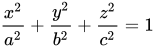
where Failed to parse (Conversion error. Server ("https://wikimedia.org/api/rest_") reported: "Cannot get mml. Server problem."): {\displaystyle a} , and define the lengths of the axis.


Overlap algorithm
The most widely used overlap algorithm is that of Perram and Wertheim:
Geometric properties
The mean radius of curvature is given by (Ref. 2)
- Failed to parse (SVG (MathML can be enabled via browser plugin): Invalid response ("Math extension cannot connect to Restbase.") from server "https://wikimedia.org/api/rest_v1/":): {\displaystyle R= \frac{a}{2} \left[ \sqrt{\frac{1+\epsilon_b}{1+\epsilon_c}} + \sqrt \epsilon_c \left\{ \frac{1}{\epsilon_c} F(\varphi , k_1) + E(\varphi,k_1) \right\}\right], }
and the surface area is given by
- Failed to parse (SVG (MathML can be enabled via browser plugin): Invalid response ("Math extension cannot connect to Restbase.") from server "https://wikimedia.org/api/rest_v1/":): {\displaystyle S= 2 \pi a^2 \left[ 1+ \sqrt {\epsilon_c(1+\epsilon_b)} \left\{ \frac{1}{\epsilon_c} F(\varphi , k_2) + E(\varphi,k_2)\right\} \right], }
where Failed to parse (SVG (MathML can be enabled via browser plugin): Invalid response ("Math extension cannot connect to Restbase.") from server "https://wikimedia.org/api/rest_v1/":): {\displaystyle F(\varphi,k)} is an elliptic integral of the first kind and Failed to parse (SVG (MathML can be enabled via browser plugin): Invalid response ("Math extension cannot connect to Restbase.") from server "https://wikimedia.org/api/rest_v1/":): {\displaystyle E(\varphi,k)} is an elliptic integral of the second kind, with the amplitude being
- Failed to parse (SVG (MathML can be enabled via browser plugin): Invalid response ("Math extension cannot connect to Restbase.") from server "https://wikimedia.org/api/rest_v1/":): {\displaystyle \varphi = \tan^{-1} (\sqrt \epsilon_c),}
and the moduli
- Failed to parse (SVG (MathML can be enabled via browser plugin): Invalid response ("Math extension cannot connect to Restbase.") from server "https://wikimedia.org/api/rest_v1/":): {\displaystyle k_1= \sqrt{\frac{\epsilon_c-\epsilon_b}{\epsilon_c}},}
and
- Failed to parse (SVG (MathML can be enabled via browser plugin): Invalid response ("Math extension cannot connect to Restbase.") from server "https://wikimedia.org/api/rest_v1/":): {\displaystyle k_2= \sqrt{\frac{\epsilon_b (1+\epsilon_c)}{\epsilon_c(1+\epsilon_b)}},}
where the anisotropy parameters, Failed to parse (SVG (MathML can be enabled via browser plugin): Invalid response ("Math extension cannot connect to Restbase.") from server "https://wikimedia.org/api/rest_v1/":): {\displaystyle \epsilon_b} and Failed to parse (SVG (MathML can be enabled via browser plugin): Invalid response ("Math extension cannot connect to Restbase.") from server "https://wikimedia.org/api/rest_v1/":): {\displaystyle \epsilon_c} , are
- Failed to parse (SVG (MathML can be enabled via browser plugin): Invalid response ("Math extension cannot connect to Restbase.") from server "https://wikimedia.org/api/rest_v1/":): {\displaystyle \epsilon_b = \left( \frac{b}{a} \right)^2 -1,}
and
- Failed to parse (SVG (MathML can be enabled via browser plugin): Invalid response ("Math extension cannot connect to Restbase.") from server "https://wikimedia.org/api/rest_v1/":): {\displaystyle \epsilon_c = \left( \frac{c}{a} \right)^2 -1.}
The volume of the ellipsoid is given by the well known
- Failed to parse (SVG (MathML can be enabled via browser plugin): Invalid response ("Math extension cannot connect to Restbase.") from server "https://wikimedia.org/api/rest_v1/":): {\displaystyle V = \frac{4 \pi}{3}abc.}