Ising model: Difference between revisions
Jump to navigation
Jump to search
Carl McBride (talk | contribs) No edit summary |
Carl McBride (talk | contribs) No edit summary |
||
| Line 28: | Line 28: | ||
*[http://www.sandia.gov/LabNews/LN04-21-00/sorin_story.html Three-dimensional proof for Ising model impossible, Sandia researcher claims to have shown] | *[http://www.sandia.gov/LabNews/LN04-21-00/sorin_story.html Three-dimensional proof for Ising model impossible, Sandia researcher claims to have shown] | ||
*[http://dx.doi.org/10.1145/335305.335316 Sorin Istrail "Statistical mechanics, three-dimensionality and NP-completeness: I. Universality of intracatability for the partition function of the Ising model across non-planar surfaces", Proceedings of the thirty-second annual ACM symposium on Theory of computing pp. 87 - 96 (2000)] | *[http://dx.doi.org/10.1145/335305.335316 Sorin Istrail "Statistical mechanics, three-dimensionality and NP-completeness: I. Universality of intracatability for the partition function of the Ising model across non-planar surfaces", Proceedings of the thirty-second annual ACM symposium on Theory of computing pp. 87 - 96 (2000)] | ||
==ANNNI model== | |||
The '''axial next-nearest neighbour Ising''' (ANNNI) model is used to study alloys, adsorbates, ferroelectrics, magnetic systems, and polytypes. | |||
*[http://dx.doi.org/10.1016/0370-1573(88)90140-8 Walter Selke "The ANNNI model — Theoretical analysis and experimental application", Physics Reports '''170''' pp. 213-264 (1988)] | |||
==See also== | ==See also== | ||
*[[History of the Ising model]] | *[[History of the Ising model]] | ||
[[Category: Models]] | [[Category: Models]] | ||
Revision as of 18:34, 11 July 2007
Also known as the Lenz-Ising model.
Ising Model
The Ising model is commonly defined over an ordered lattice. Each site of the lattice can adopt two states: either UP (S=+1) or DOWN (S=-1).
The energy of the system is the sum of pair interactions between nearest neighbors.
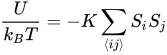
where indicates that the sum is done over nearest neighbors, and indicates the state of the i-th site.


is called the Coupling constant.

1-dimensional Ising model
- 1-dimensional Ising model (exact solution)
2-dimensional Ising model
Solved by Lars Onsager in 1944.
3-dimensional Ising model
Sorin Istrail has shown that the solution of Ising's model cannot be extended into three dimensions for any lattice:
- Three-dimensional proof for Ising model impossible, Sandia researcher claims to have shown
- Sorin Istrail "Statistical mechanics, three-dimensionality and NP-completeness: I. Universality of intracatability for the partition function of the Ising model across non-planar surfaces", Proceedings of the thirty-second annual ACM symposium on Theory of computing pp. 87 - 96 (2000)
ANNNI model
The axial next-nearest neighbour Ising (ANNNI) model is used to study alloys, adsorbates, ferroelectrics, magnetic systems, and polytypes.